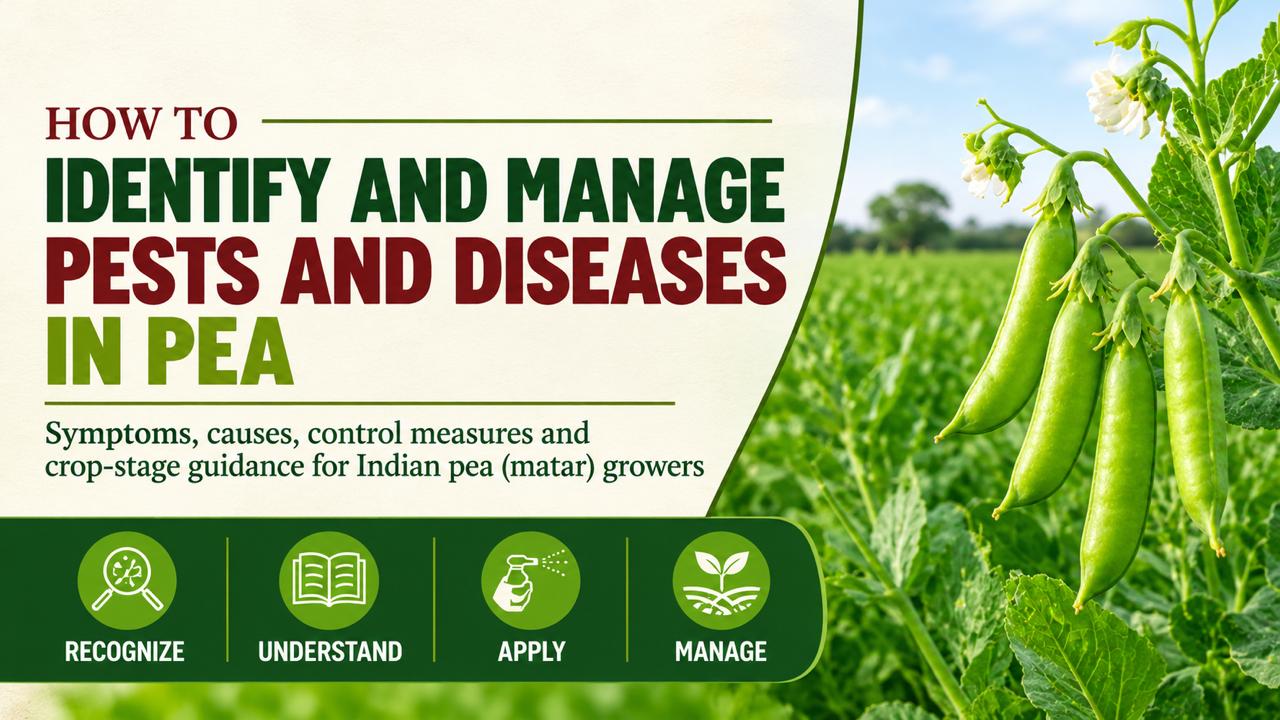
Pea (Pisum sativum), known as matar in Hindi, is one of India's most important rabi vegetables and pulses. It is grown for tender green pods as a vegetable and for mature dry seed as a pulse, mainly in Uttar Pradesh, Madhya Pradesh, Punjab, Haryana, Himachal Pradesh, Uttarakhand, Jammu & Kashmir, Bihar, Jharkhand and West Bengal. Popular varieties include Arkel, Azad P4, Pant P5, Rachna, Aparna, Ambika, Pusa Panna and Malviya Matar 15. Peas are highly nutritious, with about 7.2 g of digestible protein, 15.8 g of carbohydrate, 9 mg of vitamin C and 139 mg of phosphorus per 100 g.
Early identification matters. Pod borers hide inside the pods, pea weevil grubs feed unseen inside the seed, and powdery mildew and rust can spread across a field within days in the right weather. Rust alone can cut yield by up to 30%. By the time damage is obvious, control is harder and costlier.
This guide follows the AESA-based integrated pest management (IPM) approach recommended by the National Institute of Plant Health Management (NIPHM): how to identify each problem, what favours it, how to manage it, and what to do at each crop stage.
Major insect pests of pea
1. Pea pod borer (Etiella zinckenella)
Symptoms: Flowers and young pods drop. The larva feeds inside the pod, and its droppings collect there, causing soft, rotten patches. Seeds are partly or fully eaten, with frass and silk inside. Older pods show a brown spot where the larva entered.
Identification: Larvae are dirty greenish-grey to reddish and 15–22 mm long. The moth is 8–11 mm long with yellow- or greyish-brown forewings, a light stripe along the front edge and an orange spot near the base. A female lays 100–300 eggs, and there can be up to three generations a year.
Monitoring: Count the total pods, damaged pods and larvae on individual plants during weekly scouting.
Cultural and mechanical control:
- Plough deeply in summer to kill the resting pupae in the soil.
- Hand-pick caterpillars and pupae early in the infestation.
- Collect and destroy infested pods.
- Use a light trap @ 1 per acre, 15 cm above the canopy, and run it from 6 pm to 10 pm.
- Erect bird perches @ 20 per acre for predatory birds such as the king crow and common mynah.
Biological control: Conserve the egg parasitoid Trichogrammatoidea armigera and the larval parasitoids Bracon hebetor, Phanerotoma sp., Phanerotoma planifrons and Tetrastichus sp. Avoid chemical sprays when 1–2 larval parasitoids are seen.
Chemical control (only when needed): Chlorantraniliprole 18.5 SC @ 0.6 ml per litre of water. Keep a waiting period of 5 days between the last spray and harvest.
2. Gram pod borer (Helicoverpa armigera)
Symptoms: Young larvae feed on leaves and can cause serious defoliation. At the reproductive stage, larvae bore into the developing pods and eat the seeds, with the head pushed inside and most of the body hanging outside. Damaged pods are unfit to eat.
Identification: The full-grown larva is about 3.5 cm long, brown at first and later greenish with dark broken lines along the sides. The moth is stout with brownish-grey forewings and a dark band near the outer edge.
Monitoring: Install pheromone traps @ 4–5 per acre, at least 75 feet apart and one foot above the canopy. Change the lures every 2–3 weeks, and count and remove the moths every week.
Control: Collect and destroy eggs and early-stage larvae, hand-pick older larvae, and conserve natural enemies. Where chemical control is needed, follow the chemical recommendation given above for pea pod borer.
3. Pea aphid (Acyrthosiphon pisum)
Symptoms: Nymphs and adults suck sap from young shoots, the undersides of tender leaves, flower clusters and stems. Leaves curl and distort, shoots are stunted and malformed, and leaves turn pale and dry. Aphid honeydew leads to sooty mould, which blocks photosynthesis.
Identification: Soft-bodied, long-legged, pear-shaped aphids, green, yellow or pink, with long tubes (cornicles) at the rear. One generation takes about a week, so colonies build up fast.
Monitoring: Count nymphs and adults on five randomly selected leaves per plant. Set up yellow pan water traps or yellow sticky traps @ 4–5 per acre, 15 cm above the canopy.
Threshold monitoring: Using Fyllo Smart Sticky Traps, growers can track pest populations digitally and get alerts for the specific pest, with the spray chemical names, required quantity and schedule, when numbers cross the threshold, directly on their phone via the Fyllo App.
Cultural control:
- Use nitrogenous fertilisers carefully; too much nitrogen makes the crop succulent and attractive to aphids.
- Grow mustard as a barrier crop, or tall border crops such as maize, sorghum or millet.
Biological control:
Release first-instar larvae of the green lacewing (Chrysoperla zastrowi sillemi*) @ 4,000 per acre.
Conserve ladybird beetles, syrphid flies, predatory mites and parasitic wasps such as Aphidius, Aphelinus and Diaeretiella rapae*.
4. Stem fly (Ophiomyia phaseoli)
Symptoms: Maggots bore into the stem, causing withering and drying of the affected shoots. Adult flies puncture the leaves, and the injured spots turn yellow. Damage is more severe on seedlings than on older plants.
Identification: The adult is a small, metallic-black fly. Eggs are laid inside leaf tissue, and the pest can complete 8–9 generations.
Control:
- Mulch with rice straw.
- Apply balanced fertilisers with adequate nitrogen and phosphorus to promote vigorous growth.
- Conserve braconid wasps, which parasitise the stem fly.
5. Leaf miner (Chromatomyia horticola)
Symptoms: Maggots tunnel between the upper and lower leaf surfaces, leaving winding, serpentine mines. Heavy mining interferes with photosynthesis and growth, and badly affected leaves dry and drop. Warm weather favours its build-up.
Monitoring: Count only the live mines on five randomly selected leaves per plant.
Control:
- Remove and destroy leaves showing mines and blotches.
- Grow tomato or marigold as a trap crop.
- Use yellow sticky traps or cards for the adult flies. Fyllo Smart Sticky Traps can automate this count and show when adult numbers are rising.
- > Conserve the larval parasitoids Chrysocharis pentheus and Diglyphus isaea, the larval-pupal parasitoids Gronotoma micromorpha and Neochrysocharis formosa*, and predators such as green lacewings, ladybird beetles, spiders and red ants.
Other important pests
| Pest | Typical signs | Priority response |
|---|---|---|
| Pea weevil / bruchid (Bruchus pisorum) | Grubs bore straight through the pod into the seed; damage is usually found only when seed is mature; also attacks stored peas | Harvest early; cut volunteer and weed plants; clean the godown and disinfect gunny bags; conserve the parasitoid Dinarmus basalis |
| Lesser bandicoot (Bandicota bengalensis) | Burrows with scooped soil at the entrance, usually closed with soil; pods cut and hoarded at fruiting | Keep bunds and field edges clean; watch for live burrows from flowering onwards |
Major diseases of pea
1. Powdery mildew (Erysiphe pisi)
Symptoms: Faint, slightly discoloured specks appear on leaves first, then a greyish-white powdery growth spreads over the leaves, stems and pods. Leaves turn yellow and die, pods may not set or stay very small, and the crop sheds its leaves.
Favourable conditions: Warm (15–25°C), humid (over 70% relative humidity) weather for 4–5 days late in the season, during flowering and pod filling. Spores are carried by air and keep spreading in dry weather.
Cultural control:
- Grow resistant varieties such as Rachna, Pant P5, DMR 11, HUP 2, JP 885, KFP 103, Ambika, Shubhra, Aparna, Azad P4 and Pusa Panna.
- Burn infected pea stubble soon after harvest where practical.
- Don't sow next to last season's pea stubble, and remove volunteer pea plants.
- Adopt the bower (trellis) system.
Chemical control (as needed by crop stage; choose one):
- Carbendazim 50% WP @ 100 g in 240 litres of water per acre
- Sulphur 40% WP @ 2.26–3.00 kg in 300–400 litres of water per acre
- Sulphur 52% SC @ 800 ml in 120–160 litres of water per acre
- Sulphur 80% WG @ 750 g–1.0 kg in 300–400 litres of water per acre
- Sulphur 85% DP @ 6–8 kg per acre (dust)
- Triadimefon 25% WP @ 0.1% in 300 litres of water per acre, with a second spray after 25 days
Waiting periods before harvest: 10 days for carbendazim and sulphur, 6 days for triadimefon.
2. Rust (Uromyces fabae)
Symptoms: Many small, orange-brown pustules, usually on the underside of leaves. Badly infected leaves wither and drop. Larger pustules form on stems, and a few on pods. Severe infection reduces seed size and can cut yield by up to 30%.
Favourable conditions: Frequent rain, heavy dew and temperatures of 20–25°C. Dry, hot weather holds it back. Euphorbia weeds and infected crop residue are sources of infection; it is not seed-borne.
Control:
- Grow resistant varieties such as Hans, DMR 11, Type 163 and Malviya Matar 15.
- Destroy all diseased plant debris after harvest.
- Rotate with non-leguminous crops, and use mixed cropping.
- Chemical options: sulphur 85% DP @ 6–8 kg per acre, or triadimefon 25% WP @ 0.1% in 300 litres of water per acre, with a second spray after 25 days.
3. Downy mildew (Peronospora viciae)
Symptoms: A greyish-white mouldy growth on the lower leaf surface with a yellowish patch on the upper side. Infected leaves turn yellow and die in cool, damp weather, stems may be distorted and stunted, and pods show brown blotches with mould inside. It is a regional problem in the Indo-Gangetic plains.
Favourable conditions: High humidity and low temperatures (5–15°C) for a few days. It survives in soil, seed and water and spreads by rain splash and wind.
Control: Remove and burn diseased plants as soon as they are seen.
4. Ascochyta blight (Ascochyta pisi, A. pinodes, A. pinodella)
Symptoms: Small, irregular, purplish-brown flecks appear first on lower leaves, stems and tendrils under the canopy. In humid weather they join up and blight the lower leaves. Purplish-black lesions at the soil line (foot rot) girdle and weaken the stem, causing lodging. Pod lesions lead to early pod ageing and small, shrunken or discoloured seed. It is important in the Himalayan region and Chhattisgarh.
Favourable conditions: Warm, humid weather at about 15–25°C. It starts from infected seed or crop debris and spreads by wind and rain splash.
Control: Plant a tall barrier crop around the field to stop airborne spores, use clean seed and destroy crop debris.
5. Root rot (Fusarium solani, Rhizoctonia solani) and Fusarium wilt (Fusarium oxysporum f. sp. pisi)
Symptoms: In root rot, reddish-brown to black streaks appear on the roots and join up to girdle the lower stem; the plants are stunted, with yellowing basal leaves. In wilt, symptoms are clearest on 3–5-week-old plants: lower leaves yellow, leaflet edges curl downward and inward, the stem near the soil may be slightly swollen and brittle, and the inner stem tissue turns lemon-brown to orange-brown. Wilted plants eventually die. Root rot is regional in Uttar Pradesh, Bihar and West Bengal, and wilt in Uttar Pradesh, Uttarakhand, Himachal Pradesh and Jammu & Kashmir.
Favourable conditions: Soil temperatures of 23–27°C favour wilt; warm soil with moderate moisture favours root rot.
Control:
- Keep wider spacing and irrigate properly; avoid waterlogging.
- Deep summer ploughing and soil solarisation reduce soil-borne inoculum.
- > Treat seed and soil with Trichoderma viride or T. harzianum and Pseudomonas fluorescens, and apply FYM treated with Trichoderma*.
- Rotate with non-host crops and avoid late sowing.
Other important diseases
| Disease | Typical signs | Priority response |
|---|---|---|
| White rot (Sclerotinia sclerotiorum) | Dry, discoloured spot on the stem that girdles it; plant wilts above the spot; diseased tissue whitish and shredded; most at flowering (J&K, Himachal Pradesh) | Field sanitation; deep ploughing to bury sclerotia; rotate crops |
Nematodes, weeds and rodents
Nematodes
Root-knot nematodes (Meloidogyne incognita, M. javanica) cause root galls, stunting and yellowing, and make root rot worse. The reniform nematode (Rotylenchulus reniformis) is regionally important. They survive in soil and infected roots and are favoured by warm, moist soil.
- Plough deeply in summer and solarise the soil with a transparent 100-gauge polythene sheet for three weeks before sowing.
- Rotate with non-host crops and remove infested plant roots after harvest.
Weeds
Peas suffer badly from weed competition early on; 30–45 days after sowing is the critical period. Main weeds include lambsquarters (Chenopodium album), sweet clover (Melilotus alba), common vetch (Vicia sativa), yellow vetchling (Lathyrus aphaca), scarlet pimpernel (Anagallis arvensis), fumitory (Fumaria parviflora), canary grass (Phalaris minor), wild oat (Avena fatua) and purple nutsedge (Cyperus rotundus).
- Use the stale seedbed technique: a pre-sowing irrigation followed by shallow tillage.
- Use certified, weed-free seed, sow in lines and keep an optimum plant stand.
- Give one or two hand weedings at 25–30 and/or 45 days after sowing.
- As a pre-emergence herbicide, apply linuron 50% WP @ 0.5–0.8 kg per acre in 200 litres of water.
- Remove leftover weeds before they shed seed.
Rodents
The lesser bandicoot is found across India. Burrows have scooped soil at the entrance and are usually closed with soil, and most damage happens at the pod stage.
Nutrient deficiencies
Apply well-decomposed FYM @ 8–10 tonnes per acre, treated with Trichoderma, at field preparation. Treat seed with Rhizobium culture @ 250 g per acre. Apply a starter dose of 10 kg nitrogen, 28 kg P₂O₅ and 25 kg K₂O per acre at sowing, and if growth is stunted or slow, top-dress with 5–10 kg nitrogen per acre. Base all fertiliser on a soil test.
| Nutrient | Symptoms in pea |
|---|---|
| Nitrogen | Whole plant light green, stunted, small leaves; lower leaves turn pale yellow, then white and brown |
| Potassium | Dark green leaves with yellowing at the margins of lower leaves; leaflets cup downward; pods poorly filled |
| Sulphur | Younger leaves, including veins, turn yellow; plants small and slender |
| Iron | Yellowing between the veins, progressing to fully yellow leaves; common on high-pH black clay soils |
| Magnesium | Yellowing between the veins of older leaves, with a green band at the margins |
| Manganese | Yellow to white new leaves with green veins, grey specks; brown centres in seeds ("marsh spot") |
| Boron deficiency | Thick, stiff stems; bushy, squat growth; small young leaflets with brown tips; growing points die |
| Boron toxicity | Yellowing and browning at the tips or margins of older leaves, on alkaline soils |
Crop-stage-wise IPM calendar
| Crop stage | Main risks | Key actions |
|---|---|---|
| Pre-sowing | Resting pupae, nematodes, soil-borne fungi, weeds | Three summer ploughings at 10-day intervals; soil solarisation; FYM @ 8–10 t per acre with Trichoderma; plan maize or sorghum borders and marigold or tomato trap crops; rotate with non-hosts |
| Sowing | Root rot, wilt, weeds, stem fly | Timely sowing with resistant varieties; Rhizobium @ 250 g per acre and Trichoderma + Pseudomonas seed treatment; starter NPK; line sowing; linuron pre-emergence if needed |
| Vegetative | Aphids, leaf miner, stem fly, pod borer moths, powdery mildew, rust, weeds | Weekly scouting; yellow sticky traps @ 4–5 per acre; pheromone traps @ 4–5 per acre; light trap @ 1 per acre; bird perches @ 20 per acre; hand weeding at 25–30 and 45 days; Chrysoperla release for aphids |
| Flowering and podding | Pod borers, pea weevil, powdery mildew, rust, white rot, rodents | Hand-pick larvae and destroy infested pods; pod borer spray only if needed; fungicide spray at first sign of mildew or rust; watch for burrows |
| Harvest and storage | Pea weevil, disease carry-over | Harvest early; clean the godown and disinfect bags; incorporate crop residue; burn diseased stubble |
Fyllo Smart Sticky Traps can replace manual aphid and leaf miner adult counts through the vegetative and flowering stages, sending alerts when catches rise.
Natural enemies and resistant varieties
Spray only when the pest-to-defender (P:D) ratio is unfavourable; NIPHM's general rule is 2:1. Key defenders in pea are:
Pod borer enemies: the egg parasitoid Trichogrammatoidea armigera; larval parasitoids Bracon hebetor, Phanerotoma and Tetrastichus*; and insect-eating birds such as the king crow and mynah.
Aphid enemies: ladybird beetles, lacewings, syrphid flies, predatory mites and the parasitoids Aphidius, Aphelinus and Diaeretiella rapae*.
Leaf miner enemies: Chrysocharis pentheus, Diglyphus isaea, Gronotoma micromorpha and Neochrysocharis formosa*.
Pea weevil and stem fly enemies: Dinarmus basalis* and braconid wasps.
Ecological engineering: Grow flowering plants such as cluster bean, cowpea, carrot, sunflower, buckwheat, French bean, alfalfa, mustard, coriander-family herbs (anise, caraway, dill, parsley), cosmos and coreopsis on borders and bunds. Ocimum (basil) and peppermint act as repellent plants, and sorghum, maize and bajra make good border crops. Keep naturally growing nectar plants such as Tridax, Ageratum and Alternanthera, and reduce tillage where possible to save resting natural enemies.
Resistant varieties (examples from NIPHM):
| Problem | Varieties |
|---|---|
| Powdery mildew | Rachna, Pant P5, DMR 11, HUP 2, JP 885, KFP 103, Ambika, Shubhra, Aparna, Azad P4, Pusa Panna, HFP 4, DDR 13, HFP 8909, KPMR 114-1 |
| Rust | Hans, DMR 11, Type 163 |
| Powdery mildew and rust | Malviya Matar 15 |
Always confirm the latest recommendation for your area with the local KVK, state agricultural university or ICAR institute.
Fyllo Smart Sticky Traps and the Fyllo App
In pea, the pea aphid and the adult leaf miner fly are the main small flying pests that yellow traps catch. NIPHM recommends yellow sticky traps @ 4–5 per acre and weekly counts so that action is taken only when needed.
Fyllo Smart Sticky Traps do this counting for you. The trap photographs what it catches, AI identifies and counts the pests, and the numbers appear in the Fyllo App. When counts cross the threshold, you get an alert on your phone, along with the recommended chemical, dose and timing.
The Fyllo App also keeps your scouting notes, weather, crop-stage advisories and spray history in one place, so you can record pod borer moth catches and disease observations alongside. The traps and the app support your decisions; they don't replace field inspection, pheromone traps for pod borer, correct identification or label instructions. See how this fits into pea crop management.
Key takeaways
- Sow on time with treated seed of a powdery mildew- and rust-resistant variety.
- Plough deeply in summer, solarise where possible, and rotate with non-legume crops to cut soil-borne diseases and nematodes.
- Scout weekly and use yellow sticky traps for aphids and leaf miner, and pheromone traps for pod borer moths.
- Act on the first signs of powdery mildew and rust, and respect the waiting period before harvest.
- Protect natural enemies with flowering borders, bird perches and minimal broad-spectrum sprays.
Conclusion
Healthy pea comes from a system, not a single spray: timely sowing of treated seed of a resistant variety, summer ploughing and crop rotation, balanced nutrition based on a soil test, weekly scouting with sticky, pheromone and light traps, early action against mildew and rust, and protection of natural enemies. Together they keep pod borers, aphids, leaf miner and diseases below damaging levels.
Turn this guide into a plan for your own field: map your plots, scout weekly, record trap and disease observations, and act early while a problem is still small.
Pesticide registrations change over time, so check every chemical against its current label and local recommendations. Consult your local KVK or state agricultural university before applying pesticides or fertilisers, and always follow the label dose and safety instructions.