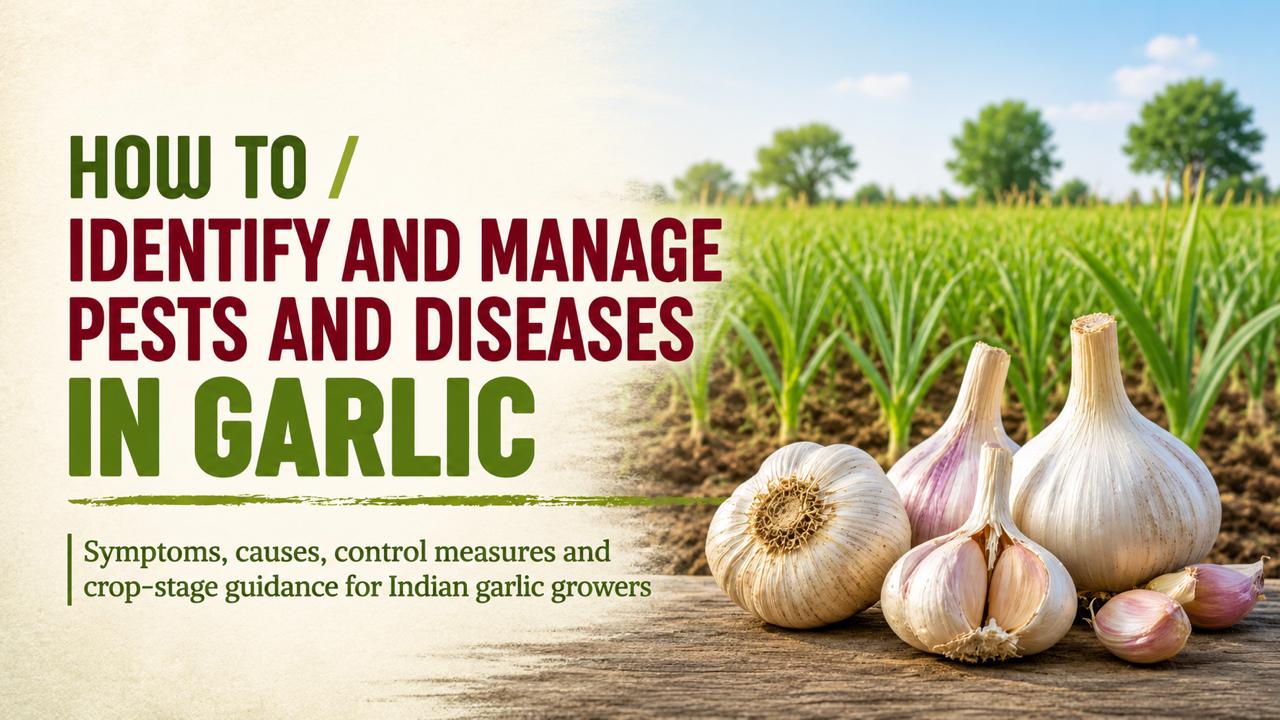
Garlic (Allium sativum) is one of India's most important spice crops. It is grown mainly in Madhya Pradesh, Rajasthan, Gujarat, Uttar Pradesh, Maharashtra and Punjab, with hill garlic in the Nilgiris of Tamil Nadu. Popular varieties include Yamuna Safed (G-1), Yamuna Safed-3 (G-282), Agrifound White, Godavari and Bhima Purple. The bulb is made up of 6 to 50 cloves and is used fresh, dehydrated and in folk medicine.
Garlic grows best in well-drained, fertile loam with a reliable source of irrigation. Heavy soils give deformed bulbs that bruise at harvest and store poorly, and high humidity favours disease build-up. Early identification matters: thrips damage, leaf blights and bulb rots all cut bulb size and storage life, and by the time leaves turn silvery or bulbs start to soften, much of the loss is already locked in.
This guide follows the AESA-based integrated pest management (IPM) approach recommended by the National Institute of Plant Health Management (NIPHM): how to identify each problem, what favours it, how to manage it, and what to do at each crop stage.
Major insect and mite pests of garlic
A note on sprays: The NIPHM garlic IPM package does not recommend any chemical insecticide or fungicide by name or dose. It relies on cultural practices, traps, biological control and natural enemies. If a pest or disease still crosses safe levels and the pest-to-defender ratio is unfavourable, use only a product registered for garlic, at the label dose, after advice from your local KVK or agriculture officer.
1. Onion thrips (Thrips tabaci)
Symptoms: Adults and larvae feed inside the leaf with a punch-and-suck action. The feeding areas lose their green colour and look white to silvery, in patches and streaks. With heavy feeding, the leaves take on a silvery cast and wither, and tiny black "tar" spots of thrips droppings appear on the leaves. Thrips feed on the young leaves in the centre of the garlic neck. They also spread Iris yellow spot virus.
Identification: Adults are about 1.5 mm long, slender, yellow and brown, with two pairs of fringed wings. They fly readily when disturbed. The tiny, kidney-shaped eggs are laid inside the leaf and hatch in 5–10 days. Wingless, pale yellow larvae feed for 10–14 days, then rest for 5–10 days in the soil, at the base of the neck or under bulb scales. Females can reproduce without mating and lay eggs for about three weeks.
Monitoring: During weekly scouting, count the nymphs and adults on five terminal leaves per plant (the tapping method also works). Set up blue pan water traps or blue sticky traps @ 4–5 per acre, 15 cm above the canopy. Empty tins painted blue and coated with grease, Vaseline or castor oil also work. Fyllo Smart Sticky Traps can automate this count and show when catches are rising.
Threshold monitoring: Using Fyllo Smart Sticky Traps, growers can track pest populations digitally and get alerts for the specific pest, with the spray chemical names, required quantity and schedule, when numbers cross the threshold, directly on their phone via the Fyllo App.
Cultural control:
- Practise field sanitation and avoid planting after onion or other thrips hosts such as cabbage, cotton, tomato, cucumber, melons, pumpkin and strawberry.
- Plant the new crop upwind of an older crop so thrips do not move across early.
- Adjust planting dates.
- Use sprinkler irrigation; it reduces thrips far more than drip or surface irrigation.
- Grow two rows of maize, or an inner row of wheat and an outer row of maize, around the garlic plot as a barrier crop.
- Reflective silver plastic or aluminium-painted black mulches repel thrips (seed crop).
- Avoid excess nitrogen; it raises thrips numbers late in the crop.
Biological control: Conserve the nymphal parasitoid Ceranisus menes and predators such as syrphid flies, minute pirate bugs (Orius, Blaptostethus), predatory thrips (Aeolothrips fasciatum), damsel bugs, lacewings, ladybird beetles (Cheilomenes sexmaculata), praying mantis and spiders.
2. Onion maggot (Delia antiqua)
Symptoms: Only the maggot causes damage. It enters the base of the plant with hooked mouthparts. Seedlings wilt, go limp and die, and maggots then move to the next plant. Later generations feed on developing cloves, which become distorted and rot, and late-season feeding leaves the bulbs unmarketable.
Identification: The adult onion fly is slightly smaller and more slender than a housefly. It lays white, elongated eggs (about 1.25 mm) in the soil near the stem; they hatch in 2–3 days. The legless, creamy-white maggots grow to about 8 mm over 2–4 weeks and burrow into the roots or the basal plate of the bulb. They pupate in the soil at 5–10 cm depth.
Control:
- Avoid close spacing.
- Follow crop rotation and keep the field clean.
- > Conserve ground beetles, rove beetles and spiders by leaving grassy refuge strips, and conserve the braconid parasitoid Aphaereta pallipes*.
3. Mites: bulb mite, eriophyid mite and red spider mite
Bulb mite (Rhizoglyphus robini): Shiny, white, see-through mites, 0.5–0.9 mm long, with reddish-brown legs. They enter bulbs through the slightest injury and turn them into rotten pulp. Infested bulbs may fail to sprout or give stunted, off-colour growth. A female lays up to 700 eggs and the life cycle can be as short as 12 days at 25°C.
Eriophyid mite (Aceria tulipae): Microscopic (200–250 µm). It feeds on young leaves and between the clove layers, causing stunting, twisting, curling and discoloured leaves and dried bulb tissue. The life cycle takes 7–9 days.
Red spider mite (Tetranychus cinnabarinus): Reddish mites feed on the underside of leaves. The upper surface gets stippled with tiny dots, fine silk webbing appears, and leaves bleach and may drop. It breeds fastest in hot, dry weather; a female can live 24 days and lay 200 eggs.
Monitoring: Count nymphs and adults on five randomly selected leaves per plant.
Control:
- Sow clean seed cloves and avoid planting garlic after cole crops; decaying cauliflower can carry very high bulb mite numbers.
- Avoid successive onion or garlic crops.
- Flood irrigation reduces bulb and eriophyid mites in the soil.
- A thorough water spray washes red spider mites off the plants.
- > Conserve predatory mites (Amblyseius, Phytoseiulus persimilis), Stethorus punctillum, Oligota beetles, Orius bugs, lacewings, hover flies and the predatory gall midge Feltiella minuta*.
4. Caterpillars: gram pod borer, tobacco caterpillar and cutworm
Gram pod borer (Helicoverpa armigera), tobacco caterpillar (Spodoptera litura) and cutworm (Agrotis ipsilon) are pests of regional importance in garlic. Larvae feed on and damage the leaves, and cutworms cut young plants at ground level.
Monitoring: Count damaged leaves and larvae per plant. Install pheromone traps for each species @ 4–5 per acre, more than 75 feet apart and one foot above the canopy. Change lures every 2–3 weeks, count moths weekly and destroy them after each count. Set up a light trap @ 1 per acre and run it from 6 pm to 10 pm, using a model with an exit for small natural enemies.
Control:
- Grow intercrops such as cowpea, maize, coriander or urdbean, and four rows of sorghum or maize around the field as a guard crop. Basil and marigold act as repellent and trap plants.
- Rotate garlic with a non-host cereal, cucurbit or crucifer.
- Erect bird perches @ 20 per acre for king crows and mynahs.
- > Release Trichogramma pretiosum* @ 40,000 per acre, 4–5 times at weekly intervals from flower initiation, only after moths appear in pheromone traps. Avoid chemical sprays for seven days after a release.
- > Apply entomopathogenic nematodes (Steinernema feltiae*) @ 20–120 crore infective juveniles per acre.
- Where available, apply HaNPV or SlNPV against egg masses and young larvae, only in the evening after 5 pm.
Major diseases of garlic
1. Purple blotch (Alternaria porri)
Symptoms: Small, sunken, whitish flecks with purple centres on leaves and flower stalks. The lesions can girdle the leaf or stalk so that it droops, and badly infected plants fail to form bulbs.
Favourable conditions: Hot, humid weather at 21–30°C with 80–90% relative humidity. The fungus survives in soil, infected bulbs, plant debris and weed roots.
Control:
- Use healthy seed cloves and soak them in hot water at 50°C for 20 minutes.
- Rotate with non-host crops for 2–3 years.
- Keep the field well drained and use only the recommended doses of N and P.
- Grow resistant varieties.
2. Stemphylium leaf blight (Stemphylium vesicarium)
Symptoms: Small yellowish to orange flecks or streaks in the middle of the leaves, which grow into long, spindle-shaped spots with a pinkish margin. On the flower stalk it badly damages seed crops.
Favourable conditions: Warm (18–25°C), humid weather with 16 hours or more of leaf wetness. The fungus survives in plant debris and soil.
Control: Collect and destroy crop residue, follow long rotations, keep the field well drained, reduce plant density and use hot-water-treated seed cloves (50°C for 20 minutes).
3. Anthracnose / twister disease (Colletotrichum gloeosporioides)
Symptoms: Water-soaked, pale yellow spots that spread along the whole leaf blade. Leaves curl, stretch abnormally, shrivel and droop.
Favourable conditions: Warm (25–30°C), moist soils rich in organic matter. Disease slows below 15°C. The fungus survives for years as sclerotia in soil.
Control: Destroy infected plant debris and use resistant varieties.
4. Fusarium basal rot (Fusarium oxysporum f. sp. cepae)
Symptoms: Leaves yellow and dry from the tip downward and the plant is stunted. Roots turn pink and then rot, and the bulb decays from the base until the whole plant dies.
Favourable conditions: Moist soil at about 27°C. The fungus survives in soil and bulbs as resting spores for many years.
Control:
- Rotate with non-hosts for 4–5 years; mixed cropping with tobacco and sorghum reduces the fungus.
- Plough deeply in summer and solarise the soil with a 25-gauge polythene sheet for 30 days.
- Keep drainage good and avoid injuring plants during field work.
- Flood the field in the off-season, and grow resistant varieties.
5. White rot (Sclerotium cepivorum)
Symptoms: Leaf tips yellow and die back. Scales, stem plate and roots are destroyed and bulbs become soft and water-soaked. White, fluffy fungal growth with black, mustard-seed-like sclerotia forms on the bulbs.
Favourable conditions: Cool, dry soils. Sclerotia survive in soil for many years and also in infected debris and seed cloves.
Control: Plant in disease-free fields, rotate with cereals, treat bulbs in hot water at 49°C, and solarise the soil; heating to 35°C for 18 hours or 45°C for 6 hours cuts disease by 50–70%.
6. Iris yellow spot and onion yellow dwarf viruses
Symptoms: Iris yellow spot shows as cream, elliptical or diamond-shaped spots on leaves and flower stalks, which can collapse at the spots. Onion yellow dwarf starts as yellow streaks at the base of the first true leaves, then the leaves turn yellow, crinkled and flattened and fall over, and bulbs are undersized.
Spread: Onion thrips carry Iris yellow spot virus, and disease rises with thrips numbers. Onion yellow dwarf is carried in seed bulbs, cloves and volunteer garlic, and many aphid species spread it.
Control:
- Plant healthy, virus-free material and rotate garlic for at least three years.
- Remove infected plants, volunteers, culls and weeds around the field.
- Manage the thrips and aphid vectors; use blue sticky traps and sprinkler irrigation.
- Avoid thin, patchy stands and crop stress.
Other important diseases
| Disease | Typical signs | Priority response |
|---|---|---|
| Damping off (Pythium, Rhizoctonia, Fusarium, Sclerotium) | Seed and seedling rot before emergence; collar rot and collapse after emergence; up to 60–75% damage in the rainy season | Raised beds over 15 cm high; avoid overwatering and dense sowing; solarise nursery beds for 30 days; well-decomposed FYM |
| Downy mildew (Peronospora destructor) | Pale green leaves with white cottony growth, later yellow to brown and drying; warm, humid weather | Healthy seed bulbs; 3–4 year rotation; destroy culls and debris; avoid late planting, poor drainage and excess fertiliser or irrigation |
| Black mould (Aspergillus niger) and green mould | Black discolouration around the neck; powdery black spore streaks between outer scales; above 30°C in the field or 24°C in storage | Dry bulbs 2 days in the field and 10–15 days in shade; avoid bruising; ventilate storage |
| Bacterial brown rot / slippery skin and soft rot | Central leaves wilt; inner scales turn watery; rotted core slides out of the neck; foul-smelling liquid in soft rot | Good tilth and drainage; quick curing and drying; discard affected bulbs before storage; artificial curing in the rainy season |
| Pink root rot (Phoma terrestris) | Pink to purple discoloured, rotting roots | Crop rotation; field sanitation |
Nutrient deficiencies and physiological disorders
| Nutrient | Symptoms | Correction |
|---|---|---|
| Nitrogen | Yellowish-green, upright, curled, dwarf leaves; soft tissue above the bulb at maturity | Foliar urea 1% or DAP 2%, twice at weekly intervals |
| Phosphorus | Slow growth, light green leaves, tip burn on older leaves, few dry outer skins | Recommended P at planting; foliar DAP 2%, twice at fortnightly intervals |
| Potassium | Tip burn, dark green erect leaves, older leaves yellow and dying; bolting promoted | Foliar K₂SO₄ 1%, twice at weekly intervals |
| Sulphur | Uniform yellowing of the whole plant, including young leaves | Foliar K₂SO₄ or CaSO₄ 1%, twice at fortnightly intervals |
| Manganese | Tip burn, pale curled leaves; delayed bulbing with thick necks | Foliar MnSO₄ 0.3%, twice at fortnightly intervals |
| Zinc | Restricted growth; yellow young leaves and interveinal necrosis | Foliar ZnSO₄ 0.5%, twice at fortnightly intervals |
| Iron | Complete yellowing of the youngest leaves, common on calcareous soils | Foliar FeSO₄ 0.5% |
Physiological disorders: Premature sprouting of bulbs in the field follows winter rain, excess soil moisture or excess nitrogen, and early planting. Splitting comes from delayed harvest or irrigation after a long dry spell. Rubberification (rubbery bulbs), reported around Rajkot and in the Nilgiris, rises with heavy urea and frequent irrigation; NIPHM notes it was controlled with zinc sulphate and ammonium molybdate, and also with neem cake and gibberellic acid. Aerial bulbils form where long cool spells or big temperature swings occur, and G-282 is more prone to them.
Fertiliser plan (per acre):
- Apply well-rotted FYM @ 10 t or vermicompost @ 4 t before planting.
- Treat planting material with Azotobacter and PSB @ 240 g each.
- Apply NPK @ 40:20:40 kg, with one third of the N, all the P and 60% of the K at planting.
- Give another third of the N and the remaining 40% K at 21 days, and the last third of the N (about 13.33 kg) later in the season, at around 45–60 days.
- Too much nitrogen makes the crop succulent and invites thrips and disease.
Crop-stage-wise IPM calendar
| Crop stage | Main risks | Key actions |
|---|---|---|
| Pre-planting | Soil-borne fungi, nematodes, resting insects, weeds | Soil test; deep summer ploughing; stale seedbed; soil solarisation with 45-gauge polythene for three weeks; FYM @ 10 t or vermicompost @ 4 t per acre; raised beds over 15 cm |
| Planting | Damping off, basal rot, white rot, bulb mite, purple blotch | Clean, healthy seed cloves; hot water treatment; Trichoderma and Pseudomonas fluorescens on planting material and soil; Azotobacter and PSB @ 240 g each per acre; basal NPK |
| Vegetative | Thrips, onion maggot, mites, caterpillars, purple blotch, Stemphylium blight, anthracnose, viruses, weeds | Weekly scouting; blue sticky traps @ 4–5 per acre; pheromone traps @ 4–5 per acre; light trap @ 1 per acre; sprinkler irrigation; barrier crop; weed-free for 30–45 days; N and K top dressing |
| Reproductive and bulbing | Thrips, caterpillars, leaf blights, downy mildew, basal and white rot | Trichogramma releases from flower initiation; remove damaged leaves; last N split; remove leftover weeds before they seed |
| Harvest and storage | Black and green mould, bacterial and soft rots, sprouting | Harvest when tops yellow; dig gently; cure until necks turn brown; dry in shade 10–15 days; discard damaged bulbs; ventilated, cool, dry storage; no pesticides in the 7 days before harvest |
Fyllo Smart Sticky Traps can replace manual thrips trap counts through the vegetative and bulbing stages, sending alerts when catches rise.
Natural enemies and conservation
Spray only when the pest-to-defender (P:D) ratio is unfavourable; NIPHM's general rule is 2:1. Key defenders in garlic are:
Thrips enemies: the parasitoid Ceranisus menes*, minute pirate bugs, predatory thrips, syrphid flies, lacewings, ladybird beetles, damsel bugs, praying mantis and spiders.
Onion maggot enemies: rove beetles, ground beetles, spiders and the braconid wasp Aphaereta pallipes*.
Mite enemies: predatory mites, Stethorus beetles, Oligota beetles, Orius* bugs, lacewings and gall midges.
Caterpillar enemies: Trichogramma, Telenomus and Tetrastichus egg parasitoids, Chelonus, Campoletis and Bracon larval parasitoids, Chrysoperla*, reduviid bugs, spiders and birds.
NIPHM notes that one ladybird beetle eats about 50 aphids a day, a hover fly larva eats around 400 aphids in its lifetime, and a predatory mite eats 20–35 plant-feeding mites a day.
Ecological engineering: Grow flowering plants such as buckwheat, sunflower, marigold, coriander, mustard, cowpea, French bean, alfalfa, spearmint, cosmos and carrot-family herbs on borders and bunds, with shorter plants towards the crop and taller ones on the edge. Keep naturally growing nectar plants such as Tridax, Ageratum and Alternanthera. Add FYM or vermicompost, reduce tillage, rotate with legumes, and apply Trichoderma, Pseudomonas fluorescens, mycorrhiza and PGPR. Avoid broad-spectrum pesticides when the P:D ratio is favourable.
For the latest variety and product advice for your area, contact the nearest KVK, state agricultural university or ICAR institute.
Fyllo Smart Sticky Traps and the Fyllo App
In garlic, onion thrips are the main flying pest that sticky traps catch, and they matter twice over: they damage the leaves directly and spread Iris yellow spot virus. NIPHM recommends blue sticky or pan traps @ 4–5 per acre for thrips, and blue traps also help watch the aphids that carry onion yellow dwarf virus.
Fyllo Smart Sticky Traps do this counting for you. The trap photographs what it catches, AI identifies and counts the pests, and the numbers appear in the Fyllo App. When counts cross the threshold, you get an alert on your phone, along with the recommended chemical, dose and timing.
The Fyllo App also keeps your scouting notes, weather, crop-stage advisories and spray history in one place, so you can record pheromone trap catches, mite counts and disease observations alongside. The traps and the app support your decisions; they don't replace field inspection, pheromone traps for caterpillars, correct identification or label instructions. See how this fits into garlic crop management.
Key takeaways
Plant clean, healthy seed cloves in well-drained soil, with hot water treatment and Trichoderma or Pseudomonas* on the planting material.
* Rotate away from onion and garlic for several years and solarise the soil to cut basal rot, white rot and soil mites.
* Scout weekly and use blue sticky traps @ 4–5 per acre for thrips, the most important pest and the carrier of Iris yellow spot virus.
* Keep nitrogen balanced; too much raises thrips, sprouting and rubberification.
* Cure and dry bulbs well and avoid bruising to prevent black mould and bacterial rots in storage.
Conclusion
Healthy garlic comes from a system, not a single spray: clean seed cloves, long rotations, soil solarisation, balanced nutrition, sprinkler irrigation, weekly scouting with blue sticky, pheromone and light traps, protection of natural enemies, and careful curing. Together they keep thrips, mites, blights and bulb rots below damaging levels and protect storage quality.
Turn this guide into a plan for your own field: map your plots, scout weekly, record trap and disease observations, and act early while a problem is still small.
Pesticide registrations change over time, so check every product against its current label and local recommendations. Consult your local KVK or state agricultural university before applying pesticides or fertilisers, and always follow the label dose and safety instructions.