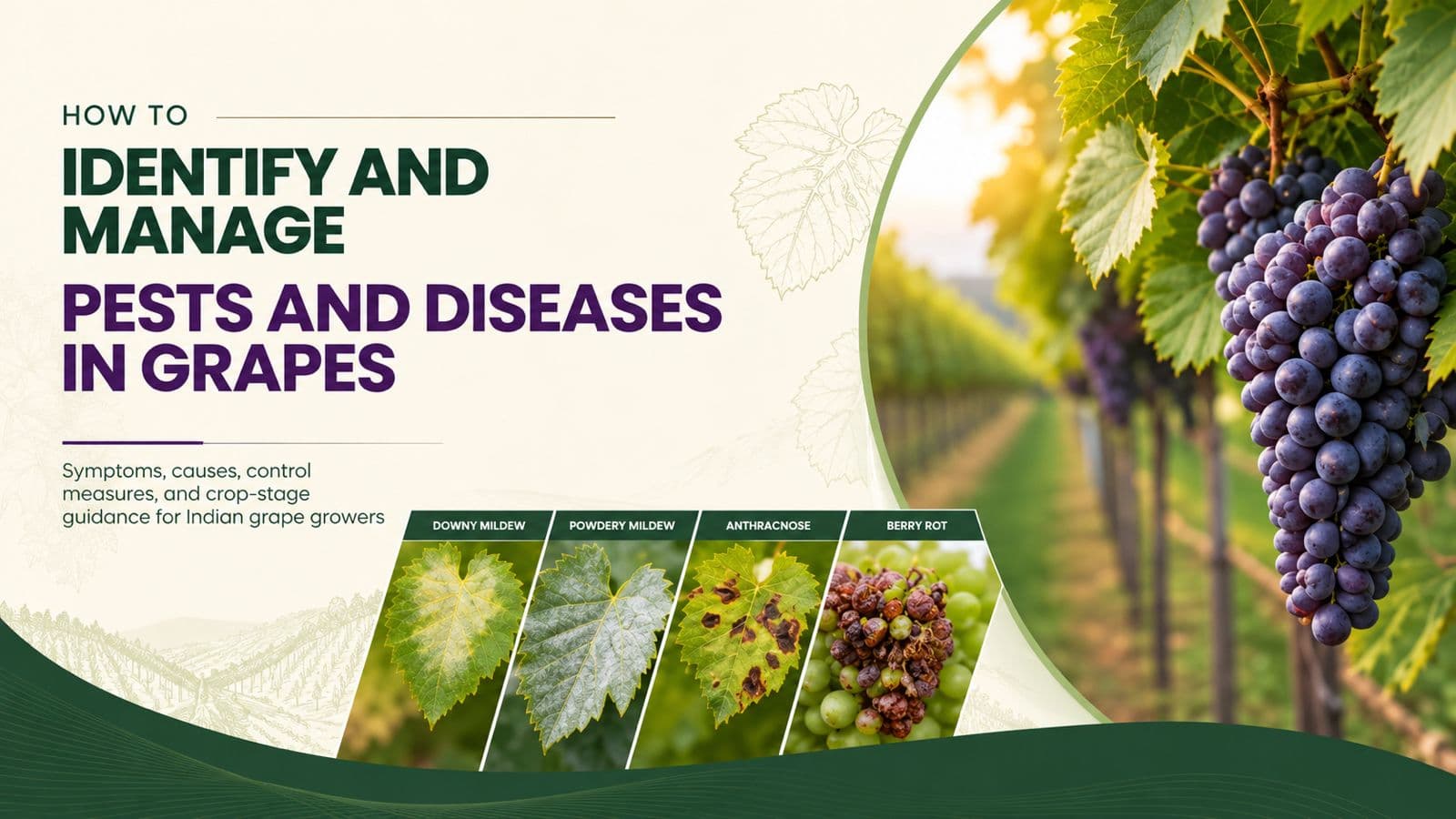
Grapes are among India's most commercially important fruit crops. With major production concentrated in Maharashtra, Karnataka, Telangana, Andhra Pradesh, and Tamil Nadu, India is also one of the world's leading exporters of fresh grapes.
From vineyard establishment through harvest and storage, pest and disease management directly affects yield, fruit quality, marketability, and export potential. This guide brings together the major insect pests, fungal diseases, nematodes, nutrient deficiencies, crop-stage practices, and integrated management measures relevant to Indian grape growers. For crop-specific advisory, see Fyllo's grape farming solution.
Introduction
Grape cultivation is highly susceptible to a wide range of pests and diseases. If they are not identified and managed at the right time, they can cause 30–70% yield loss, reduce fruit quality, and severely affect export potential.
The most effective approach is to identify symptoms early and combine cultural, biological, nutritional, and need-based chemical measures. This guide covers major insect pests, fungal and bacterial diseases, post-harvest rots, root-knot nematodes, nutrient deficiencies, crop-stage management, natural enemies, resistant varieties, and digital tools that help growers monitor vineyard conditions.
Major Insect Pests of Grapes
Insect pests can damage vines, leaves, shoots, flowers, berries, and trunks. Regular scouting is essential because early intervention is usually more effective and less disruptive than late, broad-spectrum spraying.
1. Mealybugs
Mealybugs are among the most destructive grape pests in India. Common species include Maconellicoccus hirsutus (pink mealybug), Ferrisia virgata (striped mealybug), and Pseudococcus maritimus (maritimus mealybug).
Symptoms of damage
- Nymphs and adults suck sap from trunks, buds, leaves, shoots, and grape bunches.
- Honeydew secretion leads to sooty mould on leaves and fruits.
- Infested bunches become sticky and unfit for sale as table grapes or for raisin making.
- Severe infestation can kill young vines; in extreme cases, losses can reach 100%.
Favourable conditions
Warm, dry weather favours mealybugs. They hide under loose bark and can remain active almost year-round.
Cultural control
- Remove loose bark from vines during pruning.
- Uproot weeds and alternate host plants such as hibiscus, okra, custard apple, and guava from the vineyard area.
- Deep-plough in summer to expose and kill nymphal stages in the soil.
Biological control
Release the predatory beetle Cryptolaemus montrouzieri* at 10 beetles per vine.
* Spray neem-based formulations: 50,000 ppm at 1 ml/L, 10,000 ppm at 2.5 ml/L, or 3,000 ppm at 5 ml/L.
Chemical control
- Buprofezin 25% SC at 400–600 ml in 200–400 L water per acre.
- Methomyl 40% SP at 500 g in 200–400 L water per acre.
Note: Fyllo Smart Sticky Traps use AI-based image recognition to automatically identify the type and count of pests landing on the trap. The data syncs with the Fyllo App, providing real-time pest alerts without requiring growers to manually count insects every day.
2. Thrips
Thrips (Rhipiphorothrips cruentatus) are tiny insects that rasp leaf surfaces and suck cell sap from grape leaves and berries.
Symptoms of damage
- Silvery speckling appears on the lower surface of leaves.
- Leaves may curl under heavy attack.
- Berries develop a corky brown layer, reducing market value.
- Blossoms and young berries can be damaged during the flowering stage.
Favourable conditions
Hot, dry weather and a dense canopy favour thrips. Populations build rapidly when humidity is low.
Cultural control
- Install sticky traps at 4–20 per acre, positioned 15 cm above the canopy, for monitoring and mass trapping.
- Take action when the trap count crosses 100 thrips per trap per day.
- Deep-plough in summer to destroy pupae in the soil.
- Remove weeds and alternate host plants in and around the vineyard.
Biological control
Predatory mites (Amblyseius swirskii), predatory thrips (Aeolothrips spp.), and minute pirate bugs (Orius insidiosus*) help control thrips naturally.
Spray Verticillium lecanii or Beauveria bassiana* at 5 ml or 5 g per litre in humid conditions.
Chemical control
- Emamectin benzoate 5% SG at 88 g in 200–400 L water per acre.
- Fipronil 80% WG at 20–25 g in 300–400 L water per acre.
- Lambda-cyhalothrin 4.9% CS at 100 g in 200–400 L water per acre.
3. Flea Beetle
The grape flea beetle (Scelodonta strigicollis) is a small, shiny, metallic-blue beetle that feeds on swelling buds after pruning. Each destroyed bud can mean a lost shoot and lost fruit.
Symptoms of damage
- Adults scrape and hollow out sprouting buds; damaged buds fail to sprout.
- Feeding on tender shoots and leaves causes them to wither.
- The greatest economic loss occurs between the bud swell and first leaf stages.
- Once shoot growth exceeds 7 cm, flea beetle damage typically does not affect yield.
Favourable conditions
Damage risk is concentrated around pruning and early shoot emergence, when swelling buds are exposed and highly valuable to the developing crop.
Cultural control
- Remove loose bark at pruning to prevent egg laying.
- Shake vines to dislodge beetles and collect them in trays containing kerosenated water at a 1:9 ratio.
- Place bundles of dry banana sheath strips on pruned vine ends in the evening; beetles shelter there and can be collected the following morning.
- Use vigorous, high-quality planting material so seedlings establish quickly.
- Crop rotation helps reduce persistent populations.
Biological control
- Neem-based sprays can be used at the same dosages listed for mealybugs.
Chemical control
- Imidacloprid 17.8% SL at 120–160 ml in 400 L water per acre.
- Malathion 50% EC at 400 ml in 600–800 L water per acre.
4. Leaf-Eating Caterpillar (Spodoptera litura)
The tobacco caterpillar is a polyphagous pest that attacks grapes, cotton, tomato, cabbage, and other crops. The larvae are velvety black with yellowish-green dorsal stripes and can cause heavy defoliation.
Symptoms of damage
- In early stages, larvae are gregarious and scrape chlorophyll from leaves, creating a papery white appearance.
- Later, larvae feed individually and make large, irregular holes in leaves.
- Heavy defoliation weakens the vine and affects fruit development.
Favourable conditions
Risk increases when moths have suitable host plants for egg laying and when larval populations are allowed to build before detection.
Cultural control
Grow castor as a trap crop around the vineyard; Spodoptera* moths prefer to lay eggs on castor.
* Install pheromone traps at 4–5 per acre to monitor moth populations and change lures every 2–3 weeks.
* Collect and destroy egg masses from leaf undersides manually.
Biological control
- Spray NSKE (Neem Seed Kernel Extract) at 5% against eggs and first-instar larvae.
- > Release Trichogramma chilonis* egg parasitoids.
- Conserve natural enemies such as lacewings, spiders, and predatory wasps through ecological engineering.
Chemical control
Chemical control should be used only as a last resort when the pest-to-defender ratio exceeds 2:1. Follow label recommendations and rotate insecticide classes to avoid resistance.
Threshold monitoring: Using Fyllo Smart Sticky Traps, growers can track pest populations digitally and receive alerts — including the spray chemical, required quantity, and schedule — when numbers cross the relevant threshold, delivered directly to their phone via the Fyllo App.
Other Important Insect Pests
| Pest | Key damage | Main control measure |
|---|---|---|
| Hoppers (Empoasca, Erythroneura) | Suck sap, causing yellowing and curling of leaves. | Plant tall border crops such as maize and sorghum; spray oxydemeton-methyl 25% EC at 400 ml per acre. |
| Stem borer (Celosterna scabrator) | Grubs bore inside the trunk; sawdust-like frass is visible. | Pierce infested stems with a sharp needle and remove loose bark at pruning. |
| Grape leaf folder (Desmia funeralis) | Larvae fold leaves and skeletonize them from inside. | Collect and burn infested leaves; use Bacillus thuringiensis sprays. |
| Mites (Tetranychus spp.) | Bronze patches develop on leaves and sugar content in berries is reduced. | Maintain proper irrigation scheduling and release predatory mites. |
| Girdle beetle | Females girdle canes at two points; shoots die and drop. | Cut infested shoots below the lower girdle before adult emergence; use malathion 50% EC. |
Major Diseases of Grapes
Fungal and bacterial diseases can affect every green part of the vine, from leaves and shoots to flowers, berries, and bunch stems. Disease management depends on sanitation, canopy and irrigation practices, weather awareness, early protection, and rotation of fungicide classes.
1. Downy Mildew
Downy mildew, caused by Plasmopara viticola, is the most damaging grape disease in India. It can attack leaves, shoots, tendrils, and berries.
Symptoms
- Yellow, oily spots appear on the upper surface of leaves.
- White cottony fungal growth develops on the lower surface of leaves.
- Infected shoots and tendrils curl into a "shepherd's crook" shape and eventually die.
- Young berries can be covered with white fungal structures.
- Severely infected leaves drop prematurely.
Favourable conditions
A wet winter followed by a warm, humid summer with intermittent rains favours disease development. Splashing rain spreads the disease rapidly.
Survival
The fungus overwinters in fallen leaves on the ground. These leaves are the primary source of infection for the next season.
Cultural control
- Prune vines after the second week of October to minimise damage.
- Remove and destroy all affected vine portions at pruning time.
- Collect infected leaves and dispose of them in compost pits; do not leave them on the vineyard floor.
Chemical control
| Fungicide | Dosage |
|---|---|
| Copper oxychloride 50% WP | 1 kg in 300–400 L water per acre. |
| Mancozeb 75% WP | 0.6–0.8 kg in 300 L water per acre. |
| Metalaxyl 8% + Mancozeb 64% WP | 0.5% solution, 200 L per acre. |
| Cymoxanil 8% + Mancozeb 64% WP | 600–800 g in 200–400 L water per acre. |
| Fosetyl-AL 80% WP | 560–800 g in 300–400 L water per acre. |
| Cyazafamid 34.5% SC | 80 ml in 200 L water per acre. |
Preventive-spray guidance: Start protectant sprays early, before symptoms appear. Fungicides work best as a preventive measure, not as a cure. Keeping track of which fungicide to apply, at which crop stage, and in what rotation can be difficult — the Fyllo App provides crop-stage-wise spray schedules for a specific grape variety and region, including the chemical, dosage, and recommended interval.
2. Powdery Mildew
Powdery mildew is caused by Uncinula necator and is the most widespread grapevine disease worldwide. Unlike downy mildew, it does not require free water on the leaf surface; high humidity alone is sufficient.
Symptoms
- A whitish-grey, powdery coating appears on leaves, shoots, and berries.
- Petioles, cluster stems, and green shoots become distorted or stunted.
- Young infected berries split open and dry up or rot.
- Older infected berries develop a net-like russeting pattern on the surface.
Favourable conditions
High humidity above 80% and overcast weather favour powdery mildew, even without rain. A temperature range of 20–30°C is ideal.
Survival
The fungus can overwinter in dormant buds or on vine surfaces. Spores are released in spring when conditions become favourable.
Cultural control
- Maintain good air circulation through proper pruning, training, and canopy management.
- Avoid a dense canopy that traps moisture.
- Use drip irrigation instead of overhead sprinklers.
Chemical control
| Fungicide | Dosage |
|---|---|
| Sulphur 80% WP | 1–2 kg in 300–400 L water per acre. |
| Hexaconazole 5% EC | 200–400 ml in 200 L water per acre. |
| Penconazole 10% EC | 50 ml per 100 L water. |
| Kresoxim-methyl 44.3% SC | 240–280 ml in 200 L water per acre. |
| Carbendazim 46.27% SC | 0.1% solution, 100 ml in 100 L per acre. |
| Myclobutanil 10% WP | 0.04%, 200 L per acre. |
Warning: Avoid applying sulphur when the temperature exceeds 35°C because it can burn leaves. Always rotate fungicide classes to prevent resistance buildup.
3. Anthracnose (Bird's-Eye Rot)
Anthracnose is caused by Elsinoe ampelina and is a serious threat across India's grape-growing regions, particularly during wet seasons.
Symptoms
- Dark red spots appear on berries and later become circular, sunken, and ashy-grey with a dark border, producing the typical "bird's-eye" appearance.
- Spots on shoots can merge and girdle the stem, killing the tip.
- Leaves curl and become distorted.
- Infected petioles develop elongated lesions.
Favourable conditions
Continuous or intermittent rainfall with high humidity favours anthracnose.
Cultural control
- Remove all affected canes showing cankers during pruning.
- Burn or deep-bury pruned material; do not leave it in the vineyard.
- Use resistant varieties such as Bangalore Blue, Beauty Seedless, Golden Queen, and Pusa Navrang.
Chemical control
- Carbendazim 50% WP at 120 g in 240 L water per acre.
- Mancozeb 75% WP at 0.6–0.8 kg in 300 L water per acre.
- Chlorothalonil 75% WP at 0.2% — 200 g in 100 L water per acre.
4. Alternaria Blight
Alternaria blight is caused by Alternaria alternata and attacks both leaves and fruits.
Symptoms
- Small yellowish spots along leaf margins enlarge into brownish patches with concentric rings.
- Severe infection causes leaf drying and defoliation.
- Dark brown-purplish patches appear on infected berries and bunch stalks.
Favourable conditions
Relative humidity above 70%, warm temperatures of 12–25°C, and intermittent rains favour disease development.
5. Black Rot
Black rot is caused by Guignardia bidwellii and is one of the most damaging grape diseases globally.
Symptoms
- Reddish-brown irregular spots appear on leaves.
- Small elliptical dark cankers develop on young stems and tendrils.
- Berries shrivel and become hard, black, and mummy-like.
Favourable conditions
Warm, moist weather with extended rainy and cloudy conditions favours black rot.
6. Bacterial Leaf Spot
Bacterial leaf spot is caused by Xanthomonas campestris. It is more common during June–August and again in February–March.
Symptoms
- Minute water-soaked spots appear on the lower surface of leaves along veins.
- Spots merge to form larger brownish patches.
- Berries develop brownish-black lesions and shrivel.
Favourable conditions
A temperature of 25–30°C and relative humidity of 80–90% favour bacterial leaf spot.
Field diagnosis reminder: Leaf spots, berry lesions, powdery growth, and nutrient-related chlorosis can look similar at first glance. Compare the pattern, plant part affected, weather conditions, and crop stage before selecting a control measure. When diagnosis is uncertain, seek qualified local advice.
Post-Harvest Diseases of Grapes
Grapes are vulnerable to several fungal rots after harvest. These pathogens mainly enter through injuries caused by improper handling, packing, or storage.
| Disease | Causal organism | Key symptoms | Favourable temperature |
|---|---|---|---|
| Botrytis bunch rot (Grey mould) | Botrytis cinerea | Greyish-tan powdery spores on decaying berries; cluster stems shrivel. | Above 30°C in the field; 24°C in storage. |
| Blue mould rot | Penicillium digitatum | Bluish-green mould covers berries and produces a mouldy flavour. | Above 10–14°C. |
| Black mould rot | Aspergillus niger | Berries turn black and the pulp becomes watery. | Above 30°C in the field; 24°C in storage. |
| Green mould rot | Aspergillus flavus | Berries turn yellowish-green and develop powdery green spores. | Above 30°C in the field; 24°C in storage. |
| Rhizopus rot | Rhizopus nigricans | Light brown, water-soaked lesions and a fermented smell. | Above 30°C. |
How to prevent post-harvest rots
- Handle bunches gently during harvesting and avoid bruising and injury.
- Pre-cool grapes immediately after harvest.
- Store grapes at 1–2°C.
- Include SO₂-releasing pads in packaging boxes.
- Remove visibly infected berries during grading.
- Avoid tight packing that can injure berries.
Nematode Pest in Grapes
Root-Knot Nematode (Meloidogyne spp.)
Root-knot nematodes are microscopic, soil-dwelling worms that attack grapevine roots. They are difficult to detect because the damage occurs underground.
Symptoms
- Plants appear in unhealthy patches in the vineyard.
- Knobby, knotty galls form on the roots.
- Root branching becomes excessive from gall tissue, producing a "beard root" symptom.
- Plants wilt during hot afternoons and appear stunted.
- Nematode damage creates opportunities for secondary fungal and bacterial root infections.
Favourable conditions
Light, loamy soils and soil temperatures of 21–27°C (70–80°F) favour root-knot nematodes.
Management
- Use resistant rootstocks; Dogridge and 1613 provide strong nematode resistance.
- Deep-plough in summer to expose nematodes to heat.
- Use soil solarisation for nursery beds.
- Intercrop with marigold; its roots release compounds toxic to nematodes.
- Apply decomposed poultry manure at 200 g per sq. m.
- Raise nursery plants only on nematode-free or fumigated and solarised beds.
Why diagnosis matters: Unhealthy patches and stunting can have several causes. Inspect roots where possible and distinguish galling from general root damage before deciding on management. Resistant rootstocks, clean nursery beds, and summer soil practices are central to long-term nematode management.
Common Nutrient Deficiencies in Grapes
What appears to be a disease may instead be a nutrient deficiency. Misidentification can lead to unnecessary pesticide spraying while vines continue to suffer. The table below summarises common symptoms and treatment recommendations.
| Nutrient | Deficiency symptoms | Treatment |
|---|---|---|
| Nitrogen | Uniformly pale green or yellow leaves; reduced growth; small berries. | Urea at 20–60 kg per acre in soil, or a 0.3–0.5% foliar spray. |
| Potassium | Yellowing or bronze-reddening of older leaf margins; upward curling; poor berry set. | Potash at 200–320 kg K₂O per acre for 2–3 years. |
| Iron | Interveinal chlorosis on young leaves: veins remain green while tissue between them turns yellow. | Fe-EDTA in soil, or ferrous sulphate at 250 g per 100 L water as a foliar spray. |
| Boron | Shoot tip death; zigzag internodes; poor fruit set; "hen and chicken" berries. | Borax at 12–32 kg per acre in soil, or Solubor at 0.25% spray. |
| Zinc | Short internodes; mottled, light-coloured interveinal areas; poor bunch development. | Zinc sulphate at 0.5–1.0% spray, 3 weeks before flowering. |
| Magnesium | Bright yellow areas between veins in white varieties, or red wedge-shaped areas between veins in red varieties. | MgO at 20–40 kg per acre in soil, or MgSO₄ at 2% spray. |
| Calcium | Shoot tips stunted or die; young leaf margins develop necrosis; berries wither. | Quicklime or dolomite at 0.02–0.6 t per acre in soil, or CaCl₂ at 1% spray. |
Testing tip: Conduct a soil test and petiole analysis before applying corrective sprays. Sample the fifth leaf from the base, 45 days after summer pruning. Testing helps prevent over-application and saves cost. After receiving a soil test report, growers can upload the results to the Fyllo App with the crop type and location to get a customised nutrient schedule indicating which nutrients to add, in what quantity, and at which crop stage.
Distinguishing deficiency from disease
- Look at distribution — uniform symptoms across older or younger leaves can indicate a nutrient issue, while disease often begins in characteristic spots or patches.
- Check the pattern — interveinal chlorosis, marginal scorch, and distinctive colour changes can help narrow the diagnosis.
- Consider crop stage — flowering, fruit set, and post-pruning growth can change nutrient demand and symptom expression.
- Test before correcting — soil and petiole results provide a stronger basis for treatment than visual diagnosis alone.
Crop-Stage-Wise Pest and Disease Management Calendar
Before Planting
- Deep-plough in summer to expose soil-borne pests, nematodes, and fungal spores.
- Solarise nursery beds.
- Destroy crop debris and alternate host plants.
- > Apply Trichoderma viride/harzianum and Pseudomonas fluorescens* to the soil.
- Grow attractant plants such as sunflower, marigold, and cosmos on borders, and keep repellent plants such as basil and mint nearby.
Planting Stage
Fill pits with well-decomposed FYM at 50 kg per pit, mixed with Trichoderma* and mycorrhiza at 50 g per plant.
* Use disease-free, weed-free planting material.
* Apply plastic or straw mulch around seedlings.
* Intercrop with marigold to suppress nematodes.
Vegetative Stage
- Irrigate at critical stages and avoid both water stress and waterlogging.
- Install Fyllo Smart Sticky Traps for automated pest monitoring; AI identifies pest species and sends alerts through the Fyllo App when populations cross action thresholds.
- Erect bird perches at 20 per acre to attract predatory birds.
- Begin a protectant fungicide programme when weather favours disease; use the Fyllo App for crop-stage-specific spray schedules and dosages.
- Conserve natural enemies and avoid broad-spectrum insecticides when the pest-to-defender ratio is below 2:1.
Flowering and Fruiting Stage
- Remove unharvested bunches and excess shoots.
- Promote air circulation through canopy management.
- Continue fungicide rotation; the Fyllo App tracks spray history and suggests the next chemical class to help prevent resistance buildup.
- Correct nutrient deficiencies based on petiole analysis and upload results to the Fyllo App for stage-wise nutrient recommendations.
- Protect berries from insect damage because wounds create entry points for diseases.
Post-Harvest Stage
- Handle bunches gently, pre-cool immediately, and store at 1–2°C.
- Use SO₂ pads in boxes.
- Remove diseased berries during grading.
Calendar principle: The vineyard's risk profile changes with crop stage. Early bud protection, canopy and humidity management, preventive disease protection, threshold-based pest action, and careful post-harvest handling should be treated as a connected programme rather than isolated tasks. The Fyllo App brings this guidance together in one place to reduce confusion and errors.
Role of Natural Enemies in Grape Pest Management
Protecting and encouraging natural enemies already present in or around the vineyard is one of the most effective and cost-saving ways to manage pests.
Parasitoids lay eggs inside pests:
Trichogramma* wasps parasitise pest eggs.
Bracon and Ichneumon* wasps attack caterpillar larvae.
Chelonus* spp. target eggs and early larvae.
Predators feed directly on pests:
- Ladybird beetles, lacewings, spiders, praying mantises, dragonflies, earwigs, and predatory mites.
- Birds such as king crow and common mynah.
How to conserve natural enemies
- Avoid broad-spectrum chemical sprays.
- Grow flowering plants on vineyard bunds, including sunflower, marigold, cosmos, and buckwheat.
- > Do not uproot naturally growing weeds such as Tridax procumbens and Ageratum* that serve as nectar sources.
- > Use biopesticides such as Trichoderma, Pseudomonas, Beauveria*, and neem as first-line treatments before chemical options.
Using the pest-to-defender ratio: Avoid broad-spectrum insecticides when the pest-to-defender ratio is below 2:1, and use chemical control for leaf-eating caterpillar only as a last resort when the ratio exceeds 2:1. Field decisions should still be confirmed against current local recommendations and product labels.
Note: A vineyard with flowering border plants, protected nectar sources, bird perches, and reduced unnecessary spraying can support parasitoids and predators while helping growers delay resistance and reduce avoidable chemical inputs.
Disease-Resistant Grape Varieties
Choosing a resistant or tolerant variety can significantly reduce the need for chemical sprays. The following varieties are recognised as resistant or tolerant options available in India.
| Disease or pest | Resistant or tolerant varieties |
|---|---|
| Nematode | Dogridge, 1613. |
| Powdery mildew | Bangalore Blue, Concord, Champion, Catawba. |
| Downy mildew | Amber Queen, Dogridge, Red Sultana. |
| Anthracnose | Bangalore Blue, Golden Queen, Golden Muscat, Pusa Navrang. |
| Anthracnose + Cercospora leaf spot | Bangalore Blue, Convent Large Black. |
Contact the nearest KVK (Krishi Vigyan Kendra) or ICAR institute for the latest variety recommendations specific to your region.
Simplify Your Pest and Disease Management with Fyllo
Managing grape pests and diseases involves identifying the pest, selecting the correct chemical, applying it at the right crop stage, maintaining spray rotations, and balancing soil nutrition. Fyllo is built to simplify each of these steps.
Fyllo Smart Sticky Traps
- AI-powered pest detection — image recognition automatically identifies the types of pests landing on the trap.
- Real-time monitoring — pest data syncs with the Fyllo App, giving growers live pest counts and species identification on their phone.
- Threshold alerts — growers are notified when pest populations cross an action threshold, supporting intervention at the right time rather than spraying too early or too late.
- Cost-effective monitoring — reduces daily manual scouting and unnecessary preventive spraying.
Fyllo App — Your Complete Crop Advisory
- Pest identification and advisory — based on Smart Sticky Trap data, the app advises which pest is present, which chemical to use, the dosage, and when to apply it.
- Spray schedule management — a spray calendar based on crop type, crop stage, and region; tracks spray history and recommends the next chemical class to help avoid resistance.
- Soil-test-based nutrient recommendations — upload a soil test report, select the crop and location, and receive a customised nutrient plan covering fertiliser choice, quantity, and growth stage.
- Crop-stage-wise guidance — from planting to harvest, timely advisories tailored to vineyard conditions.
- Weather and irrigation intelligence — paired with Fyllo's Kairo weather station and Nero Infinity soil sensors, the app delivers accurate weather data and data-driven irrigation guidance on how much to irrigate and when.
Why growers are choosing Fyllo
- Reduces input costs — spray only when needed and in the right quantity, avoiding guesswork and over-application.
- Saves time — automated monitoring can replace hours of manual field scouting.
- Supports yield and quality — timely pest detection and nutrient management support fruit quality and market value.
- Works for different farm sizes — suitable for farms from 1 acre to 100 acres.
Explore Fyllo's grape farming solution to learn more about Fyllo Smart Sticky Traps and the Fyllo App.
Key Takeaways for Grape Growers
- Regular field scouting — inspect the vineyard at least once a week. Check 20 randomly selected plants per acre for insects, diseases, and overall plant health.
- Integrated approach — combine cultural practices such as pruning, sanitation, and canopy management with biological control, natural enemies, and chemical control only when necessary.
- Timing is everything — for fungal diseases, preventive spraying is far more effective than curative treatment. Start early and maintain coverage during vulnerable growth stages.
- Rotate chemicals — repeated use of the same fungicide or insecticide leads to resistance. Rotate between different chemical classes and modes of action.
- Soil testing and nutrition — feed vines based on soil tests and petiole analysis. Well-nourished vines are naturally more resistant to pests and diseases.
- Sanitation — remove and destroy infected plant material. Fallen leaves, mummified berries, and loose bark can all support reinfection.
- Select resistant varieties and rootstocks — a cost-effective long-term strategy against recurring disease and nematode problems.