Every October, grape growers in Karnataka, Maharashtra, Telangana and Tamil Nadu carry out fruit pruning. The next two weeks are a short, high-risk window: adults bore into sprouting buds, and a damaged bud cannot produce a shoot or bunch. Early detection gives growers a chance to see pressure before the loss is irreversible.
Why it hurts
- Short, decisive damage window. Adults bore into sprouting buds right after pruning; losses are heaviest after October forward pruning (NHB).
- Large losses. Reported damage is 10–30% even in well-managed vineyards (Madras Agricultural Journal, 2019).
- Easy to miss. At 4–5 mm and hiding in loose bark and soil, the beetle is rarely seen before buds show holes.
- Calendar spraying adds risk. Flea beetles, thrips, leafhoppers and caterpillars peak in the first 50 days after pruning, leading some growers to spray every 3–5 days. This raises cost and residue risk and can kill natural enemies.
Know the culprit
Scelodonta strigicollis is known in Maharashtra as the udadya beetle, because it resembles a grain of urad.
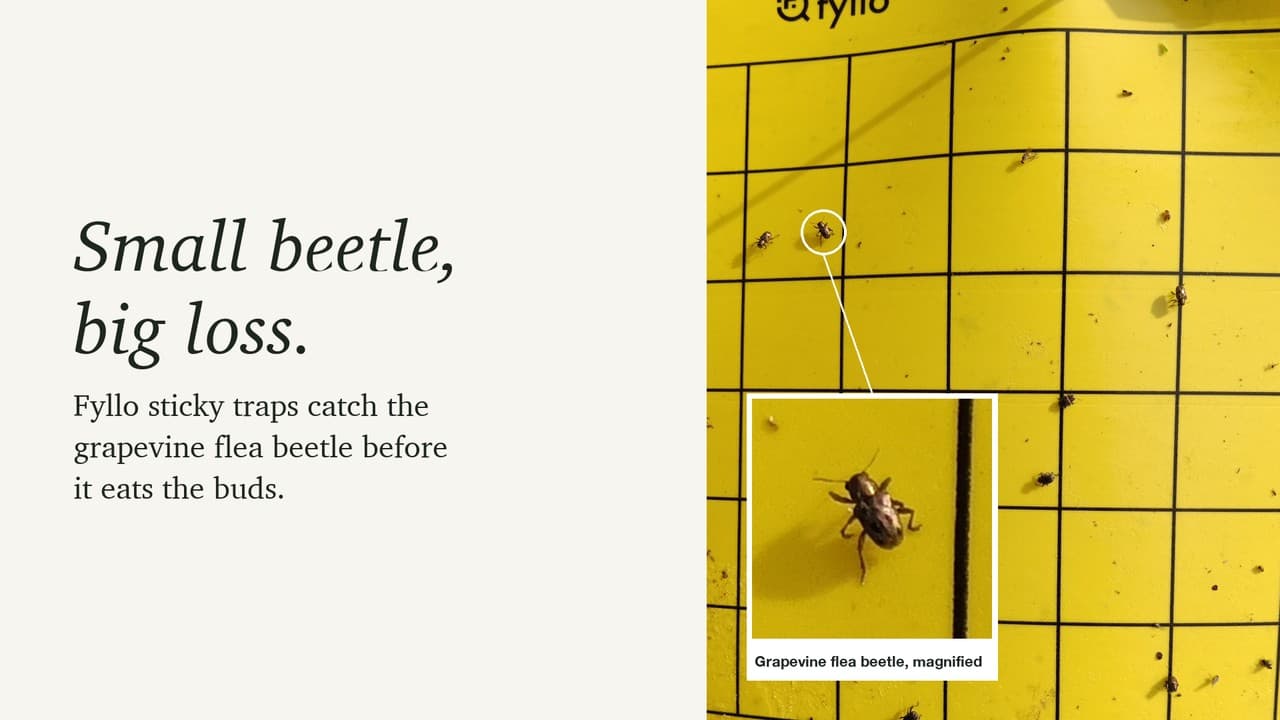
- Appearance: about 4.5 × 2.3 mm; shiny coppery-brown with a metallic sheen, dark spots on the wing covers and a compact, oval body.
- Adult damage: holes in swelling buds and shot-holes in tender leaves and shoots.
- Grub damage: brown, black-headed grubs feed on roots in the soil.
- Risk window: from bud swell until the first leaves open. Once shoots pass roughly 7 cm, feeding rarely affects the crop.
What the Fyllo traps caught
Three of four Fyllo yellow trap cards photographed in October 2026 held roughly 15–25 coppery, spotted beetles each, visually matching the grapevine flea beetle. Their round, metallic bodies stand out from the slender flies and wasps around them.
The printed grid supports consistent counting by eye or from a phone photo, making catches easier to compare over time.
A practical routine
- Install early. Hang traps within 3 days of pruning, before bud swell, at cordon/bud height; use at least one every 20 m.
- Count regularly. Count every 2 days in the morning for the first 15 days, using the same grid squares each time. Photograph the card so counts remain comparable.
- Inspect buds. Check 20 buds per trapped block.
- Act on the combined signal. Act when trap counts and fresh bud holes are rising.
- Treat the block, not the calendar. Use ICAR-NRC Grapes or Fyllo recommendations and label-registered doses.
- Keep cards usable. Remove loose bark at pruning; replace cards when debris covers the grid or after rain.
- Shift focus. After shoots reach about 7 cm, shift trap attention to thrips and jassids.
Monitoring made easier with Smart Sticky Traps
The cards have a printed grid for simple counting. Photos uploaded to the Fyllo app create dated, block-by-block records that can be considered alongside Fyllo spray recommendations. This is a low-cost way to check whether flea beetles are present before spraying. See how this fits into grape crop management.
The takeaway
A yellow sticky trap and a phone camera can provide warning before bud damage is obvious. Repeated counts can help develop an action threshold by tracking trap catches against bud damage across seasons.