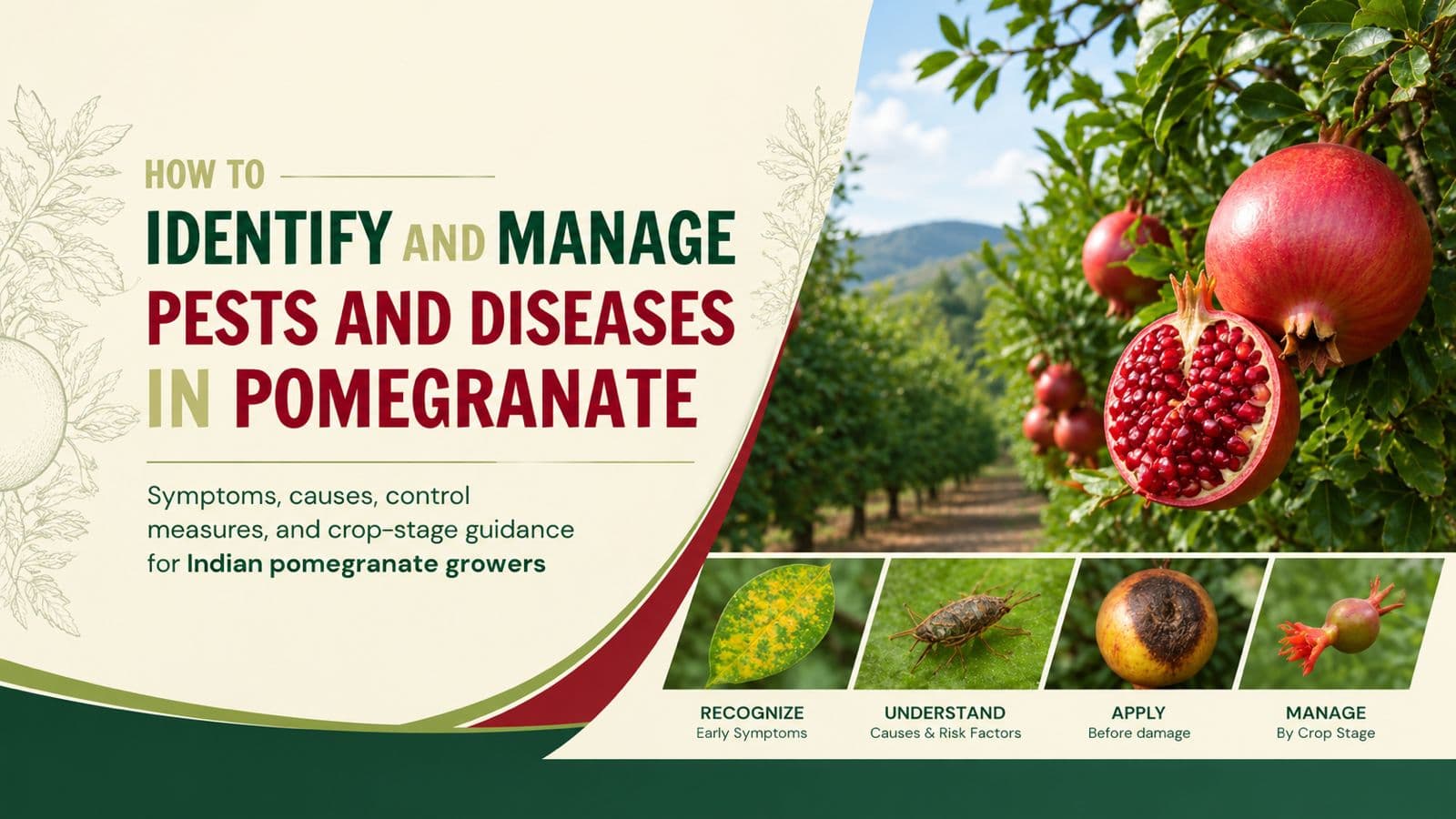
Pomegranate production in India is concentrated in Maharashtra, Karnataka, Gujarat, Andhra Pradesh, Telangana, Rajasthan, and adjoining growing regions. Varieties such as Bhagwa, Ganesh, Mridula, and Arakta are valued for their colour, arils, transportability, and market demand.
The crop's profitability depends on disciplined orchard hygiene, timely monitoring, balanced nutrition, and precise irrigation. Early identification matters because bacterial blight can cause reported losses of 60–80%, while anar butterfly or fruit borer damage can affect up to 50% of fruit when infestations are not managed promptly. This guide brings together the complete integrated-management approach: pest and disease identification, favourable conditions, survival and spread, cultural and biological practices, chemical guidance, crop-stage timing, nutrition, harvesting, storage, and digital monitoring. For crop-specific advisory, see Fyllo's pomegranate farming solution.
Major Insect Pests of Pomegranate
1. Anar Butterfly / Fruit Borer (Deudorix isocrates)
Symptoms: Small caterpillars bore into developing fruits, usually near the calyx or where fruit surfaces touch. Infested fruits show entry holes, frass, webbing, internal feeding, damaged arils, premature rotting, and premature fruit drop. Damage can reach 50% in unmanaged orchards.
Favourable conditions and risk factors: Dense canopies, overlapping fruit, poor sanitation, continuous flowering, and uncollected damaged fruit favour population build-up. Warm weather and the presence of alternate host plants can support successive generations.
Survival and spread: Larvae survive inside fruits and pupate in protected places. Adults move between trees and nearby orchards; infested fruits, discarded plant material, and alternate hosts help the pest persist and spread.
Cultural and mechanical control
- Collect and destroy infested fruits at least once a week; never leave them on the orchard floor.
- Remove excess shoots and improve canopy openness so fruit surfaces can be inspected and sprays can reach the target zone.
- Bag developing fruits where practical, using clean, breathable bags before larvae enter the fruit.
- Install pheromone traps at the recommended rate, commonly 5 traps per acre, and replace lures according to the manufacturer's schedule.
Biological control: Conserve spiders, lacewings, ladybird beetles, parasitoids, and predatory bugs. Where locally recommended, release Trichogramma chilonis at 50,000 parasitoids per hectare per week for six releases, beginning before peak egg laying.
Chemical control: When monitoring shows active infestation, use a registered product labelled for pomegranate, such as emamectin benzoate 5 SG at 0.4 g/L, spinosad 45 SC at 0.3 ml/L, or indoxacarb 14.5 SC at 0.5 ml/L, only where permitted by the current label. Rotate insecticide groups, direct the spray to fruit and canopy interiors, and observe the stated pre-harvest interval.
2. Thrips (Scirtothrips dorsalis and related species)
Symptoms: Silvery or bronzed patches, distorted tender leaves, flower shedding, russeting, scarring, and rough fruit surfaces. Damage is most serious on new flush, flowers, and young fruit.
Risk factors and spread: Thrips increase in hot, dry weather, dense foliage, flowering flushes, and weedy orchards. Adults move readily between weeds, flowers, and new growth.
Monitoring and control: Use blue or yellow sticky traps at 10–12 traps per acre for monitoring and mass trapping where appropriate. Remove weeds, avoid excessive nitrogen, conserve predatory bugs, and use need-based applications of a registered product such as spinosad or fipronil only at the current label rate and crop-stage restriction.
Threshold monitoring: Using Fyllo Smart Sticky Traps, growers can track pest populations digitally and receive alerts — including the spray chemical, required quantity, and schedule — when numbers cross the relevant threshold, delivered directly to their phone via the Fyllo App.
3. Mealybugs (Planococcus citri and related species)
Symptoms: White cottony colonies occur on shoots, leaves, fruit clusters, and around the calyx. Feeding causes yellowing, curling, weak growth, fruit drop, and honeydew that supports sooty mould.
Favourable conditions and survival: Ant activity, dense weeds, rough bark, sheltered crotches, and excessive vegetative growth favour mealybugs. Eggs and crawlers survive in bark crevices, weeds, and plant debris; ants transport crawlers and protect colonies from natural enemies.
Cultural and mechanical control: Remove weeds and heavily infested shoots, prune crowded growth, control ants, and destroy infested plant material. Use clean planting material and inspect nursery stock before planting.
Biological control: Conserve ladybird beetles and lacewings. Where available and locally advised, release the mealybug predator Cryptolaemus montrouzieri at approximately 500 adults per hectare, repeating according to infestation and local biological-control guidance.
Chemical control: Direct a registered, label-approved treatment at colonies and crawlers; products such as buprofezin or imidacloprid may be used only where currently registered for the crop and at the label rate. Do not spray during active pollination unless the label and local guidance permit it.
4. Aphids (Aphis punicae)
Symptoms: Clusters of soft-bodied insects occur on tender shoots, young leaves, flowers, and fruit stalks. Leaves curl, shoots remain stunted, honeydew encourages sooty mould, and virus-transmission risk increases where viruses are present.
Favourable conditions and spread: Cool to mild weather, lush nitrogen-fed growth, weeds, and uninterrupted new flush favour aphid multiplication. Winged forms spread between trees and orchards.
Control: Remove heavily infested shoots, regulate nitrogen, conserve ladybirds and lacewings, wash small colonies with a strong water jet, and use a registered selective insecticide only when monitoring shows that biological control is insufficient.
5. Whitefly (Aleurodicus spp. and related species)
Symptoms: Adults fly when foliage is disturbed; nymphs settle on the underside of leaves. Feeding causes yellowing, reduced vigour, honeydew, and sooty mould. Fruit quality declines when heavy contamination persists.
Risk factors and control: Dense canopies, weeds, excess nitrogen, and hot conditions favour whitefly. Prune for ventilation, remove weeds, use yellow sticky traps, conserve parasitoids and predators, and apply a registered insecticide only after scouting confirms a need.
Other Important Insect Pests
| Pest | Typical signs | Priority response |
|---|---|---|
| Fruit fly | Oviposition marks, maggots inside fruit, soft decay, and premature drop. | Collect fallen fruit, maintain sanitation, use food-bait or male-annihilation traps where recommended, and follow local fruit-fly guidance. |
| Scale insects | Fixed scales on twigs and leaves, yellowing, weak growth, and honeydew. | Prune infested wood, improve spray coverage, and conserve parasitoids. |
| Bark-eating caterpillar | Webbing, frass, and galleries beneath bark or at branch junctions. | Clean galleries, remove badly infested wood, and treat only with a registered recommendation. |
| Termites | Feeding on roots or bark, wilting, and weakened young plants. | Remove debris, avoid water stress, inspect basins, and seek local soil and termiticide advice. |
Monitoring rules for all insect pests
- Walk a fixed scouting route through the orchard and inspect representative trees rather than only the edge rows.
- Record pest stage, affected plant part, number of infested shoots or fruits, trap counts, weather, and spray history.
- Use traps for early warning, not as a replacement for sanitation, canopy management, or field inspection.
- Time chemical control against the vulnerable stage, rotate modes of action, protect natural enemies, and comply with residue and pre-harvest requirements.
Major Diseases of Pomegranate
1. Bacterial Leaf and Fruit Spot / Oily Spot Disease (Xanthomonas axonopodis pv. punicae)
Symptoms: Water-soaked, oily-looking spots develop on leaves, petioles, twigs, and fruit. Spots enlarge, become dark brown to black, crack, and may produce gummy exudates. Severe infections cause defoliation, shoot dieback, fruit cracking, blemishing, and major yield loss; reported losses may reach 60–80%.
Favourable conditions: Warm, humid weather, frequent rain, prolonged leaf wetness, dense canopies, poor drainage, overhead irrigation, and wounds favour infection.
Survival and spread: The bacterium survives in infected twigs, fallen leaves, mummified fruit, nursery material, and orchard debris. Rain splash, irrigation water, pruning tools, workers, insects, and movement of infected planting material spread it.
Cultural and mechanical control: Use disease-free nursery stock, prune infected parts during dry weather, disinfect tools between trees, remove and destroy fallen leaves and fruit, improve ventilation, avoid overhead irrigation, and maintain orchard sanitation between crop cycles.
Biological control: Use locally recommended microbial antagonists such as Trichoderma formulations in soil and nursery programmes where compatible with the production system. Biological products should be applied according to their label and kept separate from incompatible bactericidal sprays.
Chemical control: Where registered and recommended locally, copper oxychloride at 2.5 g/L and streptocycline at 0.5 g/L are used in disease-management programmes, with products rotated and applied at the crop stages advised by local experts. Do not exceed label rates, tank-mix without compatibility confirmation, or harvest inside the prescribed waiting period.
2. Leaf and Fruit Spot (Cercospora punicae and related fungi)
Symptoms: Small circular brown to grey lesions appear on leaves and fruit. Older spots may enlarge, coalesce, and cause premature leaf fall, surface blemishes, and reduced marketability.
Favourable conditions and spread: High humidity, rain, prolonged leaf wetness, dense foliage, and poor air movement favour infection. Spores survive on infected leaves, twigs, and fruit residues and spread by wind-driven rain and splashing water.
Control: Remove infected debris, prune for airflow, avoid wetting the canopy, and maintain balanced nutrition. Registered fungicides such as mancozeb at 2 g/L or copper oxychloride at 2.5 g/L may be used only when permitted by the current label and local recommendation, with rotation of fungicide groups.
3. Anthracnose (Colletotrichum gloeosporioides and related species)
Symptoms: Sunken dark lesions develop on leaves, twigs, and fruit. Fruit lesions may become circular, depressed, and cracked, with internal decay developing as the disease progresses.
Risk factors and spread: Warm, wet weather, rain splash, wounded fruit, poor sanitation, and prolonged canopy wetness increase risk. The pathogen survives on infected plant material and spreads through splashing water, tools, and contaminated debris.
Control: Remove mummified fruit and diseased twigs, prune after harvest, avoid fruit injury, improve drainage and airflow, and use a registered fungicide such as carbendazim at 1 g/L or mancozeb at 2 g/L only according to current label directions and resistance-management guidance.
4. Fusarium Wilt (Fusarium oxysporum f. sp. punicae)
Symptoms: Progressive yellowing, drooping, wilting of branches, vascular browning, reduced growth, and eventual decline or death of the tree. Symptoms may first appear on one side of the canopy.
Favourable conditions and survival: Poor drainage, root injury, contaminated soil, infected planting material, repeated planting in infested sites, and warm soil favour the disease. The pathogen survives in soil and infected roots for long periods.
Cultural and biological control: Plant healthy material in well-drained soil, remove and destroy severely affected trees with as much root material as possible, avoid moving contaminated soil, disinfect tools, and improve drainage. Apply Trichoderma viride or another locally recommended antagonist through well-decomposed organic matter and the root zone according to the product label.
Chemical control: Soil drenching or fungicidal treatment must be based on confirmed diagnosis and local recommendation. Do not repeatedly treat a dying tree without addressing drainage, root injury, and infested soil; chemical treatment is not a substitute for removal of heavily infected plants.
5. Fruit Rot and Scab
Symptoms: Soft, water-soaked or sunken fruit lesions expand during ripening. Fruit may develop cracking, black or grey mould, scab-like corky patches, internal decay, and unpleasant odour. Common associated organisms include Aspergillus, Rhizopus, and scab-associated fungi such as Elsinoë punicae.
Favourable conditions and spread: Rain, high humidity, fruit injury, insect punctures, soil contact, poor harvesting hygiene, and crowded storage encourage disease. Spores spread through rain splash, tools, hands, crates, and contaminated storage surfaces.
Control: Prevent insect injury, remove damaged fruit, maintain canopy airflow, avoid wetting fruit close to harvest, harvest gently, disinfect crates, cool fruit quickly, and store only sound fruit. Apply fungicides only where the crop, disease, rate, and pre-harvest interval are currently registered and advised locally.
Common Nutrient Deficiencies and Crop Nutrition
- Nitrogen — pale green leaves, weak shoots, and reduced growth. Excess nitrogen produces soft, pest-prone growth and can delay maturity.
- Phosphorus — slow root and shoot development, dull foliage, and weak flowering or fruit development.
- Potassium — marginal scorching, weak fruit filling, poor colour, reduced firmness, and lower tolerance to stress.
- Calcium — weak young tissues, fruit-surface disorders, cracking risk, and poor shelf life where calcium supply is inadequate.
- Magnesium — interveinal yellowing on older leaves while veins remain green.
- Iron — interveinal chlorosis on young leaves, especially in alkaline or poorly aerated soils.
- Zinc — small leaves, shortened internodes, rosetting, and reduced shoot growth.
- Boron — poor flowering, flower drop, misshapen fruit, cracking, and poor aril development.
Use soil and leaf testing to confirm deficiencies. Correct the cause before applying foliar or soil nutrients, and do not combine micronutrient sprays with pesticides unless compatibility and label directions have been checked.
Nutrient schedule — vegetative stage
| Input | Quantity | Application guidance |
|---|---|---|
| Well-decomposed farmyard manure | 20 kg per tree | Apply around the basin and incorporate before the active growth flush. |
| Urea | 250 g per tree | Apply in split doses with adequate soil moisture; avoid placing fertiliser against the trunk. |
| Single super phosphate | 500 g per tree | Apply to the active root zone and incorporate with organic matter. |
| Muriate of potash | 250 g per tree | Apply in split doses and adjust to soil-test results. |
| Micronutrients | As indicated by soil or leaf analysis | Use only a locally recommended formulation and label rate. |
Nutrient schedule — flowering and fruiting stages
| Input | Quantity | Application guidance |
|---|---|---|
| Well-decomposed farmyard manure | 20 kg per tree | Maintain organic matter and apply away from the trunk before flowering or as locally scheduled. |
| Urea | 500 g per tree | Split between flowering and fruit-development stages; avoid excess nitrogen. |
| Single super phosphate | 1 kg per tree | Apply to the active root zone and incorporate with adequate moisture. |
| Muriate of potash | 500 g per tree | Split applications support fruit filling, firmness, and quality. |
| Calcium, boron, zinc, or magnesium | According to confirmed deficiency | Use the locally recommended source, concentration, timing, and compatibility guidance. |
Crop-Stage-Wise Pest and Disease Management Calendar
| Crop stage | Priority actions | Water, nutrition, and protection |
|---|---|---|
| Site preparation and planting | Choose disease-free plants; prepare well-drained soil and clean pits. | Use spacing of 4.5 m × 3.0 m. Incorporate 20 kg farmyard manure per tree and avoid waterlogging. |
| Vegetative flush | Scout new leaves and shoots for thrips, aphids, mealybugs, and bacterial lesions. | During establishment, irrigate at 7–10 day intervals, adjusting for soil and weather. Apply the vegetative nutrient schedule and remove diseased growth. |
| Pre-flowering / bahar management | Complete sanitation, prune crowded growth, remove mummified fruit, and install monitoring traps. | Regulate irrigation according to the local bahar programme; do not create prolonged canopy wetness. Begin preventive disease monitoring before rains or flowering. |
| Flowering and fruit set | Protect pollinators, inspect flowers for thrips and fruit-borer activity, and remove damaged fruit. | Apply the flowering and fruiting nutrient schedule. Use selective interventions only when monitoring justifies them. |
| Fruit development | Maintain weekly scouting for fruit borer, fruit fly, bacterial spots, anthracnose, and rot. | Use drip irrigation and avoid sudden wet-dry fluctuations. Established trees are commonly irrigated at 10–15 day intervals, adjusted to soil, temperature, crop load, and local advice. |
| Pre-harvest | Stop unnecessary sprays, observe pre-harvest intervals, remove damaged fruit, and maintain clean crates and tools. | Do not apply an unregistered pesticide or fertiliser close to harvest. Monitor residue and export requirements where applicable. |
| Post-harvest and dormancy | Prune, remove diseased wood, destroy fallen fruit, disinfect tools, and inspect trunks and roots. | Restore organic matter, review soil and leaf tests, repair irrigation, and plan the next crop cycle from orchard records. |
Natural Enemies and Conservation Practices
Beneficial organisms are a core part of integrated pest management. Predatory ladybird beetles, lacewings, spiders, predatory bugs, parasitoid wasps, and soil antagonists can suppress aphids, mealybugs, thrips, whiteflies, and caterpillar eggs or larvae.
- Retain habitat — maintain carefully managed flowering refuges and non-competitive border vegetation where permitted, while removing weeds that host pests or interfere with orchard sanitation.
- Reduce disruption — avoid prophylactic broad-spectrum insecticides, especially during flowering, and spray after confirming the target pest and vulnerable stage.
- > Use selective biological inputs — apply Trichogramma chilonis at 50,000 per hectare per week for six releases where locally recommended, and Chrysoperla carnea* larvae at 10,000 per hectare where aphids, mealybugs, or soft-bodied pests are active.
- Keep records — note releases, trap counts, pest stages, weather, sprays, irrigation, and harvest intervals so future interventions become more precise.
Harvesting
Harvest when fruit has reached the characteristic size, colour, firmness, and maturity of the variety. Mature fruits generally develop a metallic or ringing sound when tapped, while the calyx becomes fully formed and the fruit surface shows the expected colour break. Do not rely on one sign alone; maturity should be judged alongside local variety and market requirements.
Use clean, sharp secateurs and retain a short stalk. Do not pull, drop, or twist fruit from the tree. Harvest during cool, dry conditions, keep fruit out of direct sun, and separate bruised, cracked, diseased, or insect-damaged fruit immediately.
Grading and Post-Harvest Management
| Grade | Indicative fruit profile | Handling requirement |
|---|---|---|
| Extra large | Uniform, premium-colour fruit above 350 g, free from injury and disease. | Pack separately for premium channels; minimise stacking pressure. |
| Large | Uniform fruit of approximately 250–350 g with good colour and firmness. | Use clean, ventilated packs and protect from abrasion. |
| Medium | Fruit of approximately 150–250 g with acceptable appearance and maturity. | Sort consistently and direct to the appropriate market. |
| Small or processing | Fruit below approximately 150 g, or fruit with cosmetic defects but sound arils. | Keep separate from premium fruit and process or market promptly. |
Store only clean, sound fruit. Pre-cool where facilities permit, maintain approximately 5–7°C and 85–90% relative humidity for suitable cultivars, allow ventilation, and avoid condensation. Inspect stored lots regularly and remove decayed fruit before rot spreads. Storage conditions must be adjusted to cultivar, destination, packaging, and the requirements of the receiving market.
Fyllo Smart Sticky Traps and the Fyllo App
Fyllo Smart Sticky Traps support orchard scouting by making flying-pest activity more visible and easier to compare across blocks. Use traps as part of an integrated monitoring plan for thrips, aphids, whiteflies, and other flying insects; place them at crop height, inspect them on a fixed schedule, record counts, and replace them when dusty, saturated, or past their service period.
The Fyllo App complements field observations with organised records for scouting, irrigation, weather, crop stages, alerts, and intervention history. Digital records are most useful when paired with regular physical inspection, correct pest identification, trap observations, and advice from qualified agricultural professionals. Monitoring signals should guide a field decision, not justify an automatic spray programme.
Explore Fyllo's pomegranate farming solution to learn more about Fyllo Smart Sticky Traps and the Fyllo App.
Key Takeaways for Pomegranate Growers
- Start clean — begin with healthy planting material, well-drained soil, correct spacing, and balanced nutrition.
- Scout weekly — use traps, orchard records, and crop-stage observations to find problems early.
- Sanitise relentlessly — remove and destroy infested fruit, diseased wood, fallen leaves, and contaminated debris.
- Conserve natural enemies — use selective, need-based interventions with resistance rotation.
- Protect the marketable crop — through careful irrigation, residue compliance, gentle harvest, grading, cooling, and hygienic storage.
Frequently Asked Questions
How often should a pomegranate orchard be scouted?
What should be done first when bacterial blight is suspected?
Can sticky traps replace insecticide sprays?
Why do pesticide sprays sometimes fail against stem borer or fruit borer?
How can growers reduce fruit cracking and poor shelf life?
Are the nutrient and pesticide quantities universal?
Conclusion
Consistent pomegranate production comes from a system rather than a single spray. Clean orchards, healthy soil, disciplined irrigation, balanced nutrition, early scouting, natural-enemy conservation, careful sanitation, and precise crop-stage decisions work together to reduce pest and disease pressure while protecting fruit quality.
The most reliable next step is to turn this framework into an orchard-specific plan: map blocks, inspect weekly, record trap and disease observations, verify every input against current local guidance, and act early when a problem is still manageable. Growers should consult qualified agricultural professionals before applying pesticides or fertilisers and should always follow current labels, local recommendations, export-residue requirements, and prescribed pre-harvest intervals.