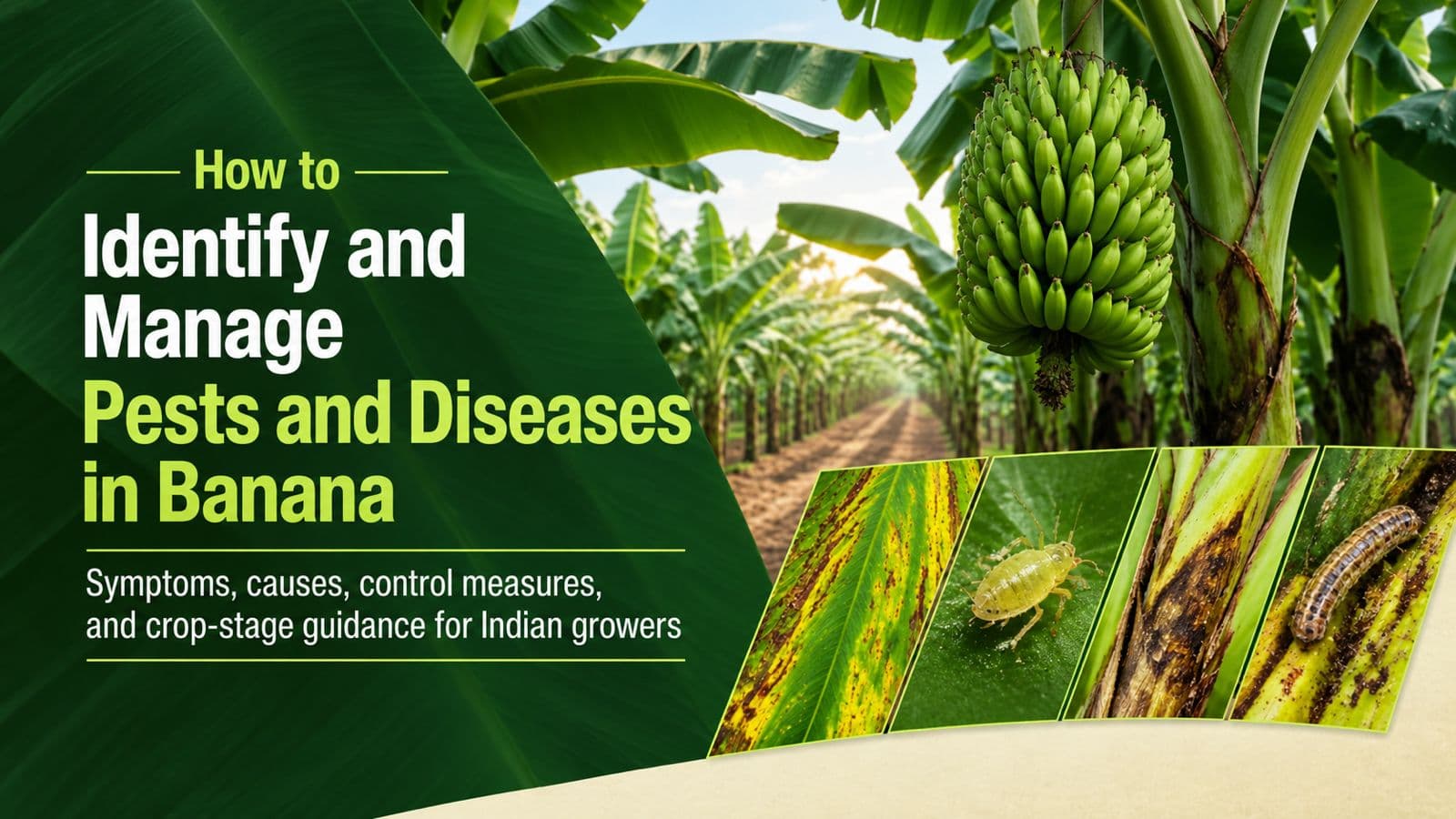
Banana (Musa sp.) is a major Indian fruit crop, grown widely in Maharashtra, Tamil Nadu, Karnataka, Gujarat, Andhra Pradesh and Assam. Commercial varieties include Grand Naine, Robusta, Dwarf Cavendish, Rasthali and Poovan.
Insects, fungal and bacterial diseases, viruses, nematodes and nutrient deficiencies can reduce plant vigour, bunch development, fruit quality and profitability. The most effective response combines clean planting material, regular scouting, sanitation, biological control, need-based chemicals and careful post-harvest handling.
Crop-loss risk: Panama wilt, Sigatoka leaf spot, bunchy top virus and stem weevils can cause losses of 30% to 100% when detection and control are delayed.
Quick diagnosis overview
Start by separating insect, disease, nematode and nutrient symptoms. Confirm the likely cause in the field before selecting a treatment.
| Problem group | Examples | Field clues |
|---|---|---|
| Insects | Weevils, caterpillar, aphid, thrips, beetles | Tunnels, bore holes, gummy exudation, defoliation, colonies, scarring, rusty fruit |
| Fungal and bacterial diseases | Panama wilt, Sigatoka, anthracnose, Moko, soft rot | Yellowing, vascular browning, leaf spots, wilt, rot, foul odour, ooze |
| Viral diseases | Bunchy top, bract mosaic, banana streak virus, infectious chlorosis | Stunting, crowded upright leaves, streaks, mosaics, chlorosis, necrosis |
| Nematodes | Burrowing, root-lesion, spiral, root-knot | Root lesions, tunnels, galls, weak anchorage, toppling |
| Nutrient deficiencies | N, P, K, B, Mg, Fe, Zn, Cu, S, Mn, Ca | Patterned chlorosis, scorching, distortion, poor roots, stunting, small bunches |
Major insect pests of banana
| Pest | Symptoms and causes | Essential management |
|---|---|---|
| Banana rhizome weevil (Cosmopolites sordidus) | Grubs make dark tunnels in the rhizome or corm; roots weaken, leaves wither, the pipe may die, and secondary fungi enter. | Remove harvested pseudostems, prune suckers monthly, sun-dry large corms for two weeks, use clean suckers, and install cosmolure pheromone traps at 2 per acre. Dip suckers in carbofuran 3% CG at 33 g per sucker and shade-dry for 72 hours, subject to current local approval. |
| Banana stem weevil (Odoiporus longicollis) | Grubs tunnel through the pseudostem; pin holes, blackened mass, gummy exudation, structural weakness and wilting follow. | Remove dried leaves, prune suckers, use healthy material, and destroy infested plants. Use split pseudostem traps at 26 per acre. |
| Leaf-eating caterpillar (Spodoptera litura) | Young larvae scrape leaves white; older larvae make large holes and can cause heavy defoliation. | Destroy egg masses and larvae, plough in summer, use basil as a repellent and sunflower, marigold, buckwheat or alfalfa on borders. Use pheromone traps at 4–5 per acre and light traps at 1 per acre from 6–10 pm. |
| Banana aphid (Pentalonia nigronervosa) | Colonies occur in leaf axils and at the pseudostem base; leaves become wavy or bunchy, honeydew causes sooty mould, and the aphid transmits bunchy top. | Keep fields clean, remove weeds, use sticky traps at 4–5 per acre, and conserve coccinellids, lacewings, parasitic wasps and predatory mites. Thiamethoxam 25 WG @ 0.5 g/L, Diafenthiuron 50 SP @ 0.5 g/L of water per acre may be directed to the crown and pseudostem base, subject to current local approval. |
| Banana thrips (Chaetanaphothrips signipennis, Helionothrips kadaliphilus, Thrips florum) | Rust thrips causes smoky, water-soaked patches between fruits that turn rusty red to dark brown-black; leaves may yellow and fruit becomes unmarketable. | Remove damaged material, use blue pan water or blue sticky traps at 4–5 per acre, apply hot-water treatment to suckers, cover bunches early, and conserve coccinellids and lacewings. |
| Leaf and fruit scarring beetle (Basilepta subcostatum) | Scarring on leaves and fruit reduces market value. | Remove grass weeds and maintain clean cultivation. |
Other important insect pests
| Pest | Damage | Control |
|---|---|---|
| Lacewing or tingid bug (Stephanitis typicus) | Spotted, yellow foliage that dries after monsoon buildup. | Destroy damaged leaves; spray Thiamethoxam 25 WG @ 0.5 g/L. |
| Hard scale (Aspidiotus destructor) | Clusters on leaves and fruit weaken plants. | Remove affected parts and release Chilocorus nigritus. |
| Banana scab moth (Nacoleia octasema) | Larvae scar young fruit and create black callous tissue. | Use uniform suckers and conserve spiders and other predators. |
| Fruit fly (Bactrocera dorsalis) — regional | Larvae infest ripe fruit. | Bag bunches, destroy fallen fruit, and install traps every 20 m. |
Digital monitoring option: Fyllo Smart Sticky Traps use image recognition to identify and count pests. The Fyllo App records activity and sends alerts when populations cross a threshold.
Major diseases of banana
1. Panama wilt (Fusarium oxysporum f. sp. cubense)
Panama wilt is soil-borne and may survive for decades. Yellowing begins on lower leaves, progresses upward, and is followed by leaf breakage, pseudostem splitting, and red or brown vascular browning. Continuous monocropping and infected rhizomes increase spread.
- Prevent: avoid Rasthali, Monthan, Red Banana and Virupakshi in wilt-prone fields; use Poovan, Robusta, Dwarf Cavendish, FHIA-1 (Gold Finger), Anai Komban or Nivedya Kadali; remove affected material and practise sanitation and rotation.
- Treat: as soon as wilt infection is noticed, drench with Carbendazim (0.1 to 0.3%) @ 3–5 litres per plant, 3–5 times at 15-day intervals. Pseudostem injection of 3 ml of 0.1% carbendazim solution at the 3rd, 5th and 7th month after planting may be carried out for all plants, both infected and uninfected.
2. Sigatoka leaf spot: yellow and black Sigatoka
Caused by Mycosphaerella musicola and Mycosphaerella fijiensis, Sigatoka produces spindle-shaped spots with grey centres and yellow halos. Spots merge, leaves die, and heavily infected fruit may be undersized, unevenly ripe and poorly stored. Wind, rain and old infected leaves spread conidia.
Remove infected leaves, improve drainage and airflow, weed regularly, and use Ney Poovan, Pachanadan, Karpuravalli, FHIA-1 (Gold Finger) or Sannachenkadali.
| Fungicide | Dosage |
|---|---|
| Mancozeb 75% WP | 600–800 g in 400 L water per acre |
| Propiconazole 25% EC | 0.1% (100 ml per 100 L water) in 200–400 L water per acre |
| Copper oxychloride 50% WP | 1 kg in 300–400 L water per acre |
Spray-scheduling guidance: the Fyllo App provides crop-stage spray schedules, dosages, intervals and spray-history support for a selected variety and region. Verify every recommendation against the locally approved label and professional advice.
3. Anthracnose (Colletotrichum musae)
Small black fruit spots enlarge and turn brown; skin shrivels, pink acervuli appear, fruit ripens prematurely, and pedicel or bunch rot may cause finger drop. High temperature, humidity, wounds, bruising and poor sanitation favour spread. Handle fruit gently, sanitise packing areas, cool promptly to 14°C, and use mancozeb 75% WP at 600–800 g in 400 L water per acre, subject to current local approval.
4. Moko disease / bacterial wilt (Ralstonia solanacearum)
Progressive yellowing, broken hanging petioles, vascular browning, bacterial ooze and internal fruit rot can lead to complete crop loss. High temperature and soil moisture favour spread through infected material, wild hosts, water and soil. Improve drainage, disinfect tools with formaldehyde diluted 1:3 with water, use a three-year rotation with sugarcane or rice, allow fallow or flooding off-season, and grow Poovan or Monthan.
5. Tip over / bacterial soft rot (Erwinia carotovora)
Young suckers develop foul-smelling collar rot, epinasty, sudden drying, water-soaked cortex and yellowish to reddish ooze; plants pull out easily. Remove and destroy infected plants, improve drainage, and drench with bleaching powder 10 g/litre/tree. Drench suckers with 2% bleaching powder at planting, followed by another soil drenching after the 3rd month of planting to control the pathogen.
6. Banana bunchy top disease (viral)
Banana Bunchy Top Virus is transmitted by Pentalonia nigronervosa. Dark green streaks on petioles and midribs, marginal chlorosis and curling, short upright brittle leaves, J-hook streaks, stunting, and failure to produce a bunch are diagnostic clues.
Use disease-free suckers, remove weeds that attract aphids, select Poovan or Pachanadan, and destroy infected plants using 2,4-D at 50 g in 400 ml water, following current local guidance. For vector management, use a recommended insecticide to control the aphid population.
7. Other important diseases
| Disease | Key symptoms | Main control |
|---|---|---|
| Banana bract mosaic virus (BBMV) | Pinkish-reddish pseudostem and peduncle streaks; mosaic bract streaks; traveller's-palm appearance. | Dry-heat treatment at 40°C for one day, avoid cucurbit intercrops, and control aphids. |
| Banana streak virus (BSV) | Yellow leaf streaks become necrotic and black on older leaves. | Use virus-free material and manage mealybugs. |
| Infectious chlorosis (CMV) | Light yellow streaks parallel to veins and declining yield. | Destroy infected plants, use dry heat at 40°C, avoid cucurbits, and control aphids. |
| Cigar end rot (Verticillium theobromae) | Dry rot and ash-grey growth at the flower end. | Cool fruit promptly to 14°C and maintain sanitation. |
| Black tip rot (Botryodiplodia theobromae) | Finger tips blacken and rot progresses inward. | Wrap bunches before the hot-water dip. |
Post-harvest storage matters: anthracnose and fruit rots are managed through clean packing areas, prompt cooling, gentle handling, and correct temperature and humidity — not through field sprays alone.
Nematode pests of banana
| Nematode | Damage | Distribution |
|---|---|---|
| Burrowing (Radopholus similis) | Root tunnels, reddish-brown lesions, weak anchorage and toppling. | Kerala, Tamil Nadu, Karnataka, Manipur, Assam |
| Root-lesion (Pratylenchus coffeae) | Dark root lesions and poor root development. | Uttar Pradesh, Tamil Nadu, Manipur |
| Spiral (Helicotylenchus multicinctus) | Root-surface lesions and reduced nutrient uptake. | Tamil Nadu, Maharashtra, Tripura |
| Root-knot (Meloidogyne incognita) | Root galls and stunted growth. | Tamil Nadu, Andhra Pradesh, Madhya Pradesh |
Nematode management: deep-plough in summer, use disease-free suckers, and grow Poovan, Kadali, Kunnan or Poomkalli. Intercrop with Crotalaria juncea or marigold; treat suckers with carbofuran 3% CG at 50 g per sucker, subject to current local approval. Apply Trichoderma viride, Trichoderma harzianum and Pseudomonas fluorescens as soil treatments.
Common nutrient deficiencies in banana
Soil testing and crop-stage observation help distinguish nutritional stress from disease. The following guide retains the main field clues and corrective inputs.
| Nutrient | Typical symptoms | Treatment |
|---|---|---|
| Nitrogen | Pale leaves, reddish-pink midribs and sheaths, rosette, low bunch weight | Urea 300 g per plant |
| Phosphorus | Stunting, poor roots, saw-tooth marginal chlorosis, bluish-green young leaves | DAP 50 g per plant |
| Potassium | Orange-yellow old leaves, marginal scorch, reduced leaf area, delayed flowering | Potassium sulphate 1% foliar spray |
| Boron | Small or curled leaves, white stripes, thickened veins, poor roots and flowers | Borax 25 g per plant |
| Magnesium | Yellow mid-blade and midrib, green margins, purple petiole mottling, necrosis | Magnesium sulphate 25 g per plant |
| Iron | Young leaves yellow or white | Iron sulphate 0.5% plus urea 1% foliar spray |
| Zinc | Small lance-shaped leaves, chlorotic bands, twisted short fruit | Zinc sulphate 0.5% foliar spray |
| Copper | Young and old leaf chlorosis; umbrella-like leaf posture | Copper sulphate 0.5% foliar spray |
| Sulphur | Yellow or white young leaves, marginal necrosis, stunting, small bunches | Complex fertiliser (20:20:0:15) at 20 g per plant |
| Manganese | Narrow green margins and comb-tooth interveinal pattern | Manganese sulphate 0.5% foliar spray |
| Calcium | Spike leaves, marginal necrosis, thickened veins | Lime 50 g per plant |
Nutrient-management guidance: upload a soil test with crop type and location to the Fyllo App for a crop-stage nutrient schedule. Check recommendations against local agronomic advice.
Crop stage-wise pest and disease management calendar
Before planting
- Deep-plough in May–June and expose soil for two to three weeks; remove debris and alternate hosts.
- Use dolomite or limestone in acidic soils and establish sunflower, marigold, cosmos, cowpea and buckwheat borders.
Planting stage
- Apply 10 kg FYM, 200–250 g N, 60–70 g P and 300 g K per plant; apply P and K at planting and N in three equal splits.
- > Treat suckers and soil with Trichoderma viride, Trichoderma harzianum and Pseudomonas fluorescens*; use certified, disease-free suckers.
- For rhizome weevil and nematodes, dip suckers in carbofuran 3% CG at 33 g and 50 g per sucker respectively, subject to current local approval; apply diuron 80% WP at 0.8 kg in 250 L water per acre before emergence, subject to approval.
- > Intercrop with cowpea or Crotalaria juncea*.
Vegetative stage
- Apply 100 g N per plant in three splits at 60, 90 and 120 days; apply 100 g K in two splits and 200–300 g K₂O according to cultivar.
- Apply ZnSO₄ 0.5%, FeSO₄ 0.2%, CuSO₄ 0.2% and H₃BO₃ 0.1% at 3, 5 and 7 months; weed and mow between rows.
- Install Fyllo Smart Sticky Traps, blue sticky traps at 4–5 per acre, pheromone traps at 4–5 per acre, and light traps at 1 per acre from 6–10 pm.
- Conserve natural enemies, remove Sigatoka leaves, and use the Fyllo App for crop-stage spray schedules while following approved labels.
Reproductive stage: fifth to seventh month
- Remove dried leaves, prune side suckers monthly, monitor stem weevil, and use split pseudostem traps at 26 per acre.
- Apply bunch covers early, continue fungicide rotation, correct deficiencies, and upload soil-test results to the Fyllo App for stage-wise guidance.
- Bag bunches against fruit fly in Karnataka and other affected regions.
Post-harvest stage
- Handle and pad fruit carefully; cool quickly to 13–14°C at 90–95% relative humidity and avoid temperatures below 14°C.
- For extended storage, use 2–5% O₂, 2–5% CO₂ and ethylene below 1 ppm. Mature-green fruit can store up to three weeks in air or six weeks in controlled atmosphere at 14°C.
- Grade fruit by size and blemish level; maintain clean packing and transport conditions.
Role of natural enemies in banana pest management
Protecting beneficial organisms can reduce spray costs and delay resistance. Avoid broad-spectrum sprays when the predator-to-pest ratio is favourable, and do not spray within seven days of releasing parasitoids.
| Beneficial group | Examples and use |
|---|---|
| Parasitoids | Trichogramma spp., Telenomus spodopterae, T. remus, Chelonus sp., Bracon sp., Ichneumon sp., Carcelia spp., Campoletis chlorideae, Ceranisus menes and Encarsia inaron |
| Predators | Lacewings (Chrysoperla zastrowi sillemi), ladybirds, spiders, dragonflies, robber flies, praying mantises, reduviids, earwigs, hover flies, predatory mites, predatory thrips, king crows and common mynahs |
Grow sunflower, marigold, cosmos, buckwheat, cowpea and alfalfa on borders; retain nectar sources such as Tridax procumbens and Ageratum where practical.
Disease-resistant banana varieties
Choose varieties according to local disease pressure and obtain regional advice from a KVK or ICAR institute.
| Disease or pest | Resistant or tolerant varieties |
|---|---|
| Panama wilt | Dwarf Cavendish, Robusta, FHIA-1 (Gold Finger), Anai Komban, Nivedya Kadali, Poovan |
| Sigatoka leaf spot | Ney Poovan, Pachanadan, Karpuravalli, FHIA-1 (Gold Finger), Sannachenkadali |
| Bunchy top disease | Poovan, Pachanadan |
| Moko disease / bacterial wilt | Poovan, Monthan |
| Nematode and corm weevil | Poovan, Kadali, Kunnan, Poomkalli |
| Banana aphid | Musa AAB group |
Regional variety advice: contact the nearest KVK (Krishi Vigyan Kendra) or ICAR institute for current recommendations specific to your region.
Simplify pest and disease management with Fyllo
Banana management requires repeated scouting, spray timing, chemical rotation, aphid-vector control and crop-stage nutrition. Digital records can reduce missed decisions and manual counting. Explore how this fits into banana crop management.
Fyllo Smart Sticky Traps
- AI-powered pest detection: image recognition identifies pests landing on the trap.
- Real-time monitoring: counts and species data sync with the Fyllo App.
- Threshold alerts: notifications help growers decide when action is needed.
- Consistent records: automated monitoring reduces daily manual counting and supports better spray decisions.
Fyllo App — your complete crop advisory
- Spray schedules: crop-stage chemical, dosage and interval guidance for a selected variety and region.
- Rotation management: spray history supports rotation of chemical classes.
- Pest advisory: photos or trap data can support pest identification and management guidance.
- Nutrient plans: soil-test data can generate a crop-stage schedule showing what, when and how much to apply.
Why growers are choosing Fyllo
- Lower input waste: apply inputs when needed and at the recommended dosage.
- Time savings: automated monitoring reduces manual scouting and guesswork.
- Yield and quality support: earlier detection supports timely crop protection.
- Scalable use: Fyllo is designed for farms from 1 acre to 100 acres.
Key takeaways for banana growers
- Start with disease-free suckers. Certified planting material limits bunchy top, Panama wilt, streak virus and other introductions.
- Treat Panama wilt as a long-term soil risk. Avoid susceptible varieties in infested fields and use tolerant varieties, sanitation and rotation.
- Control the aphid to limit bunchy top. Use clean cultivation, sticky traps, natural enemies and locally approved vector control.
- Protect the pseudostem. Sanitation, sucker treatment and pheromone or pseudostem traps reduce weevil damage.
- Manage Sigatoka continuously. Remove infected leaves, maintain airflow and rotate fungicide classes.
- Use soil testing and balanced nutrition. Correct deficiencies without over-applying nitrogen; potassium is important for fruit quality.
- Protect quality after harvest. Cool fruit promptly, prevent bruising and maintain recommended storage conditions.
Conclusion: protect the crop from planting to storage
Banana farming depends on continuous, integrated management. Begin with disease-free planting material, clean fields, balanced nutrition, regular scouting and early action. Cultural, biological, mechanical and need-based chemical measures work best together.
The practical sequence is simple: identify symptoms early, confirm the likely cause, choose a locally appropriate response, and record the action taken. Before acting, consult current agricultural extension recommendations and qualified professionals for locally approved products, dosages and safety requirements.