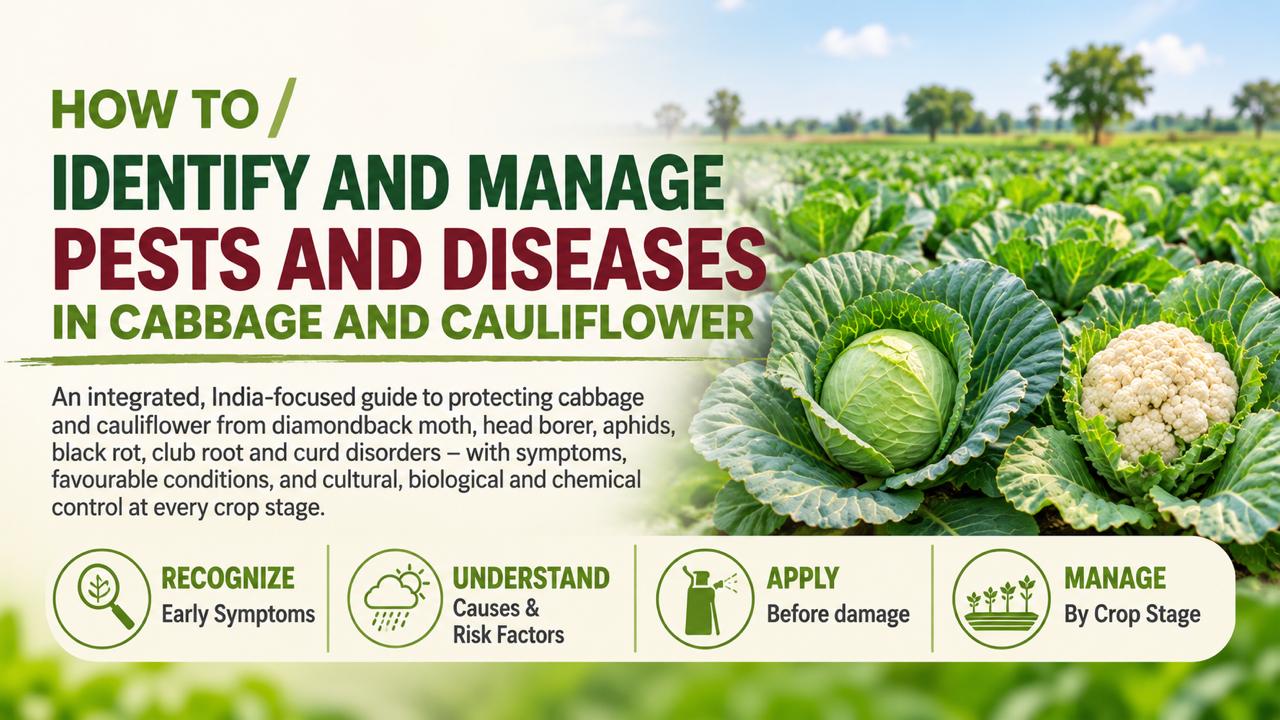
Cabbage and cauliflower are India's most important cole crops, grown widely in the Rabi season across West Bengal, Odisha, Bihar, Uttar Pradesh, Madhya Pradesh, Gujarat, Haryana, Maharashtra and Karnataka, and in the hills during summer. Growers choose among varieties such as Pusa Drum Head and Pusa Mukta in cabbage, and Pusa Snowball K-1, Pusa Snowball Kt-25, Pusa Shubra, Pusa Kartik Sankar and Pusa Hybrid-2 in cauliflower, several of which carry tolerance to black rot, black leg or downy mildew.
Early identification matters because the marketable part of both crops is the head or curd itself. A diamondback moth or head borer larva can riddle a cabbage head within days, black rot can spread from a few yellow leaf edges to the whole field after rain, and a missing micronutrient can leave cauliflower with brown, bitter or strap-leaved plants that never form a curd.
This guide brings together the integrated pest management (IPM) approach: identification, favourable conditions, cultural, biological and chemical practices, crop-stage timing, nutrition and digital monitoring.
Major insect pests of cabbage and cauliflower
1. Diamondback moth (Plutella xylostella)
The most destructive pest of crucifers in India, active throughout the year. The greyish-brown moth shows three diamond-shaped white patches on its back when its wings are folded. Each female lays 50–60 small whitish eggs singly along the veins on the underside of leaves at night. The greenish caterpillar grows to 1–1.5 cm, tapers at both ends and pupates in a thin, loose silken cocoon.
Symptoms of damage:
- Caterpillars feed on the undersurface of leaves and bite holes in them.
- Affected leaves look withered.
- Heavy feeding leaves skeletonised leaves.
Favourable conditions: The pest breeds year-round, with a full life cycle of about four weeks, so populations build fast in a continuous crucifer crop.
Cultural and mechanical control: Remove and destroy plant remnants, stubble and debris after harvest, and plough the field. Sow 2 rows of bold-seeded mustard as a trap crop for every 25 rows of cabbage: the first row 12 days before transplanting and the second 25 days after. Grow tomato, garlic, coriander or carrot in alternate rows as intercrops. Install pheromone traps @ 4–5/acre for monitoring, one foot above the canopy, changing lures every 2–3 weeks.
Threshold monitoring made simple: Using Fyllo Smart Sticky Traps, growers can track pest populations digitally and get alerts for the specific pest, with the spray chemical names, required quantity and schedule, when numbers cross the threshold, directly on their phone via the Fyllo App.
Biological control: Release the egg parasitoid Trichogramma chilonis or T. pretiosum @ 20,000/acre, 4–6 times at weekly intervals. From 20 days after planting, release the larval parasitoid Diadegma semiclausum @ 1,00,000/acre in the hills (below 25–27°C) or Cotesia plutellae @ 20,000/acre in the plains. Conserve Brachymeria and Eriborus spp.; the fungi Paecilomyces spp. and Zoophthora radicans are also effective. Spray NSKE 5% or azadirachtin 0.03% (300 ppm) neem-oil-based WSP @ 1000–2000 ml in 200–400 l of water/acre.
Chemical control: When the pest-to-defender (P:D) ratio is unfavourable, spray flubendiamide 20% WG @ 15 g in 150 l of water/acre, indoxacarb 15.8% EC @ 106.4 ml in 200–400 l of water/acre, emamectin benzoate 5% SG @ 60–80 g in 200 l of water/acre, or fipronil 5% SC @ 320–400 ml in 200 l of water/acre. Give the last spray at least 15 days before harvest, and rotate chemical groups, because diamondback moth develops resistance quickly.
2. Cabbage head borer (Hellula undalis)
The pale yellowish-brown moth has grey wavy lines on its forewings and lays shiny yellowish eggs on leaves. The greyish-yellow caterpillar, 12–15 mm long with seven purplish-brown stripes, is full grown in about 9 days and pupates in its burrow or in the soil. It attacks cabbage, cauliflower, knol-khol and beetroot.
Symptoms of damage:
- Caterpillars web the leaves and bore into the stem, stalk or leaf veins.
- They bore into the cabbage head, leaving holes filled with faecal matter and making it unfit to eat.
- If the growing point is eaten, the plant may go "blind" and form no head.
Control: Collect and destroy caterpillars by hand in the early stages of attack. Conserve Trichogramma (egg) and Brachymeria, Eriborus and Cotesia plutellae (larval parasitoids). If needed, spray the same chemicals listed above for diamondback moth.
3. Cabbage leaf webber (Crocidolomia binotalis)
The female moth lays eggs in masses of 40–100 on the underside of leaves. The caterpillar has a red head, brown stripes and rows of tubercles, and feeds for 24–27 days inside webbed foliage, moving on to flower heads in cabbage and cauliflower.
Symptoms of damage: Webbed leaves with faecal matter, and skeletonised leaves.
Control: Remove and destroy webbed leaves with the caterpillars inside. Set up a light trap @ 1/acre. Conserve parasitoids such as Trichogramma, Bracon hebetor and Cotesia crocidolomiae.
4. Cabbage aphid (Brevicoryne brassicae)
Yellowish-green aphids that multiply without mating and infest crucifers in the cold season.
Symptoms of damage:
- Nymphs and adults suck sap, causing loss of vigour.
- Sooty mould grows on the honeydew they excrete, reducing photosynthesis.
Favourable conditions: Cool winter weather.
Cultural and mechanical control: Install yellow sticky traps or yellow water pan traps @ 12/acre to monitor winged adults. Fyllo Smart Sticky Traps can automate this counting, so you see when winged aphids start arriving.
Biological control: Conserve the parasitoids Aphidius colemani, Diaeretiella and Aphelinus spp., and predators such as lady beetles, hover fly larvae, green lacewings, earwigs, rove beetles and spiders. An adult lady beetle eats about 50 aphids a day, and one hover fly larva about 400 aphids over its life.
Chemical control: Spray fenvalerate 20% EC @ 120–150 ml in 240–300 l of water/acre, or phosalone 35% EC @ 571 ml in 200–400 l of water/acre.
5. Tobacco caterpillar (Spodoptera litura)
Females lay about 300 eggs in clusters covered with brown hairs. The velvety black caterpillars with yellowish-green stripes reach 35–40 mm, and the moths are active at night. There are about eight generations a year.
Symptoms of damage:
- Young caterpillars feed in groups and scrape the leaf, giving it a papery white look.
- Older larvae make irregular holes and skeletonise leaves down to the veins and petioles.
- Heavy defoliation in severe attacks.
Cultural and mechanical control: Keep the field clean and rogue affected plants. Grow basil (Ocimum) as a repellent and castor @ 250 plants/acre as a trap crop, collecting larvae from it. Use a light trap @ 1/acre, pheromone traps @ 4–5/acre and bird perches for mynah and drongo.
Biological control: Spray NSKE 5% against eggs and first-instar larvae. Spray NPV @ 40 LE/acre with jaggery @ 1 kg, three times at 10–15 day intervals, in the evening on seeing eggs or first-instar larvae. Conserve Trichogramma chilonis, Telenomus, Tetrastichus, Campoletis chlorideae and Carcelia spp.
Chemical control: When the pest-to-defender (P:D) ratio is unfavourable, spray flubendiamide 20% WG @ 15 g in 150 l of water/acre.
6. Cabbage butterfly (Pieris brassicae)
The snow-white butterfly has black wing tips. Its velvety green caterpillars, about 4.2 cm long, feed in groups at first and then spread out.
Symptoms of damage: Caterpillars skeletonise leaves and bore into the heads of cabbage and cauliflower.
Control: Use fine-mesh netting over the nursery to keep butterflies from laying eggs. Hand-pick egg clusters and caterpillars from the undersides of leaves. Intercropping with nasturtium reduces egg-laying. Release Trichogramma spp., erect bird perches and conserve Cotesia glomeratus and Pteromalus puparum.
Other pests at a glance
| Pest | Key damage | Main control measure |
|---|---|---|
| Painted bug (Bagrada cruciferorum) | Reddish nymphs and yellow-and-black adults suck sap from leaves and shoots; plants wilt and lose vigour | Conserve big-eyed bugs (Geocoris); field sanitation |
| Mustard aphid (Lipaphis erysimi) | Sap sucking on tender parts | Yellow sticky traps; conserve lady beetles, lacewings and hover flies |
| Serpentine leaf miner (Liriomyza trifolii) | Winding mines in leaves | Yellow sticky traps against adult flies; conserve parasitoids |
| Tomato fruit borer (Helicoverpa armigera) | Larvae feed on leaves and bore into heads | Pheromone traps; Trichogramma; hand-collection of larvae |
| Root-knot and reniform nematodes (Meloidogyne spp., Rotylenchulus reniformis) | Root galls; stunted, yellowing plants in patches | Deep summer ploughing; soil solarisation; neem cake @ 100 kg/acre at transplanting |
Major diseases of cabbage and cauliflower
1. Damping off (Pythium aphanidermatum, Rhizoctonia solani)
A nursery disease. Before emergence, seedlings rot just below the soil surface. After emergence, the collar tissue turns soft and water-soaked, and seedlings topple over.
Favourable conditions: High humidity and soil moisture, cloudy weather, temperatures below 24°C for a few days, crowded seedlings and poor drainage.
Control: Use quality seed and a heat- or chemically pasteurised nursery medium. Raise seedlings on beds more than 15 cm high, or in pro-trays, and avoid excess watering. Treat seed with captan 75% WP @ 20–30 g/kg seed, and drench the soil with captan 75% WP @ 1000 g in 400 l of water/acre if needed.
2. Black rot (Xanthomonas campestris pv. campestris)
The most serious bacterial disease of cabbage, cauliflower, knol-khol and radish.
Symptoms:
- Yellow, angular areas appear first at the leaf margins.
- They extend towards the midrib as characteristic "V"-shaped yellow patches that later turn black.
- Veins blacken, and the blackening spreads into the midrib, petiole and stem; bacterial ooze may be seen.
- Early-infected plants wilt and die; late-infected plants often collapse with soft rot.
Favourable conditions: Relative humidity above 90%, high soil moisture and frequent rain. The bacterium is carried inside seed and in soil, and spreads through irrigation water and rain splash.
Control: Practise crop sanitation and rotate for 2–3 years with non-cruciferous crops. Use tolerant varieties: Pusa Mukta in cabbage, and Pusa Shubra, Pusa Snowball K-1 and Pusa Snowball Kt-25 in cauliflower.
3. Club root (Plasmodiophora brassicae)
Also called finger-and-toe disease.
Symptoms: Plants are stunted and yellow, and leaves wilt on hot days. When pulled up, roots and rootlets show club-like swellings.
Favourable conditions: Temperatures of 12–27°C (best around 25°C), high soil moisture, and neutral to acidic soils of pH 5–7. Resting spores survive in soil for about 10 years and spread through irrigation water and root contact.
Control: Use disease-free seedlings and avoid excess irrigation. Keep soil pH slightly above neutral, about 7.2, by adding hydrated lime @ 1.5 t/acre six weeks before planting.
4. Alternaria leaf spot (Alternaria brassicae, A. brassicicola)
Symptoms: Small dark spots enlarge into circular spots with concentric rings, then merge and blight the leaves. Linear spots appear on petioles and stems. The fungus is seed-borne.
Favourable conditions: Soil temperature around 28°C, high humidity or persistent dew, and moist weather with intermittent showers.
Control: Follow 3-year rotations without crucifers or cruciferous weeds such as wild mustard. Plant later crops upwind of earlier ones, and give wide spacing with rows parallel to prevailing winds. Spray mancozeb 75% WP @ 600–800 g in 300 l of water/acre or zineb 75% WP @ 600–800 g in 300–400 l of water/acre.
5. Downy mildew (Hyaloperonospora parasitica)
Symptoms: Small, pale yellow angular spots on the upper leaf surface, with downy growth and purplish-brown spots underneath. Leaves shrivel and dry early, cabbage heads are exposed to soft rot, and cauliflower curds turn brownish at the tip.
Favourable conditions: Moderate temperatures of 12–27°C and high soil moisture.
Control: Destroy infected debris, avoid thick sowing, overhead irrigation and excess moisture, follow a 3-year rotation without crucifers, and keep wide spacing for air movement. Pusa Hybrid-2 and Pusa Kartik Sankar are tolerant cauliflower varieties.
6. Other diseases
Powdery mildew (Erysiphe cruciferarum*): white powdery spots on leaves and stems, favoured by dry weather with about 80% morning humidity. Destroy infected debris and keep proper spacing.
White rust (Albugo candida*): shiny white blisters on the undersides of leaves and on stems and flowers, with distorted floral parts. Remove weeds and rotate with non-crucifers.
Black leg (Phoma lingam*): Pusa Drum Head cabbage is tolerant.
* Soft rot, ring spot and cauliflower mosaic virus occur regionally; sanitation, healthy seedlings and rotation are the main defences.
Nutrient deficiencies and curd disorders
Base fertiliser decisions on a soil test. Too much nitrogen makes the crop succulent and prone to pests; too little retards growth.
| Disorder | Symptoms | Cause and correction |
|---|---|---|
| Whiptail | Leaf blades stay strap-like; growing point deformed; no marketable curd | Molybdenum deficiency in acidic soils. Lime to raise pH to 6.5, or apply sodium or ammonium molybdate @ 1–2 kg/acre |
| Browning | Hollow stem; brown, bitter curd | Boron deficiency. Apply borax @ 20 kg/ha; in acute cases spray 0.25–0.50% borax solution |
| Buttoning | Small "button" curds form on small plants | Nitrogen shortage, seedlings older than 6 weeks, water stress or other checks to early growth |
| Riceyness | Curd turns granular and loose | Temperatures off the variety's optimum, heavy nitrogen, high humidity or delayed harvest |
| Blindness | No terminal bud, no head or curd | Bud broken or eaten by insects; remove such plants |
| Internal tipburn | Papery brown leaf margins inside the cabbage head | Non-pathogenic; visible only when the head is cut |
| Phosphorus | Pigmented old leaves; poor curd size | Soil-apply the recommended phosphorus dose |
| Zinc | Small young leaves; poor curd colour | Foliar ZnSO₄ @ 0.5% |
Boron and molybdenum applied together have been reported to increase curd size, weight and vitamin C content.
Crop-stage-wise IPM calendar
Pre-sowing: Add well-rotted FYM @ 8–10 t/acre (2–3 weeks before transplanting) or vermicompost @ 5 t/acre (1 week before), enriched with Trichoderma and/or Pseudomonas @ 2 kg/acre. Deep-plough in summer, adopt the stale seedbed technique, and solarise beds with 45-gauge (0.45 mm) polythene for three weeks. Apply neem cake @ 100 kg/acre at transplanting against nematodes and borers. Plant the first mustard trap-crop row 12 days before transplanting.
Seed and transplanting: Test the soil. Varieties need 32 kg N/acre and hybrids 48 kg N/acre, each in three equal splits, with one-third as a basal dose at transplanting. Apply all phosphorus and potassium at sowing: 60 and 40 kg/acre for varieties, 90 and 60 kg/acre for hybrids. Treat seed with Azotobacter and PSB @ 8–10 g/kg, or dip seedling roots in them @ 250 g/acre of seedlings. Keep the nursery weed-free and raise it on raised beds or pro-trays.
Vegetative stage: Give the second nitrogen dose at 30 days after transplanting and irrigate right after. Weed and hoe at 20–25 and 45 days, avoiding deep hoeing, or mulch with 30-micron black LDPE. Start weekly scouting after establishment: five random spots, four plants each, acting on the P:D ratio (general rule 2:1). Install pheromone traps for diamondback moth and Spodoptera, yellow sticky traps for aphids, and bird perches. Fyllo Smart Sticky Traps installed at this stage automate the daily count of aphids, leaf miner adults and small moths, so sprays follow field numbers rather than the calendar. Plant the second mustard row at 25 days, release Trichogramma, Cotesia or Diadegma, and watch for black rot and downy mildew after rain.
Head and curd stage: Give the third nitrogen dose at 50–60 days after transplanting (75–80 days for long-duration varieties) and correct micronutrient shortages with foliar sprays. Keep managing borers, caterpillars and aphids as above, and stop chemical sprays well before harvest.
Harvest and post-harvest: Harvest cabbage when heads are firm to hard; delay can split heads if soil moisture rises suddenly. Cut at the base and trim outer leaves. Cool heads immediately. Cabbage keeps at 0–2°C and 95% humidity for 3–6 weeks (early crop) or 5–6 months (late crop).
Natural enemies and their conservation
Cole crops have a rich set of defenders. Key parasitoids include Trichogramma (eggs of moths and butterflies), Cotesia plutellae and Diadegma semiclausum (diamondback moth larvae), Cotesia crocidolomiae (leaf webber), Aphidius colemani and Diaeretiella (aphids), and Campoletis chlorideae and Telenomus (Spodoptera). Key predators include lady beetles, green lacewings, hover flies, reduviid bugs, spiders, big-eyed bugs, earwigs, ground beetles, the predatory stink bug Eocanthecona furcellata, and birds like king crow and common mynah. A single lacewing larva can consume 100 aphids, and a spider about 5 big larvae a day.
To conserve them, avoid broad-spectrum sprays when the P:D ratio is favourable, and do not spray chemicals within seven days of releasing parasitoids. Grow flowering plants such as dill, anise, coriander, buckwheat, sunflower, mustard, cowpea, marigold and carrot on borders and bunds. Leave nectar-source weeds like Tridax and Ageratum, add organic matter, and reduce tillage.
Fyllo Smart Sticky Traps and the Fyllo App
In cabbage and cauliflower, timing is everything: a spray applied after larvae have entered the head is largely wasted. Fyllo Smart Sticky Traps make field monitoring automatic. They identify and count the flying insects that land on them, including winged aphids, leaf miner adults and small moths, and sync the data to the Fyllo App. When numbers cross the threshold, the app sends an alert with the pest name, spray chemical, quantity and schedule.
Sticky traps monitor flying insects only, so caterpillars already feeding in heads, nematodes and diseases still need the scouting and measures above. See how this fits into cabbage and cauliflower crop management.
Key takeaways
- Start with a clean nursery. Raised beds or pro-trays, pasteurised media and seed treatment prevent damping off and carry fewer pests to the field.
- Plan for diamondback moth from day one. Mustard trap crops, intercrops, pheromone traps and parasitoid releases reduce dependence on sprays.
- Rotate away from crucifers. Two to three years without cole crops is the main defence against black rot, club root, Alternaria and downy mildew.
- Feed the curd, not just the leaves. Correct soil pH, boron and molybdenum to avoid whiptail, browning and buttoning.
- Spray only when needed, and rotate. Follow the P:D ratio, alternate chemical groups and respect the pre-harvest gap.
Conclusion
Cabbage and cauliflower reward steady, season-long attention more than any single spray. With a healthy nursery, trap crops, weekly scouting, trap-based monitoring, conserved natural enemies, balanced micronutrients and need-based chemical use, growers can protect both yield and head and curd quality.
Pesticide registrations change over time, so check every chemical against its current label and local recommendations. Always follow the product label for dose, timing and pre-harvest interval, and consult your local KVK or agricultural university for region-specific advice.


