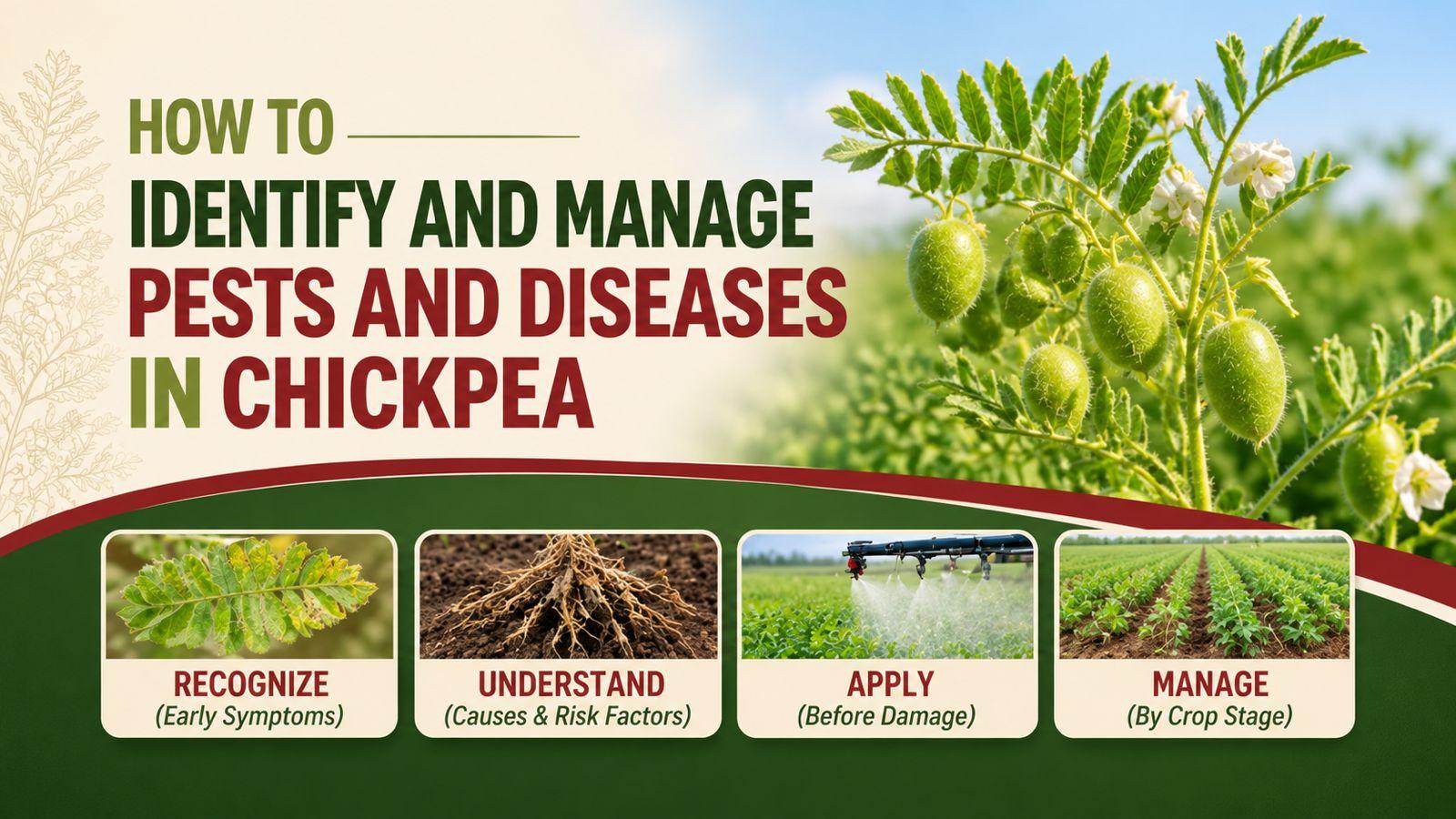
India grows about 68% of the world's chickpea and is also its largest consumer. The crop covers around 8.68 million hectares, mainly in Madhya Pradesh, Rajasthan, Maharashtra, Uttar Pradesh, Karnataka, Andhra Pradesh and Gujarat. Popular varieties include JG 11, JG 16, JG 74, Vijay, Vishal, Pusa 372, Pusa 391, Udai and, among kabuli types, KAK 2 and JGK 1. Chickpea is a key protein source in Indian diets and improves soil fertility by fixing nitrogen, but it is often grown on poor soils by small and marginal farmers with little fertiliser or irrigation.
Early identification matters. A single larva of the gram pod borer can destroy 30–40 pods, and the pest can cut yield by 10–90%. Cutworms cause 5–30% loss, termites 5–15%, and wilt and root rots 20–25%. In epidemic years, diseases alone can wipe out the crop.
This guide follows the AESA-based integrated pest management (IPM) approach recommended by the National Institute of Plant Health Management (NIPHM): how to identify each problem, what favours it, how to manage it, and what to do at each crop stage.
Major insect pests of chickpea
1. Gram pod borer (Helicoverpa armigera)
Symptoms: Young larvae feed on tender leaves and buds. Older larvae bore into the pods and eat the developing seed, often with half the body hanging outside the pod. Damaged pods show round holes and are empty. One larva can destroy 30–40 pods before it matures, and losses range from 10% to 90%.
When it appears: From the vegetative stage, with the heaviest damage at flowering and podding. Early sowing in mid-October helps escape its peak activity.
Monitoring and threshold (ETL): Install pheromone traps @ 5 per hectare, one foot above the canopy and more than 75 feet apart, and count moths every week. Light traps @ 1 per acre, 15 cm above the canopy, run from 6 pm to 10 pm, also help. Take action when you find 5–8 eggs or 2 early-stage larvae per 10 plants, or one mature larva (longer than 1 cm) per 10 plants or per metre of row.
Cultural and mechanical control:
- Plough deeply after harvest and destroy stubble.
- Sow early and synchronously across the village, with early-maturing varieties.
- Intercrop with linseed, mustard, wheat, coriander or rabi sorghum, and grow marigold on borders or between rows as a trap crop.
- Erect bird perches @ 20 per hectare, and mix 5 g of rabi sorghum or sunflower seed with the chickpea seed at sowing to attract insect-eating birds. Remove the perches at harvest.
- Place heaps of grass on the bunds; larvae gather under them and can be destroyed.
- Detop (nip) the plants at 30 days after sowing, especially in deep black soils.
Biological control:
- At pre-flowering, spray NSKE (5%) or azadirachtin 0.03% (300 ppm) neem oil-based WSP @ 2,500–5,000 ml per hectare at 15-day intervals.
- On noticing eggs or first-stage larvae, spray HaNPV 2.0% AS @ 250 LE per hectare with 0.5% jaggery and 0.1% fabric whitener (tinopal). Give 3 sprays at weekly intervals in the evening.
- > Bacillus thuringiensis var. kurstaki @ 1 kg per hectare, or Beauveria bassiana* 1% WP @ 3 kg per hectare.
- > Conserve Campoletis chlorideae*, ladybird beetles, lacewings, stink bugs, reduviid bugs, predatory wasps and spiders by intercropping with coriander.
Chemical control: Only when the ETL is crossed. Make the first spray a biopesticide and the second, if needed, a chemical with label claim. Use 500–600 litres of water per hectare.
- Chlorantraniliprole 18.5% SC @ 125 ml per hectare (0.15 ml per litre)
- Emamectin benzoate 5% SG @ 220 g per hectare (0.2 g per litre)
- Novaluron 10% EC @ 700 ml per hectare (1.5 ml per litre)
2. Aphids (Aphis craccivora, black bean aphid Aphis fabae)
Symptoms: Colonies of small, soft-bodied aphids suck sap from tender shoots, leaves and pods. Shoots curl and plants become weak and stunted. The black bean aphid is a regional problem, mainly in Haryana.
Monitoring: Count nymphs and adults on five randomly selected leaves per plant.
Threshold monitoring: Using Fyllo Smart Sticky Traps, growers can track aphid populations digitally and get alerts for the specific pest, with the spray chemical names, required quantity and schedule, when numbers cross the threshold, directly on their phone via the Fyllo App.
Control:
- Spray NSKE (5%) or azadirachtin-based neem oil.
- > Conserve ladybird beetles (Coccinella septempunctata, C. transversalis, Menochilus sexmaculatus, Brumus suturalis), lacewings (Chrysoperla) and the parasitoid Lipolexis scutellaris*. An adult ladybird beetle eats about 50 aphids a day, and a hover fly larva eats about 400 aphids in its lifetime.
3. Cutworms (Agrotis ipsilon, Spodoptera exigua)
Symptoms: Greasy, dark caterpillars hide in the soil by day and come out at night to cut young seedlings at ground level. Cut plants lie on the soil surface, leaving gaps in the row. Losses are 5–30%.
ETL: One larva per square metre found under the soil near cut plants, at the seedling stage.
Control:
- Plough deeply in summer to expose larvae and pupae.
- Place grass heaps in the field and destroy the larvae that gather under them.
- > Conserve the larval parasitoids Microgaster, Bracon kitcheneri and Fileanta ruficanda, and ground beetles (Broscus punctatus*) and field crickets that prey on larvae.
4. Termites (Odontotermes obesus, Microtermes obesi)
Symptoms: Termites feed on roots and the stem base. Affected seedlings wilt, dry and can be pulled out easily. Damage is worse in dry, light soils and in Rajasthan and Haryana. Losses are 5–15%.
ETL: 5 damaged plants per square metre at the seedling stage.
Control: Plough deeply after harvest, destroy stubble, apply only well-decomposed FYM or neem/mahua cake @ 500 kg per hectare, and avoid moisture stress at the seedling stage.
5. Semilooper (Autographa nigrisigna)
Symptoms: Green caterpillars that move with a looping action feed on leaves, buds and young pods. It is a regional pest, mainly in eastern Uttar Pradesh.
ETL: 2 larvae per 10 plants at the vegetative stage.
Control: Conserve spiders, lacewings and other natural enemies by avoiding unnecessary sprays, and install bird perches for insect-eating birds.
Other important pests
| Pest | Typical signs | Priority response |
|---|---|---|
| Tobacco caterpillar (Spodoptera litura) | Leaves skeletonised, then eaten; larvae feed at night (Andhra Pradesh) | Pheromone traps @ 5 per hectare; conserve Trichogramma chilonis, Telenomus and Bracon hebetor |
| White grub (Phyllophaga implicita) | Grubs eat the roots; plants wilt and die in patches (Gujarat, Rajasthan, Karnataka) | ETL 5 grubs per m²; summer ploughing; avoid late sowing |
Major diseases of chickpea
1. Fusarium wilt (Fusarium oxysporum f. sp. ciceri)
Symptoms: Seedlings or older plants suddenly droop, with leaves turning pale and yellow, then the whole plant dries. When the stem is split near the base, the inner tissue shows brown or black discolouration. Wilted plants appear in patches. It occurs in all chickpea zones.
Favourable conditions: The fungus is soil-borne and survives for years in infested fields. Drought stress and continuous chickpea cropping make it worse.
ETL: 5–10% of plants infected at the seedling or vegetative stage.
Control:
- Grow resistant varieties such as Avrodhi, JG 315, JG 11, JG 16, JG 74, Vijay, Vishal, KAK 2, JAKI 9218, Pusa 391, GNG 1581 and BGD 72.
- Rotate with non-legume crops. In fields with a history of wilt, don't grow chickpea for at least three years.
- Destroy diseased crop debris by deep tillage, and sow on time to avoid drought.
- > Treat seed with Trichoderma viride @ 5 g per kg of seed. In affected fields, apply T. viride* @ 5 kg per hectare multiplied on 100 kg of decomposed FYM, in moist soil.
2. Dry root rot (Rhizoctonia bataticola) and collar rot (Sclerotium rolfsii)
Symptoms: In dry root rot, plants dry up suddenly around flowering and podding; the roots are dark, brittle and rotten, with few lateral roots. In collar rot, seedlings yellow and collapse, and the stem base shows a rot with white fungal growth.
Favourable conditions: Dry root rot is favoured by high soil temperature and moisture stress at flowering and podding (central and southern zones). Collar rot is common in the central zone at the seedling stage.
Control:
- Sow on time to avoid drought, and give a light irrigation when the disease appears under stress to lower soil temperature.
- Grow resistant varieties such as JSC 37, Rajas, CSJ 556, JS 2000-07 and ICCC 32.
- > Treat seed with Trichoderma viride and apply Trichoderma*-enriched FYM, as for wilt.
3. Ascochyta blight (Ascochyta rabiei)
Symptoms: Brown spots with dark margins on leaves, stems and pods, often with tiny dark dots arranged in rings. Stem lesions girdle and break the stem, and badly affected fields look burnt. It is important in the central, north-eastern and northern hill zones, causing 5–10% loss.
Favourable conditions: Cool, wet and cloudy weather; the disease spreads from infected seed and crop debris.
Control: Destroy and bury diseased debris by deep tillage, sow on time, use disease-free seed, and grow resistant varieties such as C 235, GNG 1581, GPF 2, PBG 5, Gaurav, Vardhan, Samrat and Himachal Channa 1 and 2.
4. Botrytis grey mould (Botrytis cinerea)
Symptoms: Water-soaked lesions on flowers, stems and pods that become covered with grey, fuzzy fungal growth. Flowers drop and pods fail to set. It is mainly a problem in the Tarai region, causing 5–10% loss.
Favourable conditions: Dense, lush crop canopy with high humidity and late sowing.
Control:
- Avoid late sowing and use wider spacing (60 cm instead of 30 cm), or thin out infested crops to let in light.
- Avoid excessive vegetative growth.
- Use certified disease-free seed and resistant varieties such as BG 276, GL 90159, HK 94-134 and IPCK 2004-29.
Other important diseases
| Disease | Typical signs | Priority response |
|---|---|---|
| Rust (Uromyces ciceris-arietini) | Small brown, powdery pustules on leaves (Bihar, UP, Karnataka) | Timely sowing; field sanitation; resistant varieties |
| Stemphylium blight (Stemphylium sarciniforme) | Small brown leaf spots, early leaf fall (eastern UP, Bihar, Karnataka) | Clean seed; destroy debris; timely sowing |
Nematodes, weeds and rodents
Nematodes
Root-knot nematode (Meloidogyne incognita) causes galls on the roots, reniform nematode (Rotylenchulus reniformis) gives a "dirty" root system, and the chickpea cyst nematode (Heterodera ciceri) causes "pearly root". Root lesion nematode (Pratylenchus thornei) is also important in the central and southern zones. The ETL is 1–2 larvae per gram of soil.
- Apply neem or castor cake @ 1 tonne per hectare 10 days before sowing in infested fields.
- > Treat seed with Trichoderma viride* @ 10 g per kg of seed, which also helps against wilt.
- Grow marigold as a trap and antagonistic crop, and avoid solanaceous crops in kharif in root-knot-prone areas.
- After harvest, remove and burn infested plants.
Weeds
The main weeds are bathua (Chenopodium album), yellow pea (Lathyrus aphaca), common vetch (Vicia sativa), basal (Asphodelus), choulai (Amaranthus viridis) and wild jute (Corchorus). Keep the crop weed-free for the first 6–8 weeks with timely inter-culture and hand weeding, and remove bathua and vetch at flowering.
Rodents
The lesser bandicoot (Bandicota bengalensis) eats germinating seed and, at maturity, the pods. The working threshold is 25 live burrows per hectare.
- Plough fields, keep them weed-free and trim the bunds to remove shelter.
- Smoke burrows for 2–3 minutes each with an ANGRAU/NIPHM burrow fumigator.
- Place bromadiolone 0.005% ready-to-use wax blocks or bait inside or near burrows.
- Use 2% zinc phosphide bait only when infestation is very high, with pre-baiting, and never more than once per season, because rats become bait-shy.
Nutrition notes
Treat seed with Rhizobium* culture @ 1 packet (200 g) per hectare for good nodulation.
* Apply well-decomposed FYM, and use NPK fertilisers according to a soil test. Avoid imbalanced fertiliser use.
* Apply micronutrient mixtures only when a soil test recommends them.
* Avoid moisture stress at critical stages; it raises the risk of dry root rot and wilt.
Crop-stage-wise IPM calendar
| Crop stage | Main risks | Key actions |
|---|---|---|
| Pre-sowing | Pod borer pupae, cutworms, termites, wilt, root rots, Ascochyta, nematodes | Deep summer ploughing, destroy diseased debris, FYM or neem cake, Trichoderma-enriched FYM, resistant varieties, synchronised sowing, marigold and intercrops planned |
| Sowing and seedling | Cutworms, termites, white grub, collar rot, dry root rot, wilt, nematodes, rodents | Sow from mid-October, seed treatment with Trichoderma and Rhizobium, 5 g sorghum or sunflower seed mixed in, sow 5–7 cm deep, thin dense stands after a month |
| Vegetative | Pod borer, semilooper, aphids, weeds, wilt | Weed-free for 6–8 weeks, nipping at 30 days, pheromone traps @ 5 per hectare, bird perches @ 20 per hectare, NSKE at pre-flowering, weekly AESA from 20 days after sowing |
| Flowering and podding | Pod borer, semilooper, Botrytis grey mould, Ascochyta blight, dry root rot, rodents | HaNPV, Bt or Beauveria first; chemical spray only above the ETL; light irrigation under stress; bromadiolone bait in burrows |
| After harvest | Disease and nematode carry-over, pupae in soil | Destroy infested crop residue, deep ploughing, remove bird perches |
Fyllo Smart Sticky Traps can replace manual aphid counts through the vegetative and flowering stages, sending alerts when catches rise.
Natural enemies and resistant varieties
Spray only when the pest-to-defender (P:D) ratio is unfavourable; NIPHM's general rule is 2:1. Key defenders in chickpea are:
Pod borer and caterpillar enemies: egg parasitoids Telenomus and Trichogramma chilonis; Chelonus blackburni; larval parasitoids Campoletis chlorideae and Bracon hebetor*; and predators such as lacewings, reduviid bugs, praying mantids, spiders, big-eyed bugs and birds like the king crow (black drongo) and mynah.
Aphid enemies: ladybird beetles, hover flies, lacewings and Lipolexis* parasitoids.
Cutworm enemies: Microgaster, Bracon kitcheneri*, ground beetles and field crickets.
Ecological engineering: Grow coriander as an intercrop, and flowering plants such as sunflower, marigold, mustard, alfalfa, fennel, carrot, radish, cowpea and buckwheat on borders. Keep naturally growing nectar plants like Tridax and Ageratum. Basil acts as a repellent plant.
Resistant and tolerant varieties (examples from NIPHM):
| Problem | Varieties |
|---|---|
| Fusarium wilt | Avrodhi, JG 11, JG 16, JG 74, JG 315, Vijay, Vishal, KAK 2, JAKI 9218, GNG 1581, BGD 72, Pusa 391 |
| Dry root rot | JSC 37, Rajas, CSJ 556, JS 2000-07, ICCC 32, GL 769 |
| Ascochyta blight | C 235, GNG 1581, GPF 2, PBG 5, Gaurav, Vardhan, Samrat |
| Botrytis grey mould | BG 276, GL 90159, HK 94-134, IPCK 2004-29, ICC 1069 |
Always confirm the latest recommendation for your area with the local KVK, state agricultural university or ICAR institute.
Fyllo Smart Sticky Traps and the Fyllo App
In chickpea, aphids are the main flying sap-sucking pest, building up on tender shoots during the vegetative and flowering stages. NIPHM recommends regular counts so that sprays are used only when needed.
Fyllo Smart Sticky Traps do this counting for you. The trap photographs what it catches, AI identifies and counts the pests, and the numbers appear in the Fyllo App. When counts cross the threshold, you get an alert on your phone, along with the recommended chemical, dose and timing.
The Fyllo App also keeps your scouting notes, weather, crop-stage advisories and spray history in one place, so you can record pod borer trap catches and disease observations alongside. The traps and the app support your decisions; they don't replace field inspection, pheromone traps for pod borer, correct identification or label instructions. See how this fits into chickpea crop management.
Key takeaways
- Sow from mid-October, synchronously across the village, with treated seed of a wilt-resistant variety.
- Rotate with non-legumes and avoid chickpea for three years in fields with wilt or dry root rot.
- Use pheromone traps @ 5 per hectare and act on pod borer only when the ETL is crossed, starting with HaNPV, Bt or neem.
- Install bird perches, intercrop with coriander and protect natural enemies.
- Avoid moisture stress and overly dense, lush crops to reduce root rots and Botrytis grey mould.
Conclusion
Healthy chickpea comes from a system, not a single spray: timely, synchronised sowing of treated seed of a resistant variety, crop rotation and summer ploughing, balanced nutrition, weekly scouting with pheromone traps, bird perches and coriander intercrops, and protection of natural enemies. Together they keep pod borer, cutworms, wilt, root rots and blights below damaging levels.
Turn this guide into a plan for your own field: map your plots, scout weekly, record trap and disease observations, and act early while a problem is still small.
Pesticide registrations change over time, so check every chemical against its current label and local recommendations. Consult your local KVK or state agricultural university before applying pesticides or fertilisers, and always follow the label dose and safety instructions.


