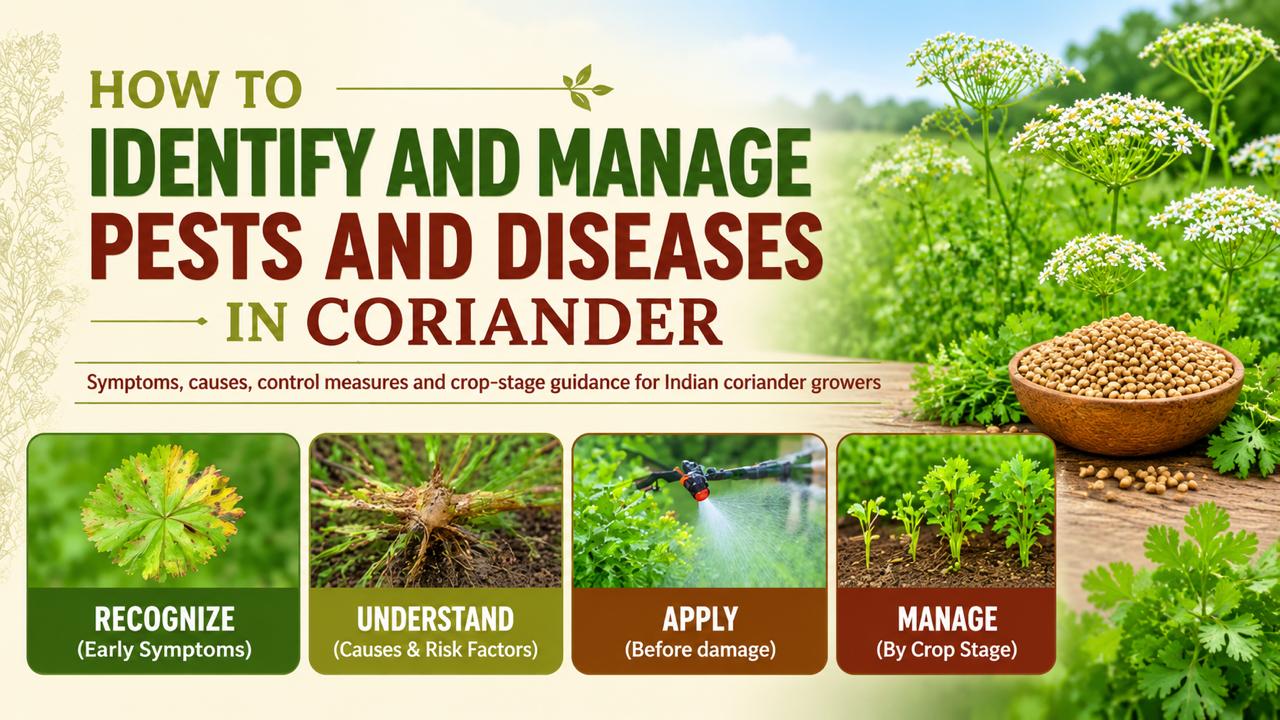
Coriander (Coriandrum sativum), known as dhania, is grown across India for both its fresh green leaves and its dried seed, one of the country's most widely used spices. NIPHM lists Rajasthan, Gujarat, Madhya Pradesh, Tamil Nadu and Uttar Pradesh as the main growing states. Popular varieties include Co.2, Co.3, CS 287, Karan, DH 206 and Hisar Bhoomit.
The plant is soft and slow-growing in its early weeks, and its value depends on clean, well-filled, aromatic seed. That is why early identification matters. Aphids and whitefly build up quickly on tender shoots, cloudy and humid weather at flowering brings powdery mildew and blight, and wilt or stem gall can kill plants outright. Once umbels dry up or seeds stay light and immature, the loss cannot be recovered.
This guide follows the AESA-based integrated pest management (IPM) approach recommended by the National Institute of Plant Health Management (NIPHM): how to identify each problem, what favours it, how to manage it and what to do at each crop stage.
Major insect pests of coriander
A note on sprays: The NIPHM coriander package does not recommend any chemical insecticide by name or dose. For insect pests it relies on cultural and mechanical practices, traps, botanicals and natural enemies. If a pest still crosses safe levels and the pest-to-defender ratio is unfavourable, use only an insecticide registered for coriander, at the label dose, after advice from your local KVK or agriculture officer.
1. Aphids (Hyadaphis coriandri, Aphis gossypii)
Aphids are a pest of national significance in coriander.
Symptoms: Aphids cluster on tender shoots and on the undersides of leaves and suck the sap. Leaves curl and crinkle, and plant growth is stunted. Aphids excrete a sugary honeydew on which black sooty mould grows.
Identification: Small, soft-bodied insects 1–4 mm long, with two long antennae and two short "horns" (cornicles) towards the rear of the body. Young aphids look like small wingless adults and become adults in 7–10 days. In warm areas aphids usually give birth to live young instead of laying eggs.
Monitoring: During weekly scouting, count nymphs and adults on three leaves (top, middle and bottom) per plant, on five plants at each of five random spots in the field. Set up yellow pan water traps or yellow sticky traps @ 4–5 per acre (15 x 7.5 cm), 15 cm above the canopy, and count the aphids on them daily. Empty tins painted yellow and coated with grease, Vaseline or castor oil also work.
Threshold monitoring: Using Fyllo Smart Sticky Traps, growers can track pest populations digitally and get alerts for the specific pest, with the spray chemical names, required quantity and schedule, when numbers cross the threshold, directly on their phone via the Fyllo App.
Cultural and mechanical control:
- Collect and destroy infested plant parts.
- Avoid excess nitrogen, which makes the crop soft and attractive to sucking pests.
- Avoid water stress and water stagnation.
Biological control:
- NIPHM notes that insecticidal soaps or oils such as neem or canola oil, or NSKE 5%, are usually the best method of control. Always check the product label before use.
- Conserve the parasitoids Aphidius colemani and Diaeretiella, and predators such as ladybird beetles, lacewings, spiders, hover flies, big-eyed bugs, earwigs, ground beetles, robber flies and praying mantids.
2. Whitefly (Bemisia tabaci)
Symptoms: Nymphs and adults suck sap from the phloem on the undersides of leaves, weakening the plant.
Identification: The adult is a soft-bodied, moth-like fly with a light yellow body and wings covered in white powdery wax, held over the body like a tent. Females lay about 300 tiny, pear-shaped eggs near the veins on the undersides of leaves. The first-stage nymph ("crawler") moves to a feeding site and then settles; later nymphs are flat, oval, greenish-yellow and do not move. Adults live one to three weeks.
Monitoring: Count nymphs and adults on three leaves (top, middle and bottom) per plant. Use yellow sticky traps @ 4–5 per acre. Fyllo Smart Sticky Traps can automate this count and show when catches are rising.
Control:
- Follow the common cultural practices: field sanitation, removal of alternate host plants and balanced fertiliser use.
- Conserve the parasitoids Encarsia, Eretmocerus mundus and Amitus aleurolobi, and predators such as spiders and ladybird beetles (Cheilomenes sexmaculata, Coccinella septempunctata).
3. Cutworm (Agrotis sp.)
Symptoms: The caterpillar cuts young plants at ground level and makes them fall over. Attack starts in the early stage of the crop and can cause heavy loss.
Identification: Moths have a wingspan of 40–55 mm with uniformly dark brown forewings marked by a lighter band and a small black dash. A female can lay 1,200–1,900 eggs, usually in clusters on foliage. Pupation takes place in the soil at a depth of 3–12 cm.
Control:
- Plough deeply in summer (May–June) to expose pupae.
- Collect and destroy eggs and larvae.
- Set up a light trap @ 1 per acre and run it from 6 pm to 10 pm, using a model with an exit for small natural enemies. NIPHM also suggests a bonfire in the evening at 7–8 pm.
- Release the egg parasitoid Trichogramma sp. @ 20,000 per acre.
- Erect bird perches @ 20 per acre for king crows and common mynahs.
4. Seed chalcid fly (Systole coriandri)
NIPHM lists the seed chalcid as a pest of national significance at the flowering and maturity stage. It is a tiny wasp whose grubs develop inside the coriander seed, so the damage shows up as light, hollow seed. The package gives no chemical for it; follow the common cultural and biological practices, keep the field clean and do not delay harvest.
5. Indigo caterpillar (Spodoptera exigua)
A pest of regional significance.
Symptoms: Young caterpillars feed in groups and scrape the green tissue of the leaves, which turn papery white. Later they eat irregular holes and can skeletonise leaves, leaving only the veins and leaf stalks.
Identification and habits: Females lay eggs in clusters covered with hairs. Pupation takes place in the soil. Moths are active at night, and the pest breeds throughout the year.
Control:
- Install pheromone traps for Spodoptera @ 4–5 per acre, more than 75 feet apart and one foot above the canopy. Change lures every 2–3 weeks, count moths weekly and destroy them after each count.
- Grow castor or marigold as a trap crop.
- Collect and destroy egg masses and the gregarious young caterpillars.
- When many egg masses and young larvae are seen, NIPHM advises SlNPV at the recommended dose, sprayed only in the evening after 5 pm, and not on late-stage larvae.
- Conserve Trichogramma chilonis, Telenomus, Campoletis chloridae, Chelonus and Bracon, and predators such as lacewings, spiders, reduviid bugs, praying mantids, dragonflies and king crows.
Other pests
| Pest | Damage | Key management |
|---|---|---|
| Thrips (Thrips tabaci) | Rasp and suck leaf cells, leaving silvery patches or streaks; severe damage reduces photosynthesis and opens entry points for pathogens | Blue sticky traps @ 4–5 per acre; tall border crops of maize or sorghum; conserve Ceranisus menes, predatory mites, predatory thrips, Orius bugs and hover flies |
| Mites (Petrobia latens, Tetranychus telarius) | Plants turn whitish yellow and sickly; worst on young leaves and young inflorescences; webbing and stunting when severe | Tall border crops of maize or sorghum; manage as for aphids; spray the undersides of leaves thoroughly; conserve predatory mites, Stethorus, lacewings and Orius bugs |
| Root-knot nematode (Meloidogyne spp.) | Galls on roots, "beard root", patches of stunted plants that wilt in the heat of the day; favoured by light loamy soils | Deep summer ploughing; soil solarisation; resistant varieties where nematodes are known; 3-year rotation with non-host cereals |
| Khapra beetle (storage) | Feeds on stored seed | Store in gunny bags with moisture-proof lining |
Major diseases of coriander
1. Powdery mildew (Erysiphe polygoni)
Symptoms: Small, white, powdery patches appear on young stems, leaves and buds, grow larger and join up to cover the whole leaf surface. Affected leaves are smaller and distorted, and premature sterility is common. In severe cases the umbels dry up and seeds may not form at all.
Survival and spread: The fungus survives in plant debris as resting bodies (cleistothecia) and spreads over long distances by air.
Favourable conditions: High humidity and moderate temperatures (cloudy weather). Infection is most severe in shaded areas.
Cultural control: Grow the resistant variety DH 206 where it suits your area. Do not delay harvesting the mature crop, which NIPHM advises to avoid powdery mildew attack.
Chemical control (NIPHM): Sulphur 85% DP (dust) @ 6–8 kg per acre. This is the only chemical named in the NIPHM coriander package.
2. Wilt (Fusarium oxysporum f. sp. corianderii)
Symptoms: The tips of the plant droop, then the leaves wither and dry, and the plant dies. The water-conducting tissue of the root is discoloured. Some plants wilt only partly and stop growing. Leaves turn pinkish yellow to yellow, plants are often sterile, and any seed formed is immature and light. Severe infection in the early stage can cause total crop failure.
Survival and spread: Soil-borne; primary infection comes from the fungus in the soil.
Favourable conditions: Relatively high soil moisture and soil temperature.
Control:
- Grow tolerant or resistant varieties: Co.3 (less susceptible), CS 287 (tolerant) and Karan (highly resistant).
- Use healthy, disease-free seed and treat it with Trichoderma harzianum or T. viride and Pseudomonas fluorescens; also apply them to the soil.
- Enrich FYM with Trichoderma @ 500 g in 100 kg FYM for 15 days before applying it to one acre.
- Avoid over-irrigation, plough deeply in summer and solarise the soil.
- Rotate with non-host cereal crops for 3 years.
3. Stem gall (Protomyces macrosporus)
Symptoms: Tumour-like swellings form on leaf veins, leaf stalks, flower stalks, stems and fruits, about 3 mm wide and up to 12.5 mm long. Infected veins give the leaves a swollen, hanging look. The galls are glossy at first and later rupture and turn rough. Badly affected plants may be killed.
Survival and spread: Soil-borne; the fungus can survive in the soil as resting spores for several years.
Favourable conditions: High soil moisture and soil temperature. Galls are most numerous when excess moisture and shade keep the stem soft and succulent.
Control:
- Grow the resistant varieties Karan or Hisar Bhoomit.
- Maintain optimum soil moisture to minimise stem gall; avoid excess irrigation.
- Follow summer ploughing, solarisation and crop rotation.
4. Blight disease complex (Alternaria poonensis and Colletotrichum sp.)
Symptoms: Dark brown spots appear on the stems and leaves, and emerging umbels with young flowers are killed. Later in the season, as plants mature, a diseased field may be hard to recognise apart from reduced seed yield.
Survival and spread: The fungi survive as spores or mycelium in diseased plant debris, weeds or soil.
Favourable conditions: Moist weather with relative humidity above 70%, temperatures of 12–25°C and intermittent rain.
Control: Use healthy seed treated with Trichoderma and Pseudomonas fluorescens, destroy infected debris and weeds, avoid over-irrigation and dense stands, and follow crop rotation. NIPHM does not name a fungicide for blight in coriander; if needed, use a product registered for coriander at its label dose on local advice.
Other diseases (regional)
| Disease | Symptoms | Key management |
|---|---|---|
| Stem rot (Rhizoctonia solani) | Seeds fail to germinate or die before emergence; water-soaked reddish lesions girdle the stem at the collar and seedlings collapse; favoured by the rainy season | Healthy seed; Trichoderma and Pseudomonas seed and soil treatment; avoid waterlogging; field sanitation |
| Root rot (Pythium sulcatum) | Rotting of roots and seedlings | Avoid over-irrigation; good drainage; bio-agent seed and soil treatment |
| Grain mould (Alternaria sp., Helminthosporium sp.) | Mouldy, discoloured seed | Less susceptible varieties Co.3 and CS 287; harvest on time |
Nutrient deficiencies and nutrition
NIPHM describes two deficiencies in coriander:
| Nutrient | Symptoms | Correction (NIPHM) |
|---|---|---|
| Nitrogen | Yellowing of old leaves; stunted growth | Foliar spray of urea @ 1–2% |
| Phosphorus | Stunted growth; leaves turn purple to reddish | Soil application of 4–5 kg P₂O₅ per acre, or foliar spray of DAP @ 2% |
Recommended inputs:
- FYM 4–5 tonnes, or vermicompost @ 1.5–2.0 tonnes per acre, worked into the soil 2–3 weeks before sowing.
- Seed inoculation with Azotobacter @ 5 g per kg seed and PSB @ 8–10 g per kg seed.
- Black cotton soils: 12 kg N, 16 kg P₂O₅ and 8 kg K₂O per acre as a single basal dose.
- Light soils under irrigation: 18 kg N, 12 kg P₂O₅ and 12 kg K₂O per acre as a basal dose at sowing.
- Top dressing: 12 kg N per acre at 30 days after sowing.
- Correct micronutrient deficiencies with a foliar spray of the specific nutrient, only on a soil-test recommendation.
Too much nitrogen makes the crop succulent and prone to pests and diseases, and phosphate need not be applied every season, as residual phosphate carries over.
Crop-stage-wise IPM calendar
| Crop stage | Main risks | Key actions |
|---|---|---|
| Pre-sowing | Wilt and stem gall fungi, nematodes, resting pupae, weeds | Deep summer ploughing in May–June; soil solarisation with 45-gauge polythene for three weeks or a stale seedbed; FYM with Trichoderma; castor or marigold trap crop; maize or sorghum border; 3-year rotation with cereals; sow ecological engineering plants |
| Sowing | Wilt, blight, root rot, nematodes | Resistant or tolerant varieties; healthy, certified, weed-free seed; Trichoderma and Pseudomonas seed treatment; Azotobacter and PSB inoculation; basal NPK by soil type; line sowing; avoid over-irrigation |
| Vegetative | Aphids, whitefly, cutworm, indigo caterpillar, mites, wilt, stem gall, stem rot, weeds | Weekly scouting; yellow sticky traps for whitefly and aphids and blue for thrips @ 4–5 per acre; pheromone traps @ 4–5 per acre; light trap @ 1 per acre; bird perches @ 20 per acre; Trichogramma @ 20,000 per acre for cutworm; neem-based sprays or NSKE 5% for aphids; hand hoeing at 25 and 50 days; thin to 5–10 cm between plants before first irrigation; 12 kg N per acre at 30 days |
| Flowering and maturity | Powdery mildew, blight, grain mould, thrips, seed chalcid, aphids | Watch cloudy, humid spells closely; sulphur 85% DP @ 6–8 kg per acre for powdery mildew; remove leftover weeds; continue trap monitoring; do not delay harvest |
| Harvest and storage | Shattering, moisture damage, khapra beetle, odour taint | No pesticides in the 7 days before harvest; dry seed gently to 9% moisture without hot air; remove green material and weed seed quickly; store away from fuel and herbicides; gunny bags with moisture-proof lining |
Fyllo Smart Sticky Traps can replace manual counts of aphids, whitefly and thrips on the yellow and blue traps through the vegetative and flowering stages, sending alerts when catches rise.
Natural enemies and conservation
Spray only when the pest-to-defender (P:D) ratio is unfavourable; NIPHM's general rule is 2:1. Key defenders in coriander are:
- Aphid enemies: the parasitoids Aphidius colemani and Diaeretiella, plus ladybird beetles, lacewings, hover flies, spiders, big-eyed bugs, earwigs and robber flies.
- Whitefly enemies: Encarsia, Eretmocerus mundus and Amitus aleurolobi, plus spiders and ladybird beetles.
- Caterpillar enemies: egg parasitoids Trichogramma and Telenomus; Chelonus, Bracon, Campoletis, Apanteles and Ichneumon; and predators such as lacewings, reduviid bugs, praying mantids, dragonflies, black drongo and common mynah.
- Thrips and mite enemies: Ceranisus menes, predatory mites (Amblyseius, Phytoseiulus persimilis), predatory thrips, Orius bugs, Stethorus and Oligota beetles.
Ecological engineering: Grow flowering plants on borders and internal bunds, with shorter plants towards the crop and taller ones on the edge. NIPHM lists cowpea, carrot, sunflower, buckwheat, French bean, alfalfa, mustard, cosmos, anise, caraway, dill and chrysanthemum as attractant plants, Ocimum and spearmint as repellent plants, maize and sorghum as border plants, and castor and marigold as trap plants. Leave naturally growing nectar plants such as Tridax, Ageratum and Alternanthera. Add organic matter, reduce tillage and avoid broad-spectrum pesticides when the P:D ratio is favourable. Release parasitoids only after moth catches are seen in pheromone traps, and do not apply chemicals within seven days of a release.
For the latest variety and product advice for your area, contact the nearest KVK, state agricultural university or ICAR institute.
Fyllo Smart Sticky Traps and the Fyllo App
In coriander, the flying pests that sticky traps catch are aphids, whitefly and thrips. NIPHM recommends yellow traps for aphids and whitefly and blue traps for thrips @ 4–5 per acre, with aphid counts checked daily. Counting tiny insects on many traps takes time, and it is easy to miss the start of a build-up.
Fyllo Smart Sticky Traps do this counting for you. The trap photographs what it catches, AI identifies and counts the pests, and the numbers appear in the Fyllo App. When counts cross the threshold, you get an alert on your phone, along with the recommended chemical, dose and timing.
The Fyllo App also keeps your scouting notes, weather, crop-stage advisories and spray history in one place. This helps in coriander, where a spell of cloudy, humid weather at flowering can bring powdery mildew and blight.
The traps and the app support your decisions; they don't replace field inspection, pheromone traps for caterpillar moths, correct disease identification or label instructions. Learn more about Fyllo Smart Sticky Traps.
Key takeaways
- Start with resistant or tolerant varieties such as Karan, CS 287, Co.3, DH 206 or Hisar Bhoomit, and healthy seed treated with Trichoderma and Pseudomonas.
- Plough deeply in summer, solarise the soil and avoid over-irrigation to reduce wilt, stem gall, stem rot and nematodes.
- Scout weekly and use yellow and blue sticky traps @ 4–5 per acre for aphids, whitefly and thrips; manage aphids first with neem-based sprays or NSKE 5%.
- Watch the weather at flowering: cloudy, humid spells bring powdery mildew and blight. Sulphur 85% DP @ 6–8 kg per acre is the NIPHM option for powdery mildew.
- Harvest on time, dry seed gently to 9% moisture and store it in lined bags away from odours.
Conclusion
Healthy coriander comes from a system, not a single spray: resistant varieties, treated seed, summer ploughing and solarisation, balanced nutrition, careful irrigation, weekly scouting with sticky, pheromone and light traps, protection of natural enemies and timely action when humid weather arrives at flowering. Together they keep aphids, wilt, stem gall and mildew below damaging levels and protect the colour and aroma of the seed.
Turn this guide into a plan for your own field: map your plots, scout weekly, record trap and disease observations, and act early while a problem is still small.
Pesticide registrations change over time, so check every product against its current label and local recommendations. Consult your local KVK or state agricultural university before applying pesticides or fertilisers, and always follow the label dose and safety instructions.