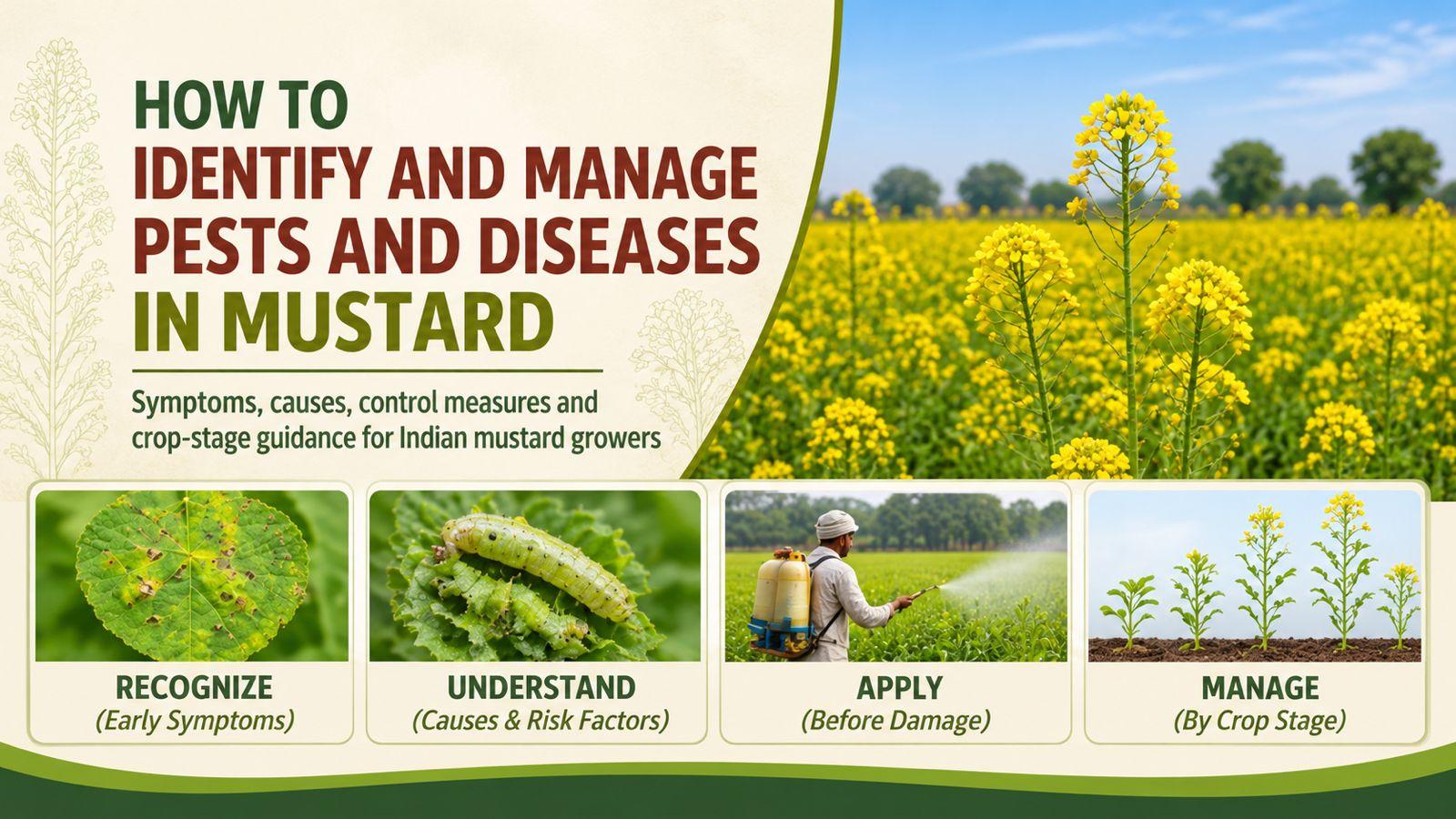
Rapeseed-mustard is India's key edible oilseed crop, supplying nearly one-third of the oil produced in the country. Indian mustard (Brassica juncea) is grown mainly in Rajasthan, Uttar Pradesh, Haryana, Madhya Pradesh and Gujarat, with Rajasthan alone accounting for nearly half the area. Because it needs little water (80–240 mm), it fits well in rainfed farming, and it is a major source of income for small and marginal farmers. Toria matures in about 75–90 days, rai in 110–180 days, yellow sarson in 130–160 days and brown sarson in 105–145 days.
Early identification matters. The mustard aphid arrives in the second and third week of December and can stunt plants and dry out pods until March. Painted bug can cut yield by around 31%, and sawfly can force resowing at the seedling stage. Alternaria blight and white rust, both favoured by humid weather and intermittent rain, shrivel the seed and deform the flowering shoots.
This guide follows the AESA-based integrated pest management (IPM) approach recommended by the National Institute of Plant Health Management (NIPHM): how to identify each problem, what favours it, how to manage it, and what to do at each crop stage.
Major insect pests of mustard
1. Mustard aphid (Lipaphis erysimi)
Symptoms: Nymphs and adults suck sap from leaves, buds and pods. Infested leaves curl, plants stay stunted, and sooty mould grows on the honeydew they excrete. In heavy attacks, plants wither and die. Wingless females are yellowish-green to olive-green with a white waxy bloom.
When it appears: The attack usually begins in the second and third week of December and continues until March, peaking at flowering and pod formation.
Monitoring: Set up yellow water pan or sticky traps 15 cm above the canopy @ 4–5 traps per acre, and install them before flowering begins. In the field, count nymphs and adults on five randomly selected leaves per plant.
Threshold monitoring: Using Fyllo Smart Sticky Traps, growers can track aphid populations digitally and get alerts for the specific pest, with the spray chemical names, required quantity and schedule, when numbers cross the threshold, directly on their phone via the Fyllo App.
Cultural and mechanical control:
- Sow early and grow tolerant varieties to escape the main aphid build-up.
- In the initial stage, remove and destroy affected parts along with the aphid colonies.
Biological control:
- Spray neem oil (2%) or neem seed kernel extract (NSKE, 5%).
- > Conserve ladybird beetles (Coccinella septempunctata, Menochilus sexmaculata, Hippodamia variegata), which eat 10–15 adult aphids a day, as well as syrphid flies, the lacewing Chrysoperla zastrowi sillemi and the parasitoid Diaeretiella rapae*.
- > Fungi such as Verticillium lecanii and Entomophthora* also infect aphids.
Chemical control (only when needed):
- Thiamethoxam 25% WG @ 20–40 g in 200–400 litres of water per acre
- Imidacloprid 30.5% SC @ 0.5 mL/L of water per acre
2. Painted bug (Bagrada hilaris)
Symptoms: Black, white and orange shield-shaped bugs (5–7 mm) and their orange-red nymphs suck sap from all parts of the plant. Young plants wilt and wither. Adults excrete a resinous substance that spoils the pods, and yield losses can reach 31%. The bug also infests the harvested crop on the threshing floor.
When it appears: Activity starts in September, so it hits seedlings first and returns at harvest.
Cultural and mechanical control:
- Plough deeply to destroy eggs, sow early, and irrigate the crop in the fourth week after sowing.
- Thresh the harvested crop quickly, and destroy the remains of the mustard crop.
- Jerk the plants to dislodge congregating bugs and kill them in kerosene water; collect and destroy nymphs and adults.
Biological control: Conserve the tachinid fly Alophora, which parasitises the eggs.
Chemical control: Imidacloprid 70% WS @ 700 g per 100 kg of seed as seed treatment, or dichlorvos 76% EC @ 250.8 ml in 200–400 litres of water per acre.
3. Mustard sawfly (Athalia lugens proxima)
Symptoms: Greenish-black, wrinkled larvae nibble the leaves, then feed from the margins towards the midrib, leaving shot holes and riddled leaves. They also eat the epidermis of the shoot, drying up seedlings. Losses are 5–18%, and in severe seedling attacks the crop must be resown. Larvae drop and feign death when touched.
Cultural and mechanical control:
- Plough in summer to destroy pupae, keep the field clean, and sow before 20 October.
- Irrigate at the seedling stage; most larvae die from drowning.
- Collect and destroy larvae in the morning and evening.
Biological control: Conserve the larval parasitoid Perilissus cingulator and the bacterium Serratia marcescens. Bitter gourd seed oil emulsion works as an antifeedant.
Chemical control: Imidacloprid 70% WS @ 700 g per 100 kg of seed as seed treatment, or thiamethoxam 25 WDG @ 0.5 g/L.
4. Mustard leaf miner (Chromatomyia horticola)
Symptoms: Larvae make long, whitish, winding mines in the leaves, mostly on the upper surface. Mined leaves wither and the plant loses vigour; damage is usually worse on older leaves. The small fly is active from the seedling stage.
Monitoring and control:
- Count live mines on five leaves per plant.
- Yellow sticky traps or cards reduce the density of adult flies. Fyllo Smart Sticky Traps can count these adults for you, so you see when activity starts to rise.
- > Conserve the parasitoids Diglyphus isaea, Gronotoma micromorpha, Halticoptera circulus and Opius phaseoli*, and predators such as lacewings, ladybird beetles and spiders.
- If needed, dimethoate 30% EC @ 264 ml in 200–400 litres of water per acre.
5. Diamondback moth (Plutella xylostella)
Symptoms: Pale yellowish-green caterpillars feed on the foliage, giving leaves a withered look; later they bore holes and may eat leaves completely. They also bore into pods and eat the developing seed. The small greyish-brown moth shows three white diamond-shaped marks at rest.
Control:
- Install pheromone traps @ 4 per acre to monitor adults, one foot above the canopy, and change the lures every 2–3 weeks.
- Collect and destroy larvae.
- > Conserve the parasitoids Cotesia plutellae and Diadegma insulare*, and spray NSKE (4%).
Other important pests
| Pest | Typical signs | Priority response |
|---|---|---|
| Bihar hairy caterpillar (Spilosoma obliqua) | Hairy caterpillars up to 5 cm; young larvae feed in groups under the leaves; severe attacks defoliate the crop | Pre-monsoon deep ploughing 2–3 times; collect egg masses and gregarious larvae twice a week; remove wild hosts |
| Cabbage head borer (Hellula undalis) | Larvae mine leaves white and papery, then bore into stems; hole covered with silk and frass | Collect gregarious larvae twice a week; conserve Pteromalus puparium; NSKE 4% |
| Leaf webber (Crocidolomia binotalis) | Red-headed caterpillars web leaves together and eat leaves, buds, pods and seeds | Hand-collect webbed larvae; pheromone traps @ 4–5 per acre; NSKE 4% |
Major diseases of mustard
1. Alternaria blight (Alternaria brassicae, A. brassicicola)
Symptoms: Small, circular, brown spots with concentric rings start on the lower leaves, enlarge and merge into large blighted patches, causing leaf fall. Dark brown, elongated lesions form on stems and pods, and infected pods give small, discoloured, shrivelled seed.
Favourable conditions: Relative humidity above 70%, warm weather of 12–25°C and intermittent rain. The fungus is carried in seed and survives on diseased debris and weeds.
Control:
- Use certified seed of a resistant or tolerant variety, and sow on time, between 10 and 25 October.
- Keep the field clean, remove cruciferous weeds and other collateral hosts, and apply the recommended dose of potash.
- Chemical: metalaxyl 8% + mancozeb 64% WP @ 1,000 g in 400 litres of water per acre.
2. White rust (Albugo candida)
Symptoms: White to creamy-yellow raised pustules on the leaves, which merge into patches. In systemic infection, often mixed with downy mildew, the stem and flowering parts swell and twist into a "stag head".
Favourable conditions: Relative humidity above 70%, 12–25°C and intermittent rain. The pathogen survives as oospores in infected tissue and soil.
Control:
- Use certified seed of a resistant variety, sow on time, and rotate crops.
- Destroy crop debris, especially stag heads from the previous crop. Avoid over-irrigation and waterlogging, and apply the recommended potash.
- Treat seed with freshly prepared garlic bulb extract (2% w/v).
- Chemical: metalaxyl 35% WS @ 0.75–1.0 kg per 100 kg of seed as seed treatment; metalaxyl 8% + mancozeb 64% WP @ 1,000 g in 400 litres of water per acre as a spray.
3. Downy mildew (Hyaloperonospora parasitica)
Symptoms: Greyish-white, irregular patches on the underside of leaves, later with a brownish-white fungal growth. The most striking sign is a swollen, distorted flowering stalk (stag head).
Favourable conditions: 10–20°C with relative humidity above 90%.
Control: Same as white rust. Metalaxyl M 4% + mancozeb 64% WP @ 1,000 g in 400 litres of water per acre.
4. Sclerotinia stem rot (Sclerotinia sclerotiorum)
Symptoms: Long, water-soaked lesions on the stem near the crown, later covered with white cottony growth. From a distance the plants look whitish. Stems shred, plants ripen early, wilt and dry, and black sclerotia form inside and on infected parts.
Favourable conditions: Humidity of 90–95%, 18–25°C and wind. Sclerotia survive in soil and seed.
Control: Plough deeply in summer, level the field and drain it well, use certified seed of a tolerant variety, sow on time, keep the field clean, and rotate with non-hosts such as rice and maize.
5. Powdery mildew (Erysiphe cruciferarum)
Symptoms: Dirty-white, floury patches on both sides of the leaves, which can spread over stems, flowers and pods.
Favourable conditions: Unlike most mustard diseases, it favours warm (15–28°C), dry weather with humidity below 60% and wind.
Control: Sow on time, keep the field clean, destroy infected residues and apply the recommended potash.
Other important diseases
| Disease | Typical signs | Priority response |
|---|---|---|
| Bacterial blight / black rot (Xanthomonas campestris pv. campestris) | V-shaped yellow areas from the leaf edge, black veins, dark streaks girdling the stem, hollow stems | Clean seed, field sanitation, crop rotation |
| Club root (Plasmodiophora brassicae) | Stunted, pale, wilting plants with club-shaped swellings on the roots | Long crop rotation; destroy cruciferous weeds; improve drainage; lime @ 1 kg per m² to raise soil pH to 7.2, or neem cake @ 0.5 kg per m² |
Weeds and broomrape
The main weeds are broadleaf species such as lambsquarters (Chenopodium album), scarlet pimpernel, sweet clover, fine-leaf fumitory, corn spurry, field bindweed, wild onion, bur clover, common vetch and yellow pea; grasses such as bluegrass and canary grass (Phalaris minor); and purple nutsedge.
- Plough deeply in summer and use the stale seedbed technique: irrigate before sowing, let the weeds germinate, then plough them in.
- Sow early in lines with weed-free certified seed, and hand weed at 25 and 45 days after sowing.
- Pre-emergence: oxadiargyl 6% EC @ 600 ml in 200 litres of water per acre, 0–3 days after sowing, followed by one hand weeding at 30 days if required.
- Remove leftover weeds before they shed seed.
Broomrape (Orobanche aegyptiaca) is a leafless root parasite that can reduce yield severely. If a field had broomrape last season, sow a pulse instead of mustard. Uproot and burn broomrape shoots at flowering, before they set their dust-like seed. Two drops of soybean oil per young broomrape shoot also reduced infestation.
Nutrient deficiencies and fertiliser schedule
| Nutrient | Deficiency symptoms | Correction |
|---|---|---|
| Sulphur (S) | Younger leaves turn pale from the margins inward, often purple, and cup inward; late, poorly coloured flowers, short pods, poor seed set | Gypsum @ 100 kg per acre; use sulphur-containing fertilisers |
| Zinc (Zn) | From about 20 days: small leaves with pinkish margins, papery white tissue between green veins, cupped leaves | Zinc sulphate @ 8–10 kg per acre placed near the seed row at sowing, or spray 0.5% zinc sulphate + 0.25% slaked lime |
| Iron (Fe) | Yellowing from the leaf base towards the tip; new leaves bleached and puckered; fewer, smaller pods | Spray 0.5% ferrous sulphate 3–4 times at weekly intervals |
| Manganese (Mn) | Yellowing on middle leaves with greyish-brown spots that merge; flowers shed early | Spray 0.2–0.3% manganese sulphate 2–3 times at weekly intervals |
| Copper (Cu) | Yellowing between veins on young leaves, turning papery; flower buds wither | Spray 0.2% copper sulphate 2–3 times at weekly intervals |
| Molybdenum (Mo) | Mustard is very sensitive: cupped, scorched leaves and much slower growth | Sodium molybdate (37–39% Mo), as advised locally |
Fertiliser schedule (on soil-test basis):
- Apply FYM @ 4 t per acre or vermicompost @ 2 t per acre before sowing, and treat seed with Azotobacter culture @ 240 g per acre.
- The general requirement is 32 kg N, 16 kg P and 16 kg K per acre, plus 16 kg sulphur per acre at sowing (through gypsum in alkaline soils).
- Apply half the N at sowing and top-dress 16 kg N per acre at 45 days after sowing.
- Spray thiourea (0.1%) at 50% flowering to improve yield.
Crop-stage-wise IPM calendar
| Crop stage | Main risks | Key actions |
|---|---|---|
| Pre-sowing (summer) | Soil-borne diseases, sclerotia, club root, pupae of sawfly and hairy caterpillar, weeds | Deep summer ploughing, levelled and well-drained field, destroy plant debris, stale seedbed, FYM, lime or neem cake where club root occurs |
| Sowing and seedling | Painted bug, sawfly, leaf miner, white rust, downy mildew, weeds, broomrape | Sow 10–25 October with certified seed of a resistant variety, seed treatment (imidacloprid, metalaxyl, garlic extract, Trichoderma), irrigate in week 4, pre-emergence herbicide |
| Vegetative | Sawfly, painted bug, leaf miner, diamondback moth, head borer, leaf webber, hairy caterpillar, Alternaria blight, white rust, powdery mildew | Hand weeding at 25 and 45 days, N top-dressing, pheromone traps @ 4 per acre, hand collection of larvae, NSKE 4%, weekly AESA |
| Flowering | Aphids, leaf miner, Alternaria blight, white rust, Sclerotinia stem rot, club root, broomrape | Yellow sticky traps before flowering, thiourea spray, uproot broomrape, aphid sprays only when counts and P:D ratio demand it |
| Pod formation and maturity | Aphids on pods, painted bug, powdery mildew, weed seed shedding | Keep monitoring aphids, remove leftover weeds, harvest when 75–85% of pods turn golden yellow, quick threshing |
| Storage | Painted bug on threshing floor, moisture | Dry bundles 7–8 days, thresh quickly, store seed at about 8% moisture |
Fyllo Smart Sticky Traps can replace manual counts on yellow traps for aphids and leaf miner flies from flowering through pod formation, sending alerts when catches rise.
Natural enemies and resistant varieties
Spray only when the pest-to-defender (P:D) ratio is unfavourable; NIPHM's general rule is 2:1. Key defenders in mustard are:
Aphid enemies: ladybird beetles (an adult can eat about 50 aphids a day), hover fly larvae (about 400 aphids in a lifetime), lacewings, Diaeretiella rapae and Aphelinus* parasitoids, and the wagtail bird.
Caterpillar enemies: Trichogramma, Bracon, Cotesia plutellae, Diadegma*, spiders, praying mantids, ground beetles and dragonflies.
Others: tachinid flies on painted bug eggs, Perilissus cingulator on sawfly larvae, and Diglyphus* on leaf miner.
Ecological engineering: Grow flowering plants such as sunflower, cowpea, French bean, castor, maize, sorghum and Crotalaria on borders and bunds; keep naturally growing nectar plants like Tridax and Ageratum; and apply Trichoderma and Pseudomonas fluorescens to seed and soil.
Resistant and tolerant varieties (examples from NIPHM):
| Pest or disease | Varieties |
|---|---|
| White rust | Pusa Karishma (LES-39), Jawahar Mustard 1, PBR 91 |
| Alternaria blight and aphids | Coral-432, NRCHB 5-6, NPJ 112 (Pusa Mustard 25), NRCDR 601, RYSKS-2, DMH-1 |
| Alternaria blight | Saurabh |
| Aphids | RH-7846, RH-7847, RH-9020, RWAR-842 |
Always confirm the latest recommendation for your area with the local KVK, state agricultural university or ICAR institute.
Fyllo Smart Sticky Traps and the Fyllo App
In mustard, the mustard aphid is the flying pest that does the most damage, building up from late December just as the crop flowers and sets pods. Leaf miner flies are also active from the seedling stage. NIPHM recommends yellow sticky or water-pan traps for both, with regular counts.
Fyllo Smart Sticky Traps do this counting for you. The trap photographs what it catches, AI identifies and counts the pests, and the numbers appear in the Fyllo App. When counts cross the threshold, you get an alert on your phone, along with the recommended chemical, dose and timing.
The Fyllo App also keeps your scouting notes, weather, crop-stage advisories and spray history in one place. The traps and the app support your decisions; they don't replace field inspection, correct identification or label instructions. See how this fits into mustard crop management.
Key takeaways
- Sow between 10 and 25 October with certified, treated seed of a resistant or tolerant variety; early sowing escapes the worst of aphids, sawfly and diseases.
- Plough deeply in summer and keep fields level and well drained to cut sawfly, hairy caterpillar, Sclerotinia and club root.
- Set yellow sticky traps before flowering and scout weekly; act on aphids only when counts and the P:D ratio call for it.
- Apply sulphur and the recommended potash; they protect yield and reduce disease.
- Protect ladybird beetles, hover flies and parasitoids, and rotate chemical groups when spraying is needed.
Conclusion
Healthy mustard comes from a system, not a single spray: timely October sowing of treated seed of a resistant variety, summer ploughing and good drainage, balanced nutrition with sulphur and potash, weekly scouting with yellow and pheromone traps, and protection of natural enemies. Together they keep aphids, painted bug, sawfly, blights and mildews below damaging levels.
Turn this guide into a plan for your own field: map your plots, scout weekly, record trap and disease observations, and act early while a problem is still small.
Pesticide registrations change over time, so check every chemical against its current label and local recommendations. Consult your local KVK or state agricultural university before applying pesticides or fertilisers, and always follow the label dose and safety instructions.


