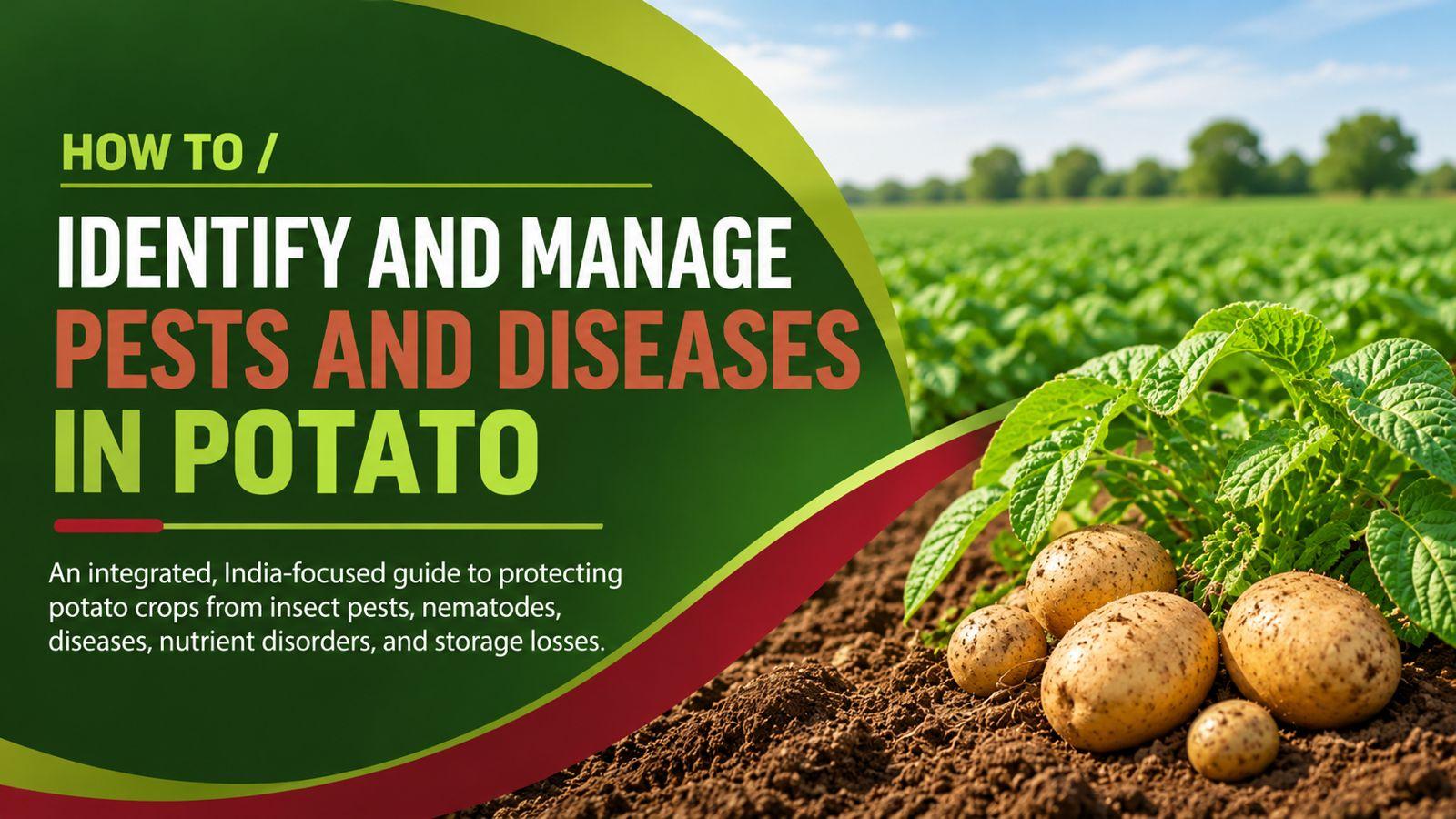
Potato (Solanum tuberosum L.) is one of the four major food crops of the world and a key cash and food crop for India. The crop is grown on about 1.5 million hectares, mainly as a Rabi (winter) crop in the plains, with major cultivation in Uttar Pradesh, West Bengal, Bihar, Gujarat, Madhya Pradesh, Punjab, Haryana, Assam and Karnataka. India is the world's second-largest potato producer after China. Popular varieties such as Kufri Jyoti, Kufri Pukhraj, Kufri Bahar, Kufri Badshah, Kufri Chandramukhi and the processing types Kufri Chipsona-1 to 4 are widely grown; several, like Kufri Girdhari, carry useful resistance to late blight.
Potato does best when maximum temperatures stay below 35°C and night temperatures below 20°C, with ideal tuberisation between 16–22°C. The crop faces pressure from sap-sucking insects, tuber- and leaf-feeding caterpillars, nematodes, and several fungal, bacterial and viral diseases — late blight alone can destroy a crop within days under cool, humid weather. Identifying trouble early and acting at the right crop stage is the key to a healthy, profitable harvest.
This guide follows the AESA (Agro-Ecosystem Analysis) based IPM approach recommended by NIPHM: observe the field weekly, weigh the pest-to-defender (P:D) ratio, rely first on cultural, mechanical and biological measures, and use chemicals only as a last resort when the P:D ratio crosses 2:1.
Major insect pests of potato
1. Aphids (Myzus persicae, Aphis gossypii)
Aphids are small, soft-bodied, sap-sucking insects and the most important pests of potato in India — not so much for direct feeding as for spreading viruses.
Symptoms of damage:
- Nymphs and adults puncture tender leaves and shoots and suck sap; leaves fail to open fully and stay small.
- Severe infestation causes shoots to wilt and dry.
- Honeydew secretion leads to black sooty mould on leaves, reducing photosynthesis.
- Indirect damage is worse: winged aphids carry Potato Virus Y (PVY) and Potato Leaf Roll Virus (PLRV) from plant to plant.
Favourable conditions: Relative humidity around 66% and temperature of 11–14°C are ideal; populations fall sharply when humidity rises above 73%.
Cultural control: Use healthy, certified seed; plant early-bulking or early-maturing cultivars so the seed crop escapes peak aphid flights; practise green manuring and balanced fertiliser use.
Mechanical control: Set up yellow sticky/pan traps 15 cm above the canopy @ 4–5 traps/acre for whitefly and blue traps for thrips, and scout five leaves per plant weekly.
Biological control: Spray NSKE 5%. Conserve ladybird beetles, lacewings, hoverflies and aphid parasitoids (Aphidius colemani, Diaeretiella sp.).
Chemical control: When the threshold is crossed, spray thiamethoxam 25% WG @ 40 g in 200 l of water/acre, or apply it as a soil drench @ 80 g in 200 l water/acre. Rotate chemical classes to prevent resistance.
Threshold monitoring made simple: Using Fyllo Smart Sticky Traps, growers can track aphid, whitefly, thrips and leafhopper populations digitally and get alerts for the specific pest — with the spray chemical names, required quantity and schedule — when numbers cross the threshold, directly on their phone via the Fyllo App. Since aphids are also the main virus carriers in potato, catching their build-up early helps protect seed-crop health.
2. Potato tuber moth (Phthorimaea operculella)
The potato tuber moth is the most destructive pest of potato in the field and especially in storage. The small greyish-brown moth lays 150–200 eggs on the underside of leaves or on exposed tubers near the eyes.
Symptoms of damage:
- Larvae mine inside leaves, leaving a dried-up outer skin, and tunnel into stems.
- In tubers, larvae bore irregular galleries and tunnels; larval faeces are visible near bore holes.
- Severe damage occurs in storage, making tubers unmarketable.
Favourable conditions: 22–28°C and 60–70% relative humidity; 8–9 overlapping generations in a year.
Cultural control: Plant seed tubers 10 cm deep; ridge the crop 6–7 weeks after planting so tubers stay at least 25 cm below the surface; give timely irrigation to prevent soil cracking that exposes tubers; grow intercrops such as cowpea, onion, maize, coriander or urdbean (1:2 ratio) and repellent basil (Ocimum); store only healthy tubers in moth-proof structures.
Biological control: Inundative release of Trichogramma pretiosum @ 0.4 lakh/acre, 4–5 times at weekly intervals from flower initiation. Conserve Copidosoma koehleri and Chelonus blackburni.
Sticky traps are for flying sap-suckers; tuber moth is monitored with pheromone traps @ 4–5/acre, with lures changed every 2–3 weeks.
3. Jassids / leafhoppers (Amrasca devastans, Empoasca fabae)
Wedge-shaped, pale-green hoppers that suck sap from the underside of leaves.
Symptoms of damage: Both nymphs and adults suck sap; leaves curl, turn pale and bronze ("hopper burn"), and dry up.
Favourable conditions: Temperature 27–36°C and relative humidity below 75%.
Cultural and mechanical control: Grow tolerant varieties; keep fields clean; use yellow sticky traps for monitoring. The same sucking-pest sprays (NSKE 5%, and the thiamethoxam recommended for aphids) help manage leafhoppers when populations are high.
4. Whitefly (Bemisia tabaci)
Tiny white-winged insects dusted with waxy powder, found on the underside of leaves. A key vector of potato leaf curl disease.
Symptoms of damage: Chlorotic spots, yellowing, downward curling and drying of leaves; honeydew and sooty mould.
Favourable conditions: 28–36°C, 62–92% relative humidity, and scanty rainfall from August to January.
Cultural and mechanical control: Grow peppermint as a repellent border; remove alternate hosts; install yellow sticky/pan traps @ 4–5/acre, 15 cm above the canopy. Fyllo Smart Sticky Traps automate the counting of whitefly, aphids and other flying pests caught on these traps, so you no longer have to inspect and count insects by hand each day. Conserve Encarsia formosa and Eretmocerus spp.
Other pests of potato
| Pest | Key damage | Main control measure |
|---|---|---|
| Cutworm (Agrotis segetum) | Larvae sever young stems at night and drag plant parts into the soil; bore holes in tubers; worst at 25–35 days after planting | Place rice-bran heaps in the evening and destroy larvae next morning; flood the field before planting where possible; conserve Trichogramma |
| Tobacco caterpillar (Spodoptera litura) | Early larvae scrape leaves to a papery white; later make irregular holes and cause heavy defoliation | Grow castor as a trap crop; release Trichogramma pretiosum @ 20,000/acre/week (4 times); spray NSKE 5% on eggs/early larvae; apply EPNs |
| Gram pod borer (Helicoverpa armigera) | Caterpillars make irregular holes in leaves, then skeletonise them | Release Trichogramma pretiosum @ 20,000/acre/week (4 times); spray NSKE 5% against eggs and first-instar larvae |
| White grub (Lachnosterna spp.) | Grubs feed on roots then make large, shallow, circular holes in tubers | Entomopathogenic nematodes (EPNs) @ 1 billion/acre in infested fields; summer deep ploughing |
| Leafminer (Liriomyza huidobrensis) | Larvae mine inside leaves; severe infestation leaves only upper and lower leaf skins | Usually not of economic importance; yellow sticky traps catch the adult flies; conserve Diglyphus isaea, Chrysocharis pentheus |
| Spider mites (Polyphagotarsonemus latus) | Leaves turn reddish-brown and bronzy; fine silken webbing; leaves wither and dry | Grow flowering plants (carrot family, French bean) to attract predatory mites; conserve Orius and anthocorid bugs |
| Root-knot and cyst nematodes (Meloidogyne sp.; Globodera spp.) | Root swelling, wilting in heat; misshapen, warty tubers; patchy, stunted, yellowing plants | Plant in the 2nd week of October / early January; grow African marigold (Tagetes) between potato rows; apply NSKE 4% and neem cake @ 80 kg/acre |
Major diseases of potato
1. Late blight (Phytophthora infestans)
Late blight is the single most dangerous disease of potato — it can kill an entire crop within two or three days under favourable weather.
Symptoms: Leaves appear blistered, as if scalded by hot water, then turn brown-black and rot; a white, floury growth appears on the underside of leaves in humid weather; stems blacken from the tips; tubers show dry, brown spots on skin and flesh.
Favourable conditions: High humidity, low temperature and leaf wetness. A forecast model warns of blight within 10 days when a 7-day moving sum of RH >85% lasts at least 90 hours together with temperatures of 7.2–26.6°C for at least 115 hours.
Cultural control: Use short-duration and resistant varieties (e.g. Kufri Girdhari); plant disease-free tubers; destroy infected debris; avoid dense canopies.
Chemical control: Spray a protectant such as mancozeb 75% WP @ 600–800 g in 300 l water/acre, or copper oxychloride 50% WP @ 1 kg in 300–400 l water/acre. Under disease pressure, use a systemic combination like cymoxanil 8% + mancozeb 64% WP @ 600–800 g in 200–300 l water/acre, metalaxyl 8% + mancozeb 64% WP @ 0.25% (1 kg/acre) in 400 l water, dimethomorph 50% WP @ 400 g in 300 l water/acre, or azoxystrobin 23% SC @ 200 ml in 200 l water/acre. Rotate chemical groups between sprays.
2. Early blight (Alternaria solani)
Symptoms: Small black lesions on older foliage that enlarge into spots with a characteristic "bull's-eye" pattern of concentric rings; surrounding tissue yellows; stem lesions can girdle the plant. Symptoms usually appear during tuber bulking.
Favourable conditions: Warm, rainy, wet weather.
Chemical control: Mancozeb 75% WP @ 600–800 g in 300 l water/acre, chlorothalonil 75% WP @ 350–500 g in 240–320 l water/acre, copper oxychloride 50% WP @ 1 kg in 300–400 l water/acre, or hexaconazole 2% SC @ 1.2 l in 200 l water/acre, repeated as the label directs.
3. Common scab (Streptomyces scabies)
Symptoms: Rough, cracked, corky, scab-like lesions on the tuber surface; severe infections leave rough black welts. Purely a surface/quality problem, but it lowers market value.
Favourable conditions: Low soil pH, high soil moisture; aggravated by excessive irrigation.
Control: Use healthy tubers and treat seed tubers with 3% boric acid for 30 minutes before storage; maintain steady soil moisture from tuber initiation; rotate with wheat, peas, oats, barley or green-manure crops. Seed treatment with thiram 75% WS @ 25 g/l water.
4. Black scurf / canker (Rhizoctonia solani)
Symptoms: Black, soil-like crusts (scurf) on tubers — cosmetic and does not reduce yield — but the fungus also blinds stolons and kills sprouts, reducing stand and yield.
Favourable conditions: High temperature and moisture.
Control: Treat seed tubers with carbendazim 25% + mancozeb 50% WS @ (1.5 + 3.0) to (1.75 + 3.5) per 10 kg seed, or carboxin 37.5% + thiram 37.5% DS at the same rate; use healthy seed; follow crop rotation.
5. Bacterial wilt (Ralstonia solanacearum)
Symptoms: Wilting from leaf tips inward; yellowing at leaf bases; a brown ring when the stem is cut; cut tubers show black-brown rings that ooze thick white fluid; fluid and soil stick to tuber eyes.
Favourable conditions: High temperature, high soil moisture, low pH.
Control: Use pathogen-free tubers; disinfect cutting knives with 1% sodium hypochlorite; apply lime (dolomite) to correct acidity; apply neem cake @ 80 kg/acre. Where needed, give 2–3 sprays of (streptomycin sulphate 9% + tetracycline hydrochloride 1%) SP @ 40–50 ppm at 20-day intervals, first spray 30 days after planting.
6. Other diseases — Septoria leaf spot, viral diseases, soft rot, black heart
- Septoria leaf spot: Small grey-centred spots with dark margins on lower leaves; manage with field sanitation and protectant fungicide.
- Viral diseases (PVX, PVS, PVY, PLRV): Mosaic, mottling, leaf roll and stunting; controlled by managing aphid and whitefly vectors and using virus-free seed.
- > Black leg and soft rot (Erwinia*): Rotting of lower stem and tubers through wounds; avoid physical damage and cool, damp storage.
- Black heart: A storage disorder from oxygen shortage; keep cold storage well aerated at 4°C or slightly higher.
Common nutrient deficiencies in potato
A well-nourished crop resists pests and diseases better, and many "disease-like" symptoms are actually nutrient disorders. Correct them based on a soil test.
| Nutrient | Key symptom | Correction measure |
|---|---|---|
| Nitrogen (N) | Uniform yellowing of whole leaf including veins; older leaves yellow | Foliar 2% urea thrice at fortnightly intervals, or soil N per soil test |
| Phosphorus (P) | Stunting; purpling of stem, petiole, leaf undersides; necrotic spots on older leaves | Soil-apply recommended P at sowing/planting |
| Potassium (K) | Crinkled (rugose) leaves; marginal/tip burn; scorched, bronzed look | Foliar K₂SO₄ @ 1% |
| Sulphur (S) | General chlorosis with reddish veins; erect, brittle leaves | Gypsum @ 100 kg/acre in soil; foliar K₂SO₄ or CaSO₄ @ 1% |
| Magnesium (Mg) | Interveinal chlorosis and scorching on young mature leaves | Foliar 0.2% MgSO₄ |
| Zinc (Zn) | Interveinal necrosis; young leaves yellow, mature leaves pitted | Foliar ZnSO₄ @ 0.5% |
| Boron (B) | Brittle leaves, rosetting, wilting of young leaves | Foliar borax @ 0.2% |
| Iron (Fe) | Interveinal chlorosis of youngest leaves, bleaching to white | Soil FeSO₄ @ 10 kg/acre or foliar 0.5% FeSO₄ |
Manganese, molybdenum, calcium and copper deficiencies also occur; correct them with the respective sulphate/borax sprays only on the basis of a soil test — never apply micronutrient mixtures blindly.
Crop-stage-wise IPM calendar
Pre-sowing
- Summer deep ploughing and soil solarisation; field sanitation and rogueing; avoid waterlogging; follow crop rotation.
- Apply FYM @ 8 t/acre or vermicompost @ 4–6 t/acre; add 2 kg each of Azospirillum and Phosphobacterium with 10 kg FYM/acre.
- Apply neem cake @ 80 kg/acre; raise African marigold in the nursery against cyst nematode; cover beds with 0.45 mm polythene for three weeks against soil-borne pests.
- Grow 4 guard rows of maize/sorghum/bajra around the field and start ecological-engineering border plants.
Sowing / planting
- Use resistant varieties and healthy, certified, weed-free seed tubers.
- Apply 48 kg N, 16 kg P₂O₅, 48 kg K₂O per acre (N and K in two splits — half basal, half at 30 days).
- Treat seed tubers against black scurf/common scab (carbendazim + mancozeb WS, or carboxin + thiram DS; or 3% boric acid for 30 min).
- Apply the pre-emergence herbicide oxyfluorfen 23.5% EC @ 170–340 ml in 200–300 l water/acre within 3–4 days of sowing.
Vegetative and tuber development
- Apply the second split of N and K at 30 days after planting, with earthing-up.
- Scout weekly (AESA); collect and destroy infested parts, egg masses and early larvae; hand-pick older larvae.
- Install yellow and blue sticky traps @ 4–5/acre, pheromone traps @ 4–5/acre, light traps @ 1/acre (6–10 pm), and bird perches @ 20/acre. Fyllo Smart Sticky Traps at this stage automatically identify and count flying pests (whitefly, aphids, thrips, leafhoppers) and send threshold alerts with spray guidance to the Fyllo App — so sprays are timed to real field counts, not the calendar.
- Begin protectant fungicide cover if weather favours late/early blight; rotate chemical groups.
- > Release Trichogramma pretiosum* for tuber moth and caterpillars as moth catches rise.
Harvest and post-harvest
- Harvest 80–115 days after planting; leave tubers 2–3 weeks after top death to mature the skin; cover exposed tubers with soil.
- Cure tubers in heaps in a cool, shaded place for 10–15 days; remove cut/damaged/rotten tubers before storage.
- Treat seed tubers with 3% boric acid for 30 minutes; store seed in moth-proof structures; keep cold storage well-aerated at ~4°C to avoid black heart.
Role of natural enemies in potato pest management
Protecting the natural enemies already present in the field is the cheapest, most durable way to keep pests in check.
Parasitoids: Trichogramma spp., Chelonus blackburni and Copidosoma koehleri (tuber moth); Aphidius colemani and Diaeretiella sp. (aphids); Encarsia formosa and Eretmocerus spp. (whitefly); Diglyphus isaea and Chrysocharis pentheus (leafminer); Ceranisus menes (thrips).
Predators: Ladybird beetles, lacewings (Chrysoperla), hoverflies, spiders, predatory mites, minute pirate bugs (Orius), reduviid and big-eyed bugs, earwigs, ground beetles; and birds such as the black drongo (king crow) and common mynah.
How to conserve them:
- Avoid broad-spectrum sprays when the P:D ratio is below 2:1.
- Grow border and intercrop flowering plants — sunflower, mustard, coriander, buckwheat, cowpea, French bean.
- Do not spray chemicals within 7 days of releasing parasitoids.
- > Use biopesticides (NSKE, Trichoderma, Pseudomonas*, EPNs) as the first line of treatment.
Simplify pest and disease management with Fyllo
Managing potato means tracking several sap-suckers, caterpillars, nematodes and fast-moving blights across the season — and the virus-carrying aphids and whiteflies need to be caught before they spread disease. Doing all this by manual scouting is slow and easy to get wrong.
Fyllo Smart Sticky Traps use AI-based image recognition to automatically identify and count the flying pests that land on the trap — whitefly, aphids, thrips and leafhoppers. The counts sync to the Fyllo App in real time, so you get live pest numbers and threshold alerts on your phone, along with the right chemical, the correct dose and the spray interval for your stage and region. The app also tracks your spray history to help you rotate chemical groups and avoid resistance, and turns a soil-test report into a stage-wise nutrient plan.
This means spraying only when needed, at the right dose — lower input cost, less wasted chemical, and healthier tubers. See how this fits into potato crop management.
Key takeaways for potato growers
- Scout weekly and use the P:D ratio. Follow AESA, count pests and defenders, and spray chemicals only when the ratio crosses 2:1.
- Late blight is the number-one threat. Watch cool, humid, leaf-wet weather, use resistant short-duration varieties, and keep up a protectant fungicide cover with rotated groups.
- Protect the seed crop from viruses. Aphids and whiteflies spread PVY, PVS and leaf roll — control the vectors early and plant virus-free, certified seed.
- Guard tubers from the tuber moth. Plant deep, ridge and earth-up so tubers stay buried, irrigate to prevent soil cracking, and store only healthy tubers in moth-proof structures.
- Treat seed and feed by soil test. Seed-treat against scab and black scurf, apply balanced NPK and FYM, and correct nutrient deficiencies only on the basis of a soil test.
Conclusion
Healthy potato depends on clean seed, steady monitoring, balanced nutrition, and need-based protection through the whole season. Combine cultural, mechanical and biological measures first, and use chemicals judiciously only when the field situation demands it. Always follow the product label for approved doses and pre-harvest intervals, and check with your local KVK or State Agriculture Department for region-specific advice. Tools like Fyllo Smart Sticky Traps and the Fyllo App can make this process simpler, more accurate and more affordable.