What does precision farming actually mean?
Precision farming is often reduced to "using technology on the farm," but that is too loose to be useful. Precisely, it is the practice of deciding how much water, fertiliser and pesticide to apply — and when and where — based on data measured in your own field, rather than a calendar schedule or a district-level average.
The organising principle is simple: the right input, in the right amount, at the right time, in the right place. A calendar says "irrigate every third day." A soil-moisture sensor says "the root zone is still at 65% capacity — wait." Those are two different ways of farming, and the second is precision farming.
This makes it one specific branch of the broader smart-farming umbrella. Drones, digital marketplaces, satellite mapping and farm robotics are all smart farming; precision farming is the narrower discipline of input decisions grounded in field measurement.
Key Takeaways
- Precision farming is input decisions driven by measured field data — not the calendar.
- > It fits Indian smallholders better* than large farms: the margin for error on 2 acres is proportionally larger.
- Its two pillars are sensing (soil, weather, canopy) and intelligence (crop models, ML) — neither works alone.
- Field-ready IoT devices now start at ₹5,999–₹8,999, recoverable inside a single season on high-value crops.
- Fyllo runs 24,000+ installed devices across 12 countries and 35+ crops, with 90% year-on-year customer retention.
What are the two pillars of precision farming?
Precision farming stands on two legs and collapses without either.
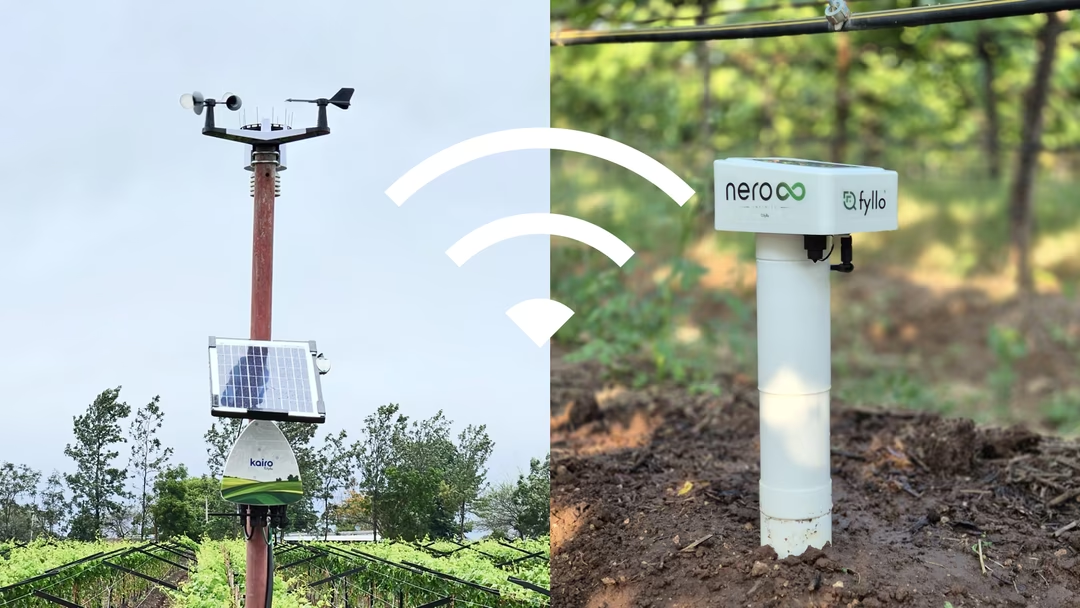
Sensing is the measurement layer: soil-moisture sensors at the root zone, weather stations, leaf-wetness sensors, canopy-temperature readings — instruments that see what the eye cannot. Soil that looks dry on top may be saturated 30 cm down; a leaf looks healthy hours before disease is visible.
Intelligence is the interpretation layer: crop models, machine-learning algorithms and agronomic knowledge bases that turn raw numbers into a decision — "irrigate now," "spray tomorrow morning," "hold fertiliser for three days."
A sensor without a model is a stream of numbers no farmer has time to read. A model without ground-truth data is just theory. The value is in the pairing — which is how Fyllo's devices and agronomy models are designed to work together.
Why does precision farming fit India better than people assume?
The common objection is that precision farming is built for 500-acre American farms with GPS tractors, and irrelevant to a 2-acre Indian holding. The reality is the opposite.
On a small farm the margin for error is smaller, not larger. A mistimed spray that costs ₹50,000 is the same ₹50,000 whether the farm is 2 acres or 20 — but on 2 acres it is a far bigger share of the season's income. Precision that prevents that one mistake matters more to the smallholder, not less.
India's high-value horticulture — grapes, pomegranate, citrus, mango — has the per-acre economics to justify sensor investment easily. And cost has collapsed: field-ready devices now start at ₹5,999 (Nero Pulse) to ₹8,999 (Nero Infinity), recoverable within a single season on these crops.
How does precision farming actually work on the farm?
The farmer's experience, end to end:
Installation. A device goes into the field — Nero Infinity connects instantly over a built-in eSIM, with no WiFi and no technician required.
Data flow. The sensor reads field conditions on a short cycle, sends them to the cloud, and surfaces a plain-language alert on the farmer's phone.
Irrigation. The decision to irrigate is triggered by actual root-zone soil moisture, not a calendar — where most of the water savings come from.
Disease prediction. Leaf wetness, temperature and humidity patterns can flag disease pressure before symptoms are visible, giving a head start of a day or more.
Spray timing. Delta-T-based spray windows keep spraying out of wasted conditions and away from imminent rain that would wash it off.
Fertigation. Nutrient application is matched to crop stage and soil data instead of a fixed routine.
Weather. A farm-level forecast beats a district-level IMD bulletin for irrigation and spray decisions, because weather 15 km away is often not the weather in your field. This is what Fyllo's DeepMet 1 rainfall prediction is built for.
What does precision farming look like crop by crop in India?
The practice is crop-specific, because the decisions that matter differ by crop.
Grapes (Maharashtra / Karnataka). Irrigation scheduling through berry development, downy-mildew prediction and export-quality management are the high-stakes calls. Fyllo's agronomy work on this crop includes berry-cracking prediction. See our grape solution.
Pomegranate. Bacterial blight (telya) management through weather-based prediction, Bahar management and fruit-cracking prevention are where data pays off. See our pomegranate solution.
Sugarcane. A water-intensive crop where precision irrigation shows some of the most dramatic savings.
Chilli. Thrips and mite prediction and spray-cost optimisation — the subject of Fyllo's early-detection work on Thrips parvispinus. See our chilli solution.
Citrus. Dry-root-rot management and irrigation in water-scarce regions.
How much water does precision farming actually save?
Water deserves its own section, because it is where precision farming has the largest measurable impact in India.
Indian agriculture consumes the overwhelming majority of the country's freshwater, and most of that goes to irrigation. Traditional flood and furrow methods waste a large share of every litre applied. Precision irrigation — driven by soil-moisture monitoring rather than habit — reduces consumption substantially across crop types. In practice this looks like a farmer moving from hours of blind irrigation to a short, targeted cycle triggered by an actual moisture reading.
What government support exists for precision farming in India?
Precision farming has real institutional backing, which matters for adoption economics.
India's first large-scale precision-farming initiative was the Tamil Nadu Precision Farming Project, followed by a national network of Precision Farming Development Centres. ICAR research programmes have contributed low-cost tools and precision nutrient-management studies. Micro-irrigation subsidies cover a significant share of drip and sprinkler installation cost, and state horticulture missions increasingly support sensor adoption.
What real, measured outcomes come from Indian farms?
This is where first-party field data matters — most articles on this topic quote only industry averages. Fyllo operates 24,000+ installed devices across 12 countries and 35+ crops, and sustains 90% customer retention year on year — itself the clearest evidence that the value holds up over multiple seasons rather than a single pilot. Documented on-farm outcomes span meaningful water savings, reduced spray counts and costs, and yield and quality improvements.
What are the honest limitations?
Precision farming is not a silver bullet, and saying so builds more trust than overclaiming.
It still requires basic agronomic knowledge and a willingness to act on the data — the alert only helps the farmer who follows it. Devices need basic mobile-network coverage, which eSIM helps with but does not fully solve everywhere. Farmers reasonably want to see one season of results before committing fully. Not every crop has an equally mature prediction model yet, and models trained in one region may need calibration for another.
What's next for precision farming in India?
The frontier is moving from single-farm decisions toward aggregated intelligence: farm-level crop insurance powered by individual-farm sensor data instead of area averages; AI advisory in farmers' own languages (Fyllo's Dharti AI is one example); community deployment models where one device serves a cluster of neighbouring farms; integration of prediction with drone-based precision spraying; and climate-risk intelligence at institutional scale for governments and insurers.
Where to go next
- Smart farming in India — the full technology landscape
- Why precision farming matters for your farm
- How to choose an agritech platform
- IoT vs traditional farming


