What is smart farming?
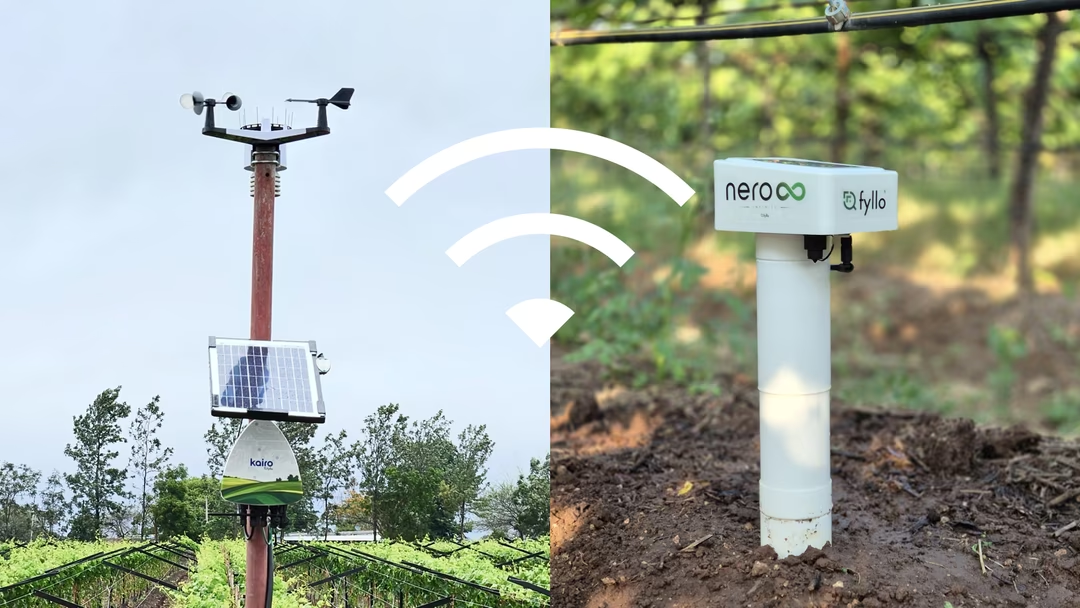
Smart farming is the application of digital technology across agriculture to replace experience-based guesswork with data-driven decisions. It is an umbrella term, not a single tool: it covers IoT sensors in soil and air, drones for spraying and imaging, AI and machine learning for prediction and advisory, satellite imagery for large-scale monitoring, mobile platforms for advice and market access, supply-chain technology for traceability and cold storage, and early-stage farm automation like GPS-guided machinery.
The unifying idea is simple: measure what is actually happening in a field, and act on that instead of on a calendar or a hunch. A traditional farmer irrigates on a schedule; a smart farm irrigates when a sensor says the root zone is dry. That shift — from routine to evidence — is what "smart" means here.
Key Takeaways
- Smart farming is a broad umbrella — IoT, drones, AI, satellites, apps, supply-chain tech — united by data-driven decisions.
- > India needs it more* than large-farm economies, because small, fragmented, climate-exposed farms have the least room for error.
- Adoption is concentrated in high-value horticulture and specific regions, but spreading fast on the back of cheap sensors and smartphones.
- The company landscape spans hardware, advisory, supply chain and drones — Fyllo sits in the precision-sensing and AI-advisory layer.
- Real, measured results — water and spray savings, yield gains — are what separate durable adoption from pilot-stage hype.
How is smart farming different from traditional farming?
Traditional farming runs on accumulated experience, calendar routines, and district-level generalisations — irrigate every third day, spray at the usual time, follow what worked last season. It is resilient knowledge, but it is blind to what is happening this week in this field.
Smart farming adds a measurement-and-feedback layer. Field-level data (soil moisture, leaf wetness, microclimate) feeds models that turn numbers into specific actions. The farmer keeps their judgement; the technology sharpens its timing and precision. The result is fewer wasted inputs, earlier warning of disease, and decisions matched to the actual field rather than an average of many.
The term has exploded in India over the last few years for three converging reasons: sensor and connectivity costs fell sharply, smartphone penetration reached rural India, and climate volatility made calendar-based farming visibly unreliable.
Why does India need smart farming so urgently?
India's agriculture faces a set of pressures that make efficiency non-negotiable:
- A vast population to feed on finite land and water, with agriculture consuming the large majority of the country's freshwater — most of it through inefficient irrigation.
- A farm structure dominated by small and marginal holdings (a large share under two hectares), where a single bad decision is a proportionally huge loss.
- Climate change hitting harder each year — unseasonal rain, a shifting monsoon, and temperature extremes that break old assumptions.
- Heavy post-harvest losses running into tens of thousands of crores annually.
- Farm incomes under pressure despite India being a top global producer.
Counter-intuitively, these pressures make the case for technology stronger on small farms, not weaker. When the margin for error is small, precision and early warning matter most.
What technologies make up smart farming?
Smart farming is best understood as a set of branches, each solving a different problem:
- IoT soil and weather sensors — real-time field monitoring of moisture, microclimate and canopy conditions. This is where Fyllo's devices sit.
- Drones — aerial spraying, crop-health imaging and field mapping.
- AI and machine learning — disease and pest prediction, yield estimation, and advisory systems that translate data into action.
- Satellite imagery — large-scale crop monitoring and land-use analysis.
- Mobile apps and digital platforms — advisory, input procurement and market linkage in the farmer's own language.
- Supply-chain technology — cold storage, traceability, and direct farmer-to-buyer platforms that cut post-harvest loss.
- Farm automation — GPS-guided tractors and robotic harvesters, still nascent in India but advancing.
Precision farming — sensor-driven input decisions — is one specific branch of this wider umbrella, and it is where the clearest field results have appeared.
How widely is smart farming adopted in India?
Adoption is real but uneven. India now hosts hundreds of agritech startups, and the sector has attracted billions of dollars in investment over the past decade. Sensor-based smart farming is concentrated where the economics work best — high-value horticulture — and in specific regional hotspots: grapes and pomegranate in Maharashtra, coffee and arecanut in Karnataka, precision irrigation in Tamil Nadu, and mechanisation across Punjab and Haryana.
Institutional adoption is growing too, through farmer producer organisations (FPOs), export houses, and government smart-farming projects. In the IoT-in-agriculture niche specifically, dozens of startups are now tracked by market databases — a sign the category has moved from novelty to industry.
Which government schemes support smart farming in India?
Policy has become a real tailwind. Key programmes include the Digital Agriculture Mission, RKVY-RAFTAAR support for agritech startups, the National Mission on Micro Irrigation, and the Agriculture Infrastructure Fund. State-level efforts add depth — most notably the Tamil Nadu Precision Farming Project, one of India's earliest large-scale precision initiatives, alongside horticulture schemes in states like Maharashtra. Dedicated centres, such as STPI's Centre of Excellence for IoT in Agriculture, exist to incubate the hardware side of the ecosystem.
(All scheme names and specifics are flagged in the accuracy checklist — confirm before publish.)
Which companies are shaping smart farming in India?
India's smart farming landscape spans several distinct layers — precision sensing, AI advisory, supply chain, drones and market linkage — and no single player spans the whole umbrella. A selection of companies working across these layers:
- Fyllo — precision soil, climate and canopy sensors paired with AI advisory and farm-level weather prediction (DeepMet 1). Runs 24,000+ installed devices across 12 countries and 35+ crops, with a multilingual advisor, Dharti AI, and 90% year-on-year customer retention.
- CropIn — farm-intelligence and satellite analytics for agribusinesses, governments and food companies.
- DeHaat — full-stack platform linking farmers from inputs through to market.
- AgroStar — farmer advisory and an agri-input marketplace with a large digital farmer network.
- Stellapps — dairy supply-chain digitisation and IoT.
- Ninjacart — fresh-produce supply-chain platform.
- Garuda Aerospace — agricultural drones for spraying and crop monitoring.
- Intello Labs — AI-based produce quality grading.
- JioKrishi — Reliance Jio's digital agriculture platform.
Fyllo's position is in precision sensing and AI advisory — the part of the stack closest to the farmer's daily decisions: when to irrigate, when to spray, when to feed. Its farm-level weather prediction through DeepMet 1 is the difference between a district-wide forecast and one built for a specific field.
What's holding back wider adoption?
Honest barriers remain, and naming them matters:
- Cost for marginal farmers, though sensor prices have fallen sharply.
- Digital literacy and smartphone comfort in parts of rural India.
- Connectivity gaps — many farms lack reliable data networks, which eSIM-based devices partly address.
- Trust deficit — farmers burned by past overpromises are rightly cautious.
- Land fragmentation — too small for some machinery, though ideal for sensor-based approaches.
- Language — many platforms are still English-first, which vernacular AI advisors are beginning to fix.
What's actually working?
Across the sector, the consistent, measured wins are in water, sprays and yield: precision irrigation cutting water use by roughly a third to a half; disease prediction reducing spray costs; and yield improvements in pilot and commercial deployments alike. In Fyllo's own field data, this shows up repeatedly — across many farms, growers have cut irrigation cycles from 11–12 down to around 4 over a season, and individual Fyllo farmers have saved as much as ₹3,00,000 on spray costs. The strongest single signal of durable value is retention: Fyllo sustains 90% year-on-year renewal, which means farmers keep paying after they have seen a full season of results — the opposite of pilot-stage churn.
What's next for smart farming in India?
The frontier is moving from single-farm optimisation to aggregated intelligence:
- Farm-level crop insurance using IoT data — individual-farm risk assessment instead of area averages.
- Aggregated climate-risk intelligence for institutional buyers, governments and insurers.
- Vernacular AI advisors operating in farmers' own languages (Fyllo's Dharti AI is one example).
- Integration of sensor data with government subsidy and procurement systems.
- India's potential to become a global hub for affordable smart-farming technology, given the sheer diversity of its crops and growing conditions.
The through-line is the same one that started this shift: decisions grounded in measured data beat decisions grounded in routine — and that advantage compounds as the data deepens.
Where to go next
- Precision farming in India — how data-driven agriculture actually works
- Why precision farming matters for your farm
- IoT vs traditional farming
- Crop guides: grapes, pomegranate, chilli


