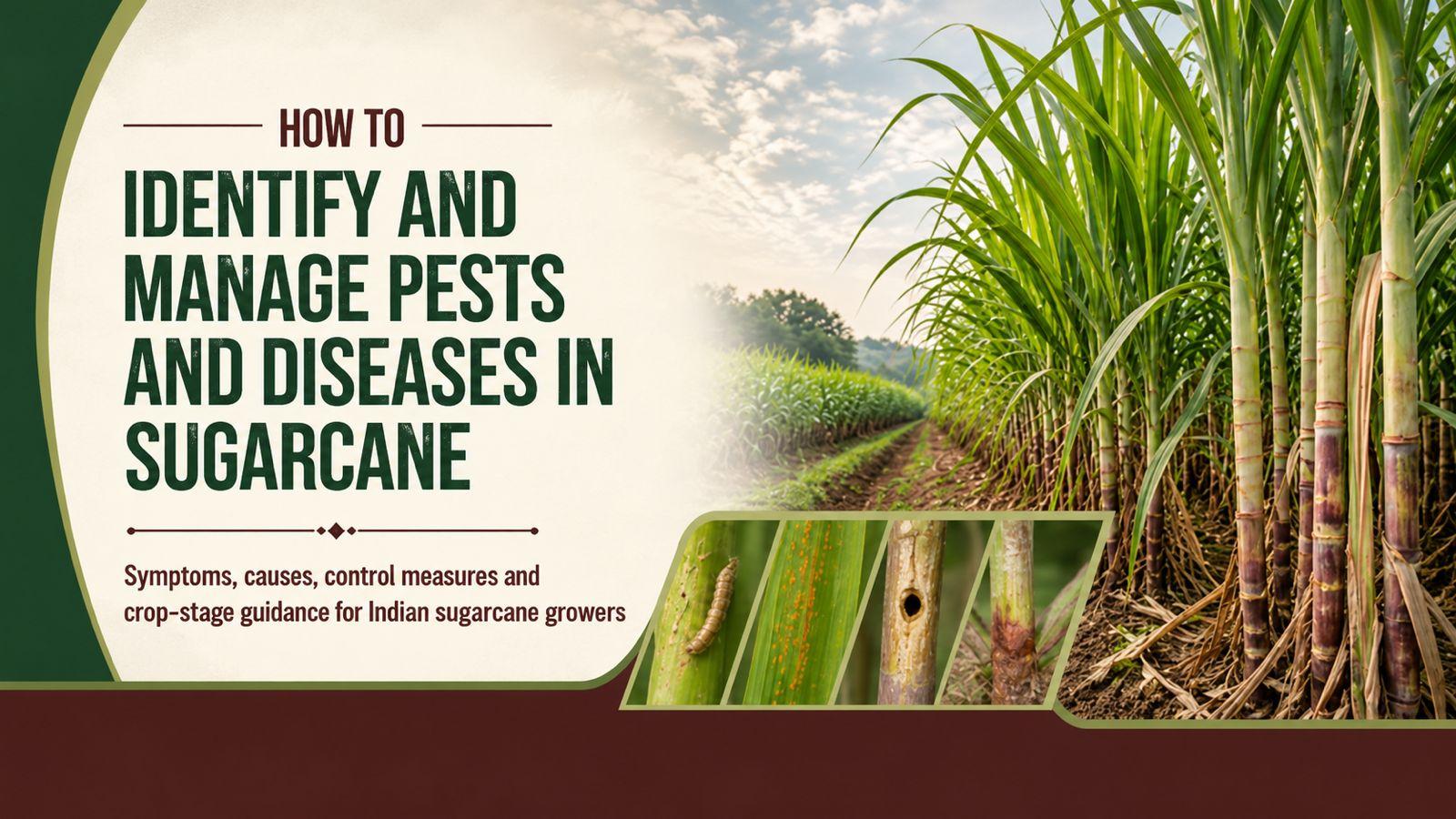
India is the world's second-largest sugarcane producer. Cane is grown in two broad belts: the tropical belt (Maharashtra, Karnataka, Tamil Nadu, Andhra Pradesh, Gujarat, Madhya Pradesh) and the subtropical belt (Uttar Pradesh, Bihar, Haryana, Punjab). Maharashtra and Uttar Pradesh together supply most of the country's sugar, and over 500 sugar mills depend on a steady supply of healthy, sugar-rich cane.
Average yields are around 60–70 tonnes per hectare, but they can range from 30 to 180 tonnes depending on how well the crop is managed. Much of that gap comes from pests and diseases. Borers cause dead hearts and hollow canes, sucking pests drain sap and sugar, and diseases like red rot can wipe out an entire field in a wet season.
This guide follows the integrated pest management (IPM) approach recommended by the National Institute of Plant Health Management (NIPHM). It covers how to identify each problem, what favours it, how to manage it with cultural, mechanical, biological and chemical methods, and what to do at each crop stage.
Major insect pests of sugarcane
1. Early shoot borer (Chilo infuscatellus)
Symptoms: Dead hearts appear in 1–3-month-old crop. The dried central shoot pulls out easily and its rotten base gives off a foul smell. Several bore holes are visible at the base of the shoot, just above ground level.
Favourable conditions: Hot, dry weather in the early growth phase, poor irrigation, and fields left with stubble and trash from the previous crop.
Cultural and mechanical control:
- Deep summer ploughing, timely irrigation and light earthing-up about three months after planting.
- Intercrop with onion, garlic or coriander; in ratoons, mulch with cane trash.
- Pull out and destroy dead hearts along with the larvae inside.
- Install pheromone traps @ 4–5 per acre for monitoring and a light trap @ 1 per acre (with an exit for natural enemies).
Biological control: Release Trichogramma chilonis @ 20,000 per acre at 10-day intervals when the pest appears, or release 125 gravid females of the tachinid parasitoid Sturmiopsis inferens per acre.
Chemical control (only when needed): Chlorantraniliprole 18.5% SC @ 150 ml in 400 litres of water per acre, or fipronil 5% SC @ 600–800 ml in 200 litres per acre, or chlorantraniliprole 0.4% GR @ 7.5 kg per acre.
2. Top shoot borer (Scirpophaga excerptalis)
Symptoms: A row of parallel shot holes on emerging leaves, a red tunnel in the midrib, and a dead heart in grown-up canes that cannot be pulled out easily. Later the top develops a bunchy appearance.
Control:
- Collect and destroy egg masses (buff-coloured hairy clusters under top leaves), adult moths and dead hearts.
- Time pheromone traps @ 4–5 per acre to brood emergence; use a light trap @ 1 per acre.
- > Release Trichogramma* spp. @ 20,000 per acre, 2–3 times at 10-day intervals.
- If needed, chlorantraniliprole 18.5% SC @ 150 ml in 400 litres of water per acre.
- Tolerant varieties include Co 419, Co 745, Co 6516, Co 859, Co 1158 and Co 7224.
3. Internode, stalk, pink and Plassey borers
Symptoms: Internodes become short and constricted, with bore holes and frass at the nodes. The inside of the cane turns red, and both cane weight and juice quality drop.
Control:
- Detrash the canes and remove water shoots every month from the 5th month onwards; avoid lodging with proper water management.
- Use balanced fertiliser; avoid excess nitrogen.
- Set pheromone traps at spindle level from the 5th month @ 4–5 per acre on a 15-metre grid, and change the lures twice at 45-day intervals.
- > Release Trichogramma chilonis* @ 20,000 per acre, six times at fortnightly intervals from the 4th month.
- If needed, chlorpyrifos 20% EC @ 500–600 ml in 200–400 litres of water per acre.
4. Sugarcane woolly aphid (Ceratovacuna lanigera)
Symptoms: White, woolly colonies on the underside of leaves. Leaves develop whitish patches that turn yellow, then dry from the tip and edges. Heavy honeydew leads to black sooty mould, and white woolly matter is clearly visible on the soil below infested clumps.
Favourable conditions: Excess nitrogen, dense planting, humid weather, and transporting infested tops or setts to new fields.
Monitoring: Set up yellow sticky traps 15 cm above the canopy @ 4–5 per acre and count the catch daily. The recommended action point is more than 100 insects per trap.
Threshold monitoring: Using Fyllo Smart Sticky Traps, growers can track woolly aphid and whitefly numbers digitally and get alerts on their phone through the Fyllo App when counts cross the threshold — along with the spray chemical name, required quantity and schedule for that specific pest.
Control:
- Use paired-row planting, avoid excess nitrogen and prefer organic manures.
- Detrash infested canes, remove water shoots and never use infested canes as seed.
- > Conserve natural enemies — Dipha aphidivora, Micromus igorotus, syrphid flies and the parasitoid Encarsia flavoscutellum* are very effective and often bring the pest under control on their own.
- > Encourage beneficial fungi such as Verticillium lecanii, Metarhizium and Beauveria bassiana*.
5. Whitefly (Aleurolobus barodensis)
Symptoms: Leaves turn yellow, then pinkish or purple, and slowly dry. Infested leaves look white with black dots (the pupae).
Favourable conditions: Water stress, waterlogging, low-lying fields and poor nitrogen management.
Control:
- Clip infested leaves and detrash puparia-bearing leaves; dispose of them immediately so adults cannot emerge.
- Avoid both water stress and waterlogging; avoid planting in low-lying areas.
- Use yellow sticky traps for monitoring. Fyllo Smart Sticky Traps make this easier because they count the whiteflies automatically, so you don't have to check every trap by hand.
- Grow tall border crops such as maize, sorghum or pearl millet.
- > Conserve Encarsia, Eretmocerus*, lacewings, ladybird beetles, mirid bugs and spiders.
6. Pyrilla (Pyrilla perpusilla)
Symptoms: Nymphs and adults suck sap from the leaves, which turn yellow and become covered with black sooty mould on the honeydew. Sugar recovery falls sharply.
Control:
- Avoid late application of nitrogen and remove dry lower leaves.
- Collect egg masses and keep them in cages so that parasitoids can emerge.
- > When 3–5 pyrilla per leaf are seen, release 3,200–4,000 cocoons (or 3.2–4.0 lakh eggs) of the parasitoid Epiricania melanoleuca per acre, and move Epiricania* from well-stocked fields to scanty ones.
- If needed, chlorpyrifos 20% EC @ 600 ml in 200–400 litres of water per acre.
7. Termites and white grubs
Symptoms: Termites leave semi-circular feeding marks on leaves; setts become hollow and filled with soil, and canes collapse if disturbed. White grubs (C-shaped, creamy grubs in the root zone) cause yellowing, wilting and drying of the whole clump, which comes off easily when pulled.
Control:
- Remove stubble and debris; locate termite mounds and destroy the queen.
- Use light traps to catch white grub beetles, and shake the host trees at night after the first monsoon rains to collect adults.
- > Apply entomopathogenic nematodes @ 100 million per acre, or bury four EPN-infected Galleria/Corcyra* cadavers per plant in May–June and/or September.
- Termite: chlorantraniliprole 18.5% SC @ 200–250 ml or clothianidin 50% WDG @ 100 g in 400 litres of water per acre.
- White grub: fipronil 40% + imidacloprid 40% WG @ 175–200 g in 400–500 litres of water per acre.
Other important pests
| Pest | Typical signs | Priority response |
|---|---|---|
| Root borer | Dead hearts that do not pull out easily; bore holes below soil level | Same cultural steps as early shoot borer; earthing-up and trash mulch |
| Black bug | Yellowing and drying of young leaves, mainly in ratoons in hot weather | Trash mulching, irrigation; quinalphos 25% EC @ 800 ml/acre only if needed |
| Mealybug | Pinkish insects with mealy coating under leaf sheaths at the nodes; sooty mould | Detrash, remove water shoots, drain excess water, conserve ladybird beetles |
| Scale insect | Grey-black scales crusting the nodes; tip drying, shrivelled canes | Healthy setts, detrash at 150 and 210 days, avoid repeated ratoons, release coccinellids |
| Mites | Red patches on leaves, later drying | Conserve predatory mites; avoid water stress |
| Nematodes | Yellow patches, stunting, stubby roots | Pressmud @ 6 t/acre or neem cake @ 0.8 t/acre; Pochonia or Paecilomyces @ 4 kg/acre at planting |
| Rats | Cut and gnawed canes, lodging | Clean bunds, burrow smoking, owl perches @ 5–6 per acre, bromadiolone bait |
Monitoring rules for all insect pests
- Walk the field every week. Check 5 random spots and 5 plants at each spot, not just the edge rows.
- For shoot borer, record the percentage of dead hearts every 30 days up to 120 days after planting.
- Use pheromone, light and sticky traps for early warning, together with field checks. Traps don't replace field checks.
- Follow the pest-to-defender (P:D) ratio. If there are at least half as many natural enemies as pests (a 2:1 ratio or better), spraying is usually not needed.
Major diseases of sugarcane
1. Red rot (Colletotrichum falcatum)
Symptoms: The 3rd and 4th leaves from the top dry out, followed by the whole crown. When the cane is split open, the inside is red with white cross-bands and has a sour, alcoholic smell. Later the canes become hollow and black dots appear on the rind.
Favourable conditions and spread: It spreads mainly through infected setts and soil, then through rain splash, irrigation water and floods. In the rainy season it can spread so fast that not a single millable cane is left.
Management:
- Plant resistant or moderately resistant varieties (for example Co 89029, CoSe 92423, CoSe 95422, CoH 2201, BO 128). Check with the local KVK or sugar mill for the current recommendation in your area.
- Discard any sett showing redness at the cut ends or nodes.
- Use setts from nurseries raised after moist hot air treatment (54 °C for 2.5 hours at 99% humidity).
- Uproot and burn affected clumps with their roots.
- Build bunds around affected fields so floodwater doesn't carry the disease to healthy fields.
- Avoid ratooning a diseased crop, harvest it early, and rotate crops.
2. Smut (Sporisorium scitamineum)
Symptoms: A black, whip-like structure, 25–150 cm long, grows from the top of the cane. It is covered with a silvery membrane full of black powdery spores. Affected canes are thin with many lateral shoots and narrow, erect leaves, which is especially common in ratoons.
Spread: Through infected setts first, then wind-blown spores, rain and irrigation water.
Management: Use healthy, heat-treated setts and smut-tolerant varieties. Carefully remove the whips in a cloth bag before they burst, and burn them. Avoid ratooning badly infected fields.
3. Wilt (Fusarium and Acremonium spp.)
Symptoms: Leaves gradually yellow and dry and canes shrink. When split, the inside is purplish-brown and pithy, with boat-shaped cavities in the internodes. It appears during and after the monsoon, singly or in small patches.
Management: Healthy setts, sett treatment with Trichoderma, good drainage, removal of affected clumps and crop rotation.
4. Grassy shoot (phytoplasma)
Symptoms: Many thin tillers with narrow, pale yellow or white leaves grow from the base of the clump, making it look like grass. Canes rarely form, and if they do they are thin with short internodes.
Spread: Through infected setts, cutting knives and ratooning. Aphids and other sucking insects act as vectors.
Management: Plant heat-treated, disease-free setts, rogue out affected clumps and avoid ratooning infected fields. Yellow sticky traps help keep the aphid vectors in check. Fyllo Smart Sticky Traps show when aphid numbers start rising, so you can act before the disease spreads.
5. Leaf scald and red stripe (bacterial)
Symptoms: In leaf scald, thin white "pencil lines" with yellow borders run along the leaf veins, and pale patches spread across the leaf. In red stripe, long, narrow, dark red stripes appear on the leaves, with whitish bacterial flakes on the underside; the top of the shoot may rot.
Spread: Cutting knives, infected stubble and setts, and wind and rain. Stress from drought, waterlogging or cold makes both diseases worse.
Management: Disinfect cutting tools, use healthy setts, remove affected clumps and avoid ratooning diseased fields.
Other diseases
| Disease | Typical signs | Priority response |
|---|---|---|
| Pokkah boeng | Yellow, wrinkled, twisted young leaves; top rot; knife-cut marks on the rind | Remove affected tops; avoid excess nitrogen in humid, cloudy weather |
| Rust | Small yellow spots turning red-brown; leaves look rusty | Resistant varieties; balanced nutrition |
| Mosaic | Green and yellow mosaic pattern on young leaves | Healthy setts; disinfect knives; avoid ratooning infected crop |
| Yellow leaf disease | Yellow midrib on the underside of leaves 3–6 from the top, mostly October–March | Virus-free seed cane; monitor and manage the aphid vectors |
Nutrient deficiencies and fertiliser schedule
| Nutrient | What you see | What to do |
|---|---|---|
| Nitrogen | Leaves light green to yellow; short, thin stalks | Soil N or foliar urea 1–2%, twice at weekly intervals |
| Phosphorus | Red-purple leaf tips and edges; poor tillering | Foliar DAP 2%, twice at fortnightly intervals |
| Potassium | Yellow-orange leaf edges; older leaves look "fired"; bunched top | Foliar KCl 1%, twice at fortnightly intervals |
| Iron | Yellowing between the veins from tip to base | FeSO₄ @ 10 kg/acre in soil, or foliar 0.5% at 90, 105 and 120 days |
| Zinc | Yellow leaf blade with green midrib; short internodes | Zinc sulphate @ 15 kg/acre before the last ploughing |
| Magnesium | Rusty spots, mottling at leaf tips | MgSO₄ @ 10 kg/acre in soil, or foliar 2% twice |
NPK schedule (kg/acre):
| Time of application | Adsali (N-P-K) | Pre-seasonal (N-P-K) | Seasonal/Ratoon (N-P-K) |
|---|---|---|---|
| At planting | 20-40-40 | 15-34-34 | 14-28-28 |
| 6–8 weeks after planting | 80-0-0 | 65-0-0 | 55-0-0 |
| 12–16 weeks after planting | 20-0-0 | 15-0-0 | 14-0-0 |
| At earthing-up | 80-40-40 | 65-34-34 | 55-28-28 |
| Total | 200-80-80 | 160-68-68 | 138-56-56 |
Always base fertiliser doses on a soil test. Too much nitrogen makes the crop soft and attracts woolly aphid, pyrilla and borers.
Crop-stage-wise pest and disease management calendar
| Crop stage | Priority actions | Nutrition, water and protection |
|---|---|---|
| Pre-planting | Deep summer ploughing; stale seedbed; remove stubble; destroy termite mounds | FYM 8–10 t/acre treated with Trichoderma, or pressmud 2 t/acre; green manure with sunhemp or dhaincha |
| Planting | Healthy, heat-treated setts of a tolerant variety; discard reddened setts; paired-row planting | Sett treatment with biofertilisers @ 5 kg/acre; zinc sulphate @ 10 kg/acre; nematode bio-agents @ 4 kg/acre |
| Tillering (0–4 months) | Weekly scouting for dead hearts; pheromone traps @ 4–5/acre; Trichogramma releases; keep weeds out for the first 120 days | Top-dress N as per schedule; trash mulch @ 2 t/acre at 45 days; light earthing-up at 3 months. Install Fyllo Smart Sticky Traps to watch for woolly aphid and whitefly from the start |
| Grand growth / cane formation (4–9 months) | Detrash monthly from the 5th month; remove water shoots; watch for pyrilla, woolly aphid, whitefly, internode borer and red rot | Avoid late nitrogen; prevent lodging and waterlogging; six Trichogramma releases for stalk borers |
| Maturity and harvest | Rogue out diseased clumps; harvest at peak maturity, cutting at ground level | Remove late shoots; deliver cane to the mill quickly |
| After harvest / ratoon | Don't burn trash (it protects natural enemies); shave stubble; avoid ratooning diseased or borer-hit fields | Incorporate residues; review trap and scouting records before planning the ratoon |
Natural enemies and resistant varieties
Natural enemies are the backbone of sugarcane IPM. Trichogramma (egg parasitoid) and Cotesia flavipes (larval parasitoid) attack borers. Epiricania controls pyrilla. Dipha, Micromus, syrphid flies and Encarsia control woolly aphid. Ladybird beetles, lacewings, spiders, reduviid bugs, dragonflies and praying mantises feed on many pests.
How to protect them:
- Avoid broad-spectrum sprays, especially as a preventive measure.
- Grow intercrops such as cowpea, onion, garlic and coriander, and flowering border plants such as sunflower, marigold and mustard, which feed and shelter beneficial insects.
- Don't burn trash after harvest.
- > Move parasitoids such as Epiricania* from well-stocked fields to scanty ones.
Tolerant varieties (examples from NIPHM):
- Shoot borer: Co 312, Co 421, Co 661, Co 917, Co 853.
- Internode borer: Co 975, Co 7304, CoJ 46.
- Smut: Co 86032, Co 87025, Co 91010, CoM 88121.
Always confirm the latest recommendation for your zone with the local KVK, sugar mill or state agricultural university.
Fyllo Smart Sticky Traps and the Fyllo App
In sugarcane, many problems first show up as flying insects. Whitefly and woolly aphid build up quickly, and aphids spread grassy shoot and yellow leaf disease. NIPHM recommends yellow sticky traps @ 4–5 per acre, with action when catches cross 100 per trap.
Fyllo Smart Sticky Traps do this counting for you. The trap photographs what it catches, AI identifies and counts the pests, and the numbers appear in the Fyllo App. When counts cross the threshold you get an alert on your phone, along with the recommended chemical, dose and timing.
The Fyllo App also keeps your scouting notes, weather, crop-stage advisories and spray history in one place. The traps and the app support your decisions; they don't replace field inspection, correct identification or label instructions. See how this fits into sugarcane crop management.
Key takeaways
- Start clean: use healthy, heat-treated setts of a tolerant variety, and discard any sett with red discolouration.
- Scout weekly and use pheromone, light and sticky traps to catch problems early.
- Detrash, remove water shoots and avoid excess or late nitrogen. This cuts down borers, woolly aphid, pyrilla and whitefly together.
- > Protect natural enemies: release Trichogramma and Epiricania* when needed, and don't burn trash.
- Spray only when monitoring shows it's needed, rotate chemical groups, and avoid ratooning diseased fields.
Conclusion
Healthy sugarcane comes from a system, not a single spray. The parts work together:
- clean, heat-treated seed cane
- tolerant varieties
- weekly scouting and trap monitoring
- timely detrashing
- balanced nutrition
- protection of natural enemies
Together they keep borers, sucking pests and diseases below damaging levels while protecting cane weight and sugar recovery.
Turn this guide into a plan for your own field: map your plots, scout weekly, record trap and disease observations, and act early while a problem is still small.
Pesticide registrations change over time, so check every chemical against its current label and local recommendations. Consult your local KVK, sugar mill cane officer or agricultural university before applying pesticides or fertilisers, and always follow the label dose and safety instructions.


