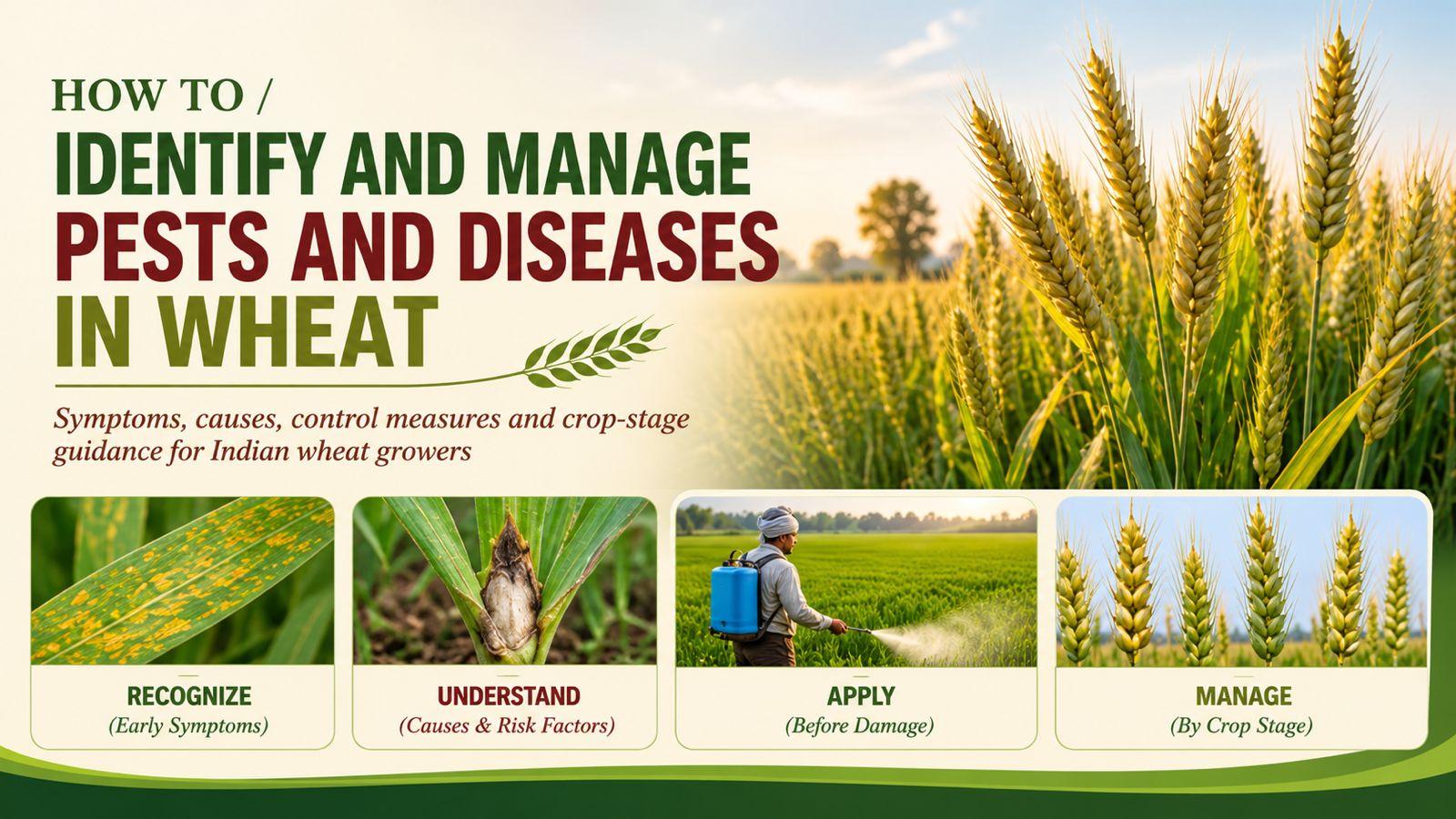
India is first in the world in wheat area and second in production, after China. Uttar Pradesh leads, followed by Punjab, Haryana, Madhya Pradesh, Rajasthan, Bihar, Maharashtra, Gujarat and West Bengal. The crop is sown from October to December and harvested between February and May, depending on the zone. Popular varieties include HD 2687, PBW 550, WH 1105, HD 2501, GW 322, Lok 1 and HS 420.
Early identification matters. Brown rust alone can cut yields by up to 30%, shoot fly can infest up to 60% of young plants, and smuts and bunts carried in seed spoil both yield and grain quality. Most of these problems are far cheaper to prevent at sowing than to fix later.
This guide follows the AESA-based integrated pest management (IPM) approach recommended by the National Institute of Plant Health Management (NIPHM): how to identify each problem, what favours it, how to manage it, and what to do at each crop stage.
Major insect and mite pests of wheat
1. Wheat aphid (Sitobion avenae, S. miscanthi)
Symptoms: Small, soft-bodied green aphids cluster on young leaves and ears and suck the sap, especially from the ears. Damage is worst in cold, cloudy weather, and populations peak in February–March when the ears are ripening.
Favourable conditions: Cloudy, cool weather and a heavily manured, well-irrigated, succulent crop, which holds the pest for longer.
Monitoring: Set up yellow sticky traps 15 cm above the canopy @ 4–10 traps (15 × 7.5 cm) per acre and count the aphids daily. In the field, count nymphs and adults on three leaves (top, middle and bottom) per plant.
Threshold monitoring: Using Fyllo Smart Sticky Traps, growers can track aphid and thrips populations digitally and get alerts for the specific pest, with the spray chemical names, required quantity and schedule, when numbers cross the threshold, directly on their phone via the Fyllo App.
Cultural control:
- Grow mustard as a barrier crop, or tall border crops such as maize, sorghum or millet.
- Avoid excess nitrogen and over-irrigation.
Biological control: Conserve natural enemies: the parasitoids Aphidius and Aphelinus, and predators such as syrphid flies, lacewings, ladybird beetles, minute pirate bugs and rove beetles.
Chemical control (only when needed): Quinalphos 25% EC @ 400 ml in 200–400 litres of water per acre, or thiamethoxam 25% WG @ 20 g in 200 litres of water per acre.
2. Termites (Odontotermes obesus, Microtermes obesi)
Symptoms: Termites attack soon after sowing and sometimes near maturity, feeding on roots and stems. Damaged plants dry up completely and pull out easily; plants hit later produce white ears.
Favourable conditions: Unirrigated fields and fields where undecomposed farmyard manure was applied before sowing.
Control:
- Do three summer ploughings at 10-day intervals, apply only well-rotted FYM, and avoid late sowing.
- Destroy crop residues, dismantle termite mounds around the field and kill the queen.
- Apply neem cake @ 80 kg per acre.
- Chemical: treat seed with chlorpyrifos 20% EC @ 3–4 ml per kg of seed, or apply it to the soil @ 0.8–1.2 litres per acre.
3. Shoot fly (Atherigona naqvii, A. oryzae)
Symptoms: Maggots bore into young shoots from about a week after germination to a month, and the central shoot dries up as a "dead heart". Side tillers may also be attacked. Infestation can reach 60%.
Control:
- Monitor regularly and grow mustard as a barrier crop or tall border crops such as maize, sorghum or millet.
- Use fish meal traps for monitoring, and destroy crop residues that carry the pest over.
- If needed, cypermethrin 10% EC @ 220 ml in 200–320 litres of water per acre, or phorate 10% CG @ 7.5 kg per acre.
4. American pod borer (Helicoverpa armigera) and armyworm (Mythimna separata)
Symptoms: Helicoverpa larvae feed on leaves, then hollow out the earheads. Armyworm larvae chew leaves from the edges to the midrib at dawn and dusk, and in heavy attacks cut the neck just below the ear.
Monitoring: Install pheromone traps @ 4–5 per acre, one foot above the canopy, and replace the lures every 20–25 days. The ETL is 8–10 moths per trap per day. Count larvae per tiller and the percentage of infested plants.
Cultural and mechanical control:
- Grow intercrops such as cowpea, onion, maize, coriander or urdbean in a 1:2 ratio, and plant 4 rows of sorghum or maize all around as a guard crop.
- Rotate wheat with a non-host cereal, cucurbit or cruciferous vegetable.
- Erect bird perches @ 4–8 per acre at earhead stage, and a light trap @ 1 per acre (6–10 pm).
Biological control: Conserve spiders, coccinellids, lacewings and syrphid flies, or release Trichogramma pretiosum @ 0.4 lakh per acre, 4–5 times at weekly intervals from flower initiation.
Chemical control:
Helicoverpa*: quinalphos 25% EC @ 640 ml in 200–400 litres of water per acre.
* Armyworm: carbaryl 50% WP @ 800 g in 200 litres of water per acre, or dichlorvos 76% EC @ 112.8–150.4 ml in 200–400 litres of water per acre.
5. Brown mite (Petrobia latens)
Symptoms: Tiny (0.5 mm) metallic brown-black mites suck sap from leaves. Leaves turn whitish, then reddish-brown and bronzy, and finally wither and dry.
Control:
- Grow tolerant varieties such as C 306.
- Spray neem oil (2%) or NSKE (5%).
- > Conserve predatory mites, Stethorus* beetles, lacewings and lady bugs.
- If needed, quinalphos 25% EC @ 640 ml in 200–400 litres of water per acre.
Other important pests
| Pest | Typical signs | Priority response |
|---|---|---|
| Pink stem borer (Sesamia inferens) | Rows of oblong holes on unfolding leaves, dead hearts in young plants, white ears at earhead stage | Bird perches @ 10 per acre; conserve Trichogramma, Telenomus, spiders; dichlorvos 76% EC @ 112.8–150.4 ml/acre only if needed |
| Wheat thrips (regional) | Tiny brown-black insects in the flag-leaf sheath and ears; silvery patches on tissue | Blue sticky traps @ 4–10 per acre for monitoring; conserve predatory thrips and hoverflies |
| Ghujhia weevil (Uttar Pradesh) | Grey, flightless weevils cut germinating seedlings at ground level in October–November, often forcing resowing | Summer ploughing, clean cultivation, common cultural and biological practices |
Major diseases of wheat
1. Rusts: brown, yellow (stripe) and black
Symptoms:
- Brown (leaf) rust: Small, round, orange-brown pustules scattered on the upper leaf blades. Severe infection causes up to 30% yield loss.
- Yellow (stripe) rust: Bright yellow to orange-yellow pustules arranged in long, narrow stripes along the leaves; also on sheaths, necks and glumes.
- Black (stem) rust: Dark reddish-brown pustules on stems, leaf sheaths, both leaf surfaces and spikes, giving a ragged, torn look as they burst.
Favourable conditions: Brown rust spreads at 20–25°C with rain or dew; yellow rust at 10–20°C with high humidity; black rust above 20°C with moisture. Spores blow in each season from the Himalayan and southern hills, and survive on volunteer wheat.
Control:
- Grow rust-resistant varieties recommended for your zone (see the variety table below).
- Avoid excess nitrogen, and use mixed cropping and crop rotation.
- Chemical: propiconazole 25% EC @ 200 ml in 200 litres of water per acre, or tebuconazole 25% EC @ 200 ml in 200 litres of water per acre, or thiophanate methyl 70% WP @ 286 g in 300–400 litres of water per acre.
2. Loose smut (Ustilago tritici)
Symptoms: Infected heads emerge earlier than healthy ones, and the whole ear turns into a mass of olive-black spores, first covered by a thin grey membrane and later powdery. The fungus hides inside healthy-looking seed.
Favourable conditions: Cool, humid weather during flowering.
Control:
- Solar seed treatment: soak the seed in cold water on a hot summer morning, keep it in the sun from 8 am to 12 noon, then dry it, taking care not to harm germination.
- Uproot plants whose boot-leaf tips turn yellow before the ears emerge; they usually produce smutted ears.
- Seed treatment: carbendazim 50% WP @ 2 g per kg of seed, or carboxin 75% WP @ 2–2.5 g per kg, or carboxin 37.5% + thiram 37.5% DS @ 3 g per kg.
3. Karnal bunt (Tilletia indica)
Symptoms: Hard to spot in the field because only a few grains per head are infected. Symptoms are clearest on the seed after harvest, where some grains are partly converted into black spore masses.
Favourable conditions: 18–20°C and high soil moisture; low-lying, waterlogged patches are most prone.
Control:
- Level the land and drain it well; avoid irrigation between awn emergence and the end of flowering.
- Use a lower seed rate and wider row spacing, and avoid lodging with balanced nitrogen and potash.
- Rotate with non-host crops; plastic mulching or solarisation reduces spore germination.
- Chemical: propiconazole 25% EC @ 200 ml in 300 litres of water per acre.
4. Flag smut and hill bunt
Symptoms: Flag smut causes twisting and drooping of leaves, with grey to black stripes of powdery spores on leaf blades and sheaths. Hill bunt (stinking smut) turns the grain into dark-green spore balls; diseased plants mature early.
Favourable conditions: Flag smut: 18–24°C and humidity above 65%; spores survive in soil for over 10 years. Hill bunt: 18–20°C and high soil moisture.
Control: Use clean seed and treat it with carboxin 75% WP @ 2–2.5 g per kg of seed. Rotate crops and remove infected plants.
5. Powdery mildew (Blumeria graminis)
Symptoms: Greyish-white powdery patches on leaves, sheaths, stems and floral parts, which later turn into black lesions and dry the leaves.
Favourable conditions: High humidity (not necessarily rain) and cool to moderate temperatures of 20–21°C.
Control: Most current varieties lack adequate resistance, so watch closely in hot-spot pockets. If needed, triadimefon 25% WP @ 200 g in 300 litres of water per acre.
Other important diseases
| Disease | Typical signs | Priority response |
|---|---|---|
| Leaf blight / spot blotch (Alternaria triticina, Bipolaris sorokiniana) | Reddish-brown oval spots with a yellow margin, merging and drying the leaves; worse in humid, high-rainfall areas | Certified seed, timely sowing, crop rotation; thiophanate methyl 70% WP @ 286 g in 200 litres of water per acre |
| Head scab (Fusarium graminearum) | Bleached, tan spikelets with an orange fungal mass at the glume base; shrivelled, chalky or pink grain | Remove crop debris; avoid wet, cool conditions at flowering where possible |
Nematodes, weeds and rodents
Nematodes
Seed gall nematode and tundu (Anguina tritici*): Crinkled, twisted leaves, swollen stem bases and dark seed galls (cockles) in place of grain; with tundu, a yellow slimy ooze on the ear. Clean the seed by sieving or by floating it in a 2% salt solution, which removes almost 100% of galls.
Cereal cyst (molya) nematode (Heterodera avenae*): Stunted, shrivelled plants with short, bunchy roots. Grow the resistant variety Raj MR 1, rotate with non-hosts such as gram, mustard, cumin, carrot or onion for 3 years, and do three summer ploughings at 10-day intervals.
Weeds
The worst are canary grass (Phalaris minor) and wild oat, plus broadleaf weeds such as lambsquarters, fumitory, sweet clover and jangali palak. Use the stale seedbed technique or zero tillage, and hand weed early.
- For broadleaf weeds, apply 2,4-D dimethyl amine salt 58% SL @ 0.344–0.416 litres in 200–240 litres of water per acre.
- > For wild oat, Phalaris and Poa*, apply isoproturon 50% WP @ 0.8 kg in 300 litres of water per acre.
- Remove leftover weeds at earhead stage so they don't shed seed.
Rodents
Rats cause 3–5% loss, cutting tillers at a 45° slant 5–10 cm above the ground. Practise clean cultivation, smoke burrows, put up owl perches, and bait as a community with bromadiolone 0.005% @ 10 g per re-opened burrow. Use 2% zinc phosphide bait, after pre-baiting, only where there are more than 20 live burrows per acre.
Nutrient deficiencies and fertiliser schedule
| Nutrient | Deficiency symptoms |
|---|---|
| Nitrogen (N) | Pale green to yellow plants; yellowing starts on lower leaves and moves up; spindly stems, slow growth |
| Phosphorus (P) | Darker-green plants with purple colour on the leaf underside; poor tillering, thin stems, late maturity |
| Potassium (K) | Yellowing and scorched margins on older leaves; weak stems that lodge |
| Zinc (Zn) | Yellowing between veins on new leaves, stunted plants with few tillers, whitish-brown spots on middle leaves |
Fertiliser schedule (on soil-test basis):
- Apply FYM @ 4 t per acre 2–3 weeks before sowing, or vermicompost @ 2 t per acre one week before sowing.
- Treat seed with Azotobacter culture @ 200 g per acre.
- The general recommendation is 60 kg N, 25 kg P₂O₅ and 20 kg K₂O per acre.
- Apply one-third of the N and the full P and K at sowing, one-third of the N with the first irrigation and the last third with the second irrigation.
- Spray deficient micronutrients as soon as symptoms appear.
Crop-stage-wise IPM calendar
| Crop stage | Main risks | Key actions |
|---|---|---|
| Pre-sowing (summer) | Soil-borne diseases, nematodes, termites, weeds | Deep summer ploughing, soil solarisation, field sanitation, crop rotation with non-cereals, mustard border, well-rotted FYM only |
| Sowing and seedling | Loose smut, bunts, flag smut, seed gall nematode, termites, shoot fly, ghujhia weevil | Timely sowing, certified seed, solar or fungicide seed treatment, 2% brine flotation, Pseudomonas seed treatment, chlorpyrifos for termites |
| Vegetative / tillering | Aphids, thrips, shoot fly, pink borer, brown mite, rusts, powdery mildew, leaf blight, weeds | Yellow and blue sticky traps @ 4–5 per acre, pheromone traps @ 4–5 per acre, light trap, bird perches @ 20 per acre, weekly AESA, herbicides, rust sprays only on detection |
| Earhead and grain fill | Aphids on ears, Helicoverpa, armyworm, Karnal bunt, loose smut, head scab | Moth counts against ETL, Trichogramma releases, rogue smutted plants, no irrigation from awn emergence to end of flowering |
| Harvest and storage | Shattering, sprouting, storage insects, rodents | Timely harvest, avoid cracking grain, store at below 12.5% moisture and below 10°C, community rodent baiting |
Fyllo Smart Sticky Traps can replace manual daily counts of aphids and thrips during the vegetative and earhead stages, sending alerts when catches rise.
Natural enemies and resistant varieties
Spray only when the pest-to-defender (P:D) ratio is unfavourable; NIPHM's general rule is 2:1. Key defenders are the parasitoids Trichogramma, Bracon, Campoletis, Aphidius and Aphelinus, and predators such as ladybird beetles, lacewings, syrphid flies, spiders, predatory mites and birds like the black drongo.
Ecological engineering: Grow flowering plants such as marigold, sunflower, mustard and buckwheat on bunds, use maize or sorghum borders, and apply Trichoderma and Pseudomonas fluorescens to seed and soil.
Rust-resistant varieties (examples from NIPHM):
| Zone | Varieties |
|---|---|
| Northern Hills | HS 420, HS 277, HS 295, HPW 251, VL 892 |
| North-Western Plains | WH 542, HD 2687, PBW 550, WH 896, WH 1105 |
| North-Eastern Plains | HP 1102, UP 262, HUW 206, K 8804 |
| Central Zone | GW 190, GW 273, GW 322, DL 803-3, Lok 1 |
| Peninsular Zone | HD 2501, MACS 2496, DWR 162, HW 971, HW 2022 |
Always confirm the latest recommendation for your zone with the local KVK, state agricultural university or ICAR institute.
Fyllo Smart Sticky Traps and the Fyllo App
In wheat, aphids and thrips are the main flying pests to watch. Aphids build up fast in cold, cloudy weather and settle on the ears just when the grain is filling. NIPHM recommends yellow sticky traps for aphids and blue traps for thrips, with catches counted daily.
Fyllo Smart Sticky Traps do this counting for you. The trap photographs what it catches, AI identifies and counts the pests, and the numbers appear in the Fyllo App. When counts cross the threshold, you get an alert on your phone, along with the recommended chemical, dose and timing.
The Fyllo App also keeps your scouting notes, weather, crop-stage advisories and spray history in one place. The traps and the app support your decisions; they don't replace field inspection, correct identification or label instructions. See how this fits into wheat crop management.
Key takeaways
- Start with certified seed of a rust-resistant variety for your zone, and treat it against smuts, bunts and seed gall nematode before sowing.
- Sow on time. Late sowing raises the risk from termites, shoot fly and several diseases.
- Scout weekly and use yellow, blue and pheromone traps to catch aphids, thrips and moths early.
- Avoid excess nitrogen and waterlogging; they invite aphids, rusts and Karnal bunt.
- Protect natural enemies and spray only when monitoring shows it is needed, rotating chemical groups.
Conclusion
Healthy wheat comes from a system, not a single spray: certified, treated seed of a resistant variety, timely sowing, weekly scouting and trap monitoring, balanced nutrition and irrigation, and protection of natural enemies. Together they keep rusts, smuts, sucking pests and caterpillars below damaging levels.
Turn this guide into a plan for your own field: map your plots, scout weekly, record trap and disease observations, and act early while a problem is still small.
Pesticide registrations change over time, so check every chemical against its current label and local recommendations. Consult your local KVK or state agricultural university before applying pesticides or fertilisers, and always follow the label dose and safety instructions.


