The Problem We Solve
India's agricultural sector consumes nearly 80% of the country's freshwater, yet most farms still irrigate on gut feel and calendar schedules rather than data. Fertilizers are over-applied by 15 to 30%, and pesticide sprays are either applied preventively without any actual pest threat or delayed until after pests have already damaged the crop — by which point the sprays are far less effective. The result is wasted water, degrading soil, rising input costs for farmers, and an environmental footprint that grows every season.
For corporates looking at meaningful CSR interventions, this is both a crisis and an opportunity. The question is no longer whether technology can help, but whether it can deliver measurable, scalable, and auditable impact.
A recent CSR project by PI Industries across three agricultural clusters in Maharashtra has answered that question with hard numbers.
The CSR Initiative by PI Industries, Powered by Fyllo
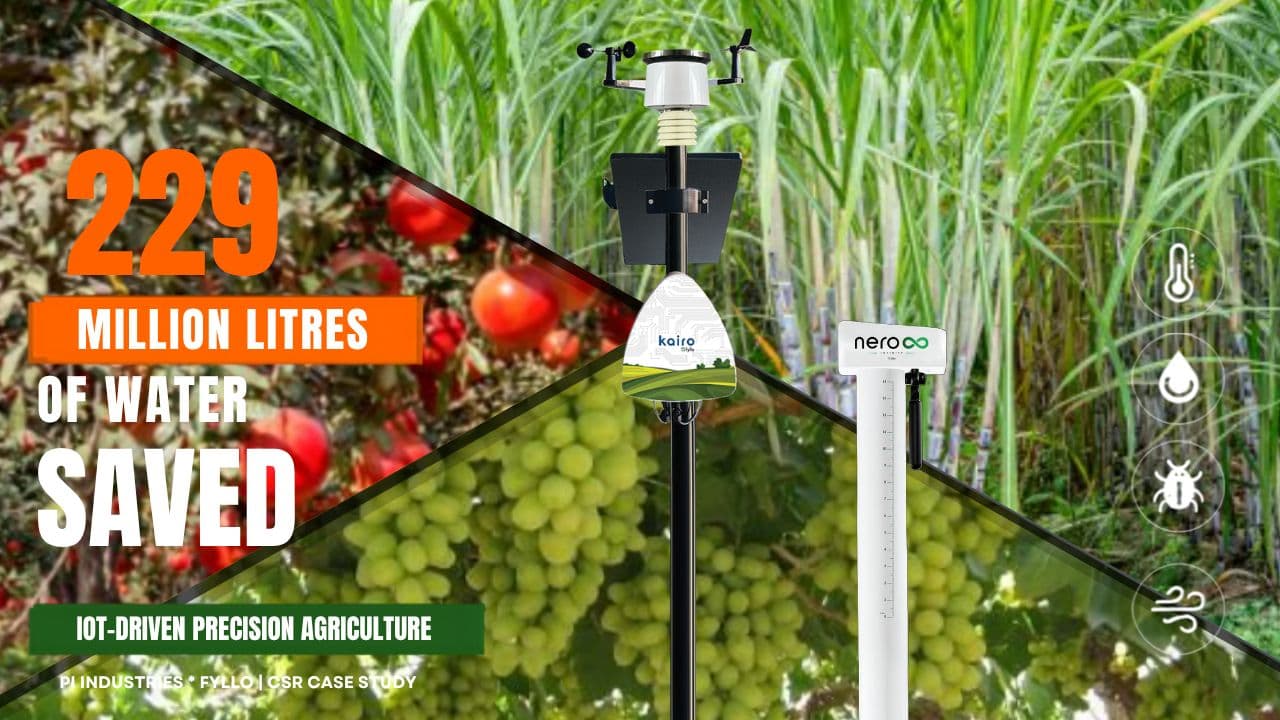
As part of its CSR initiative, PI Industries partnered with Fyllo to deploy an IoT-based precision agriculture system across 150 farmers in three major clusters in Maharashtra:
- Sangli — pomegranate (Western Maharashtra)
- Nashik — grapes (Northern Maharashtra)
- Baramati — sugarcane (Pune District)
Each farm was equipped with Fyllo's IoT devices, including the Kairo weather station and Nero Infinity soil moisture sensors, which continuously monitor soil moisture at two depths, soil temperature, air temperature, humidity, leaf wetness, wind speed, rainfall, and light intensity.
This real-time data feeds into Fyllo's cloud platform, where proprietary algorithms generate crop-stage-specific advisories for three critical inputs: irrigation, fertigation (fertilizer application), and pesticide sprays. Farmers receive these recommendations directly on their mobile phones.
This shifted calendar-based farming to demand-based precision agriculture, with the following results.
The Results
Water Savings
| Cluster | Crop | Water Saved | Reduction |
|---|---|---|---|
| Sangli | Pomegranate | 42 million litres | 22.96% |
| Nashik | Grapes | 85 million litres | 32.02% |
| Baramati | Sugarcane | 102 million litres | 27.10% |
| Total | 229 million litres | ~27% avg |
Farmers who previously irrigated every 2 to 3 days on fixed schedules were guided to irrigate every 4 to 7 days based on actual soil moisture readings. The water was not just saved — it was reallocated to when the crop actually needed it, improving both efficiency and crop health.
Fertilizer Reduction
| Cluster | Before Fyllo (kg) | After Fyllo (kg) | Saved (kg) | Reduction |
|---|---|---|---|---|
| Sangli | 4,397.55 | 3,794.12 | 603.43 | 13.81% |
| Nashik | 3,512.60 | 3,098.24 | 414.36 | 11.81% |
| Baramati | 7,354.55 | 6,474.20 | 880.35 | 12.34% |
| Total | 15,264.70 | 13,366.56 | 1,898.14 | 12.43% |
That is 1,898 kg of chemical fertilizer that didn't enter the soil and groundwater. Sangli led with a 13.81% reduction, driven by stage-specific nutrient management that replaced generic one-size-fits-all dosages. Baramati achieved the highest absolute savings at 880 kg, demonstrating the scalability of precision fertigation in large-scale sugarcane cultivation.
Pesticide Spray Reduction
This is where the impact is most striking. Across clusters, pesticide spray applications were reduced by an average of 34%:
| Cluster | Crop | Avg. Spray Reduction | Key Highlight |
|---|---|---|---|
| Sangli | Pomegranate | 41.61% | Sprays dropped from 34 to 19 during flowering |
| Baramati | Sugarcane | 31.16% | 50% reduction in grand growth phase |
| Nashik | Grapes | 29.30% | 40 to 50% reduction at grafting and planting stages |
| Average | ~34% |
Farmers moved from preventive blanket spraying to threshold-based interventions, spraying only when pest populations actually warranted it. This means less chemical exposure for farmworkers, less residue on produce, and less contamination of surrounding ecosystems.
Why Fyllo Is the Right Choice for CSR
1. Measurable, Auditable Impact
Every litre of water saved and every kilogram of fertilizer reduced is tracked and documented through the IoT platform. CSR teams don't have to rely on anecdotal evidence or self-reported surveys. The data is continuous, time-stamped, and independently verifiable — exactly what ESG reporting demands.
2. Direct Alignment with SDGs
This single intervention touches multiple Sustainable Development Goals:
| SDG | Goal | Impact |
|---|---|---|
| SDG 6 | Clean Water | 229 million litres of water conserved |
| SDG 2 | Zero Hunger | Improved crop management without yield loss |
| SDG 12 | Responsible Consumption | Reduced chemical inputs across the board |
| SDG 13 | Climate Action | Lower carbon footprint from reduced pump usage |
| SDG 15 | Life on Land | Less pesticide runoff into soil and water systems |
3. Organic Adoption by Farmers
The advisory is delivered on farmers' mobile phones in a format they can act on immediately. Adoption was organic — Sangli saw the highest fertigation advisory adoption because the recommendations were practical and showed results within the first season. This isn't technology imposed on farmers; it's technology that earns their trust through outcomes.
4. Scalable Across Crops and Geographies
The same system delivered results across three very different crops (pomegranate, grapes, sugarcane), three different soil types (sandy, clay, loam), and three different agro-climatic zones. This is not a pilot that works only under controlled conditions — it is a proven, adaptable platform ready for scale.
5. Fulfilling the Core Value of CSR
Reduced water means lower electricity bills from pumping. Reduced fertilizer means lower input costs. Reduced sprays mean lower pesticide expenditure, fewer labour days spent spraying, and significantly less residue. For smallholder farmers operating on thin margins, these savings translate directly into improved livelihoods — the core of any meaningful CSR intervention.
A Proof of Concept for Technology-Enabled CSR
India's CSR landscape is evolving. Companies are moving beyond one-time donations toward technology-enabled, outcome-driven interventions that deliver sustained impact. Agriculture remains one of the most underserved sectors in corporate CSR portfolios.
Precision agriculture through IoT offers a rare combination: environmental sustainability, farmer welfare, and measurable ROI on CSR spend — all in a single, scalable intervention.
The data from these three clusters in Maharashtra is not just a report. It is a proof of concept for what becomes possible when technology meets agriculture at scale.
Summary of Impact
229,151,841 litres of water saved | 1,898 kg of fertilizer saved | 34% average spray reduction.
Across Sangli (pomegranate), Nashik (grapes), and Baramati (sugarcane) — a CSR initiative by PI Industries, powered by Fyllo.
Fyllo's IoT-based precision agriculture platform is deployed across multiple states and crops in India. To explore how a CSR partnership can deliver measurable agricultural impact in your focus geography, reach out to the Fyllo team at bd@fyllo.in.